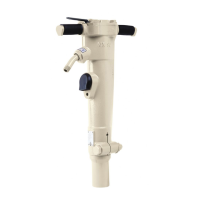
This document provides maintenance information for the Ingersoll Rand Air Paving Breaker models MX60 and MX90. It is identified as document number 51984144, Edition 6, published in May 2014. The manual emphasizes safety, general maintenance procedures, disassembly, assembly, inspection, repair, and troubleshooting.
Function Description:
The Ingersoll Rand Air Paving Breaker (models MX60 and MX90) is a pneumatic tool designed for breaking hard surfaces such as concrete and asphalt. It operates by using compressed air to drive a piston, which in turn impacts a tool (shank) to deliver powerful blows. The tool is intended for heavy-duty construction and demolition applications.
Important Technical Specifications (Derived from context):
- Models: MX60 and MX90.
- Air Pressure: The tool is designed to operate with air pressure in the range of 90 to 100 psi (6.2 to 6.9 bar) for optimal performance. It should start with less than 20 psi (1.4 bar) for initial lubrication and smooth piston reciprocation.
- Lubrication: Requires SAE oil, with specific recommendations for initial lubrication (2 to 3 oz. [.06 to .09 L]) and proper oil level in the lubricating oil reservoir. "KILFROST" anti-freeze lubricant or equivalent is recommended for moisture in the air supply line.
- Bolt Torque Specifications:
- Backhead bolts (205): 140 ft-lbs (190 Nm).
- Fronthead bolt (200) for MX60: 250 ft-lb (339 Nm) (3/4in.) or 240 ft-lb (325 Nm) (7/8in.).
- Fronthead bolt (200) for MX90: 375 ft-lb (508 Nm).
- Piston Wear Limit: The piston (4) should be replaced if a .007 in. (.178 mm) feeler gauge can be inserted between the piston and the housing bore.
- Air Supply Line: A 3/4 in. (19.1 mm) diameter air supply line is recommended, and it should be kept under 50 ft. (15 m) in length to prevent power loss.
Usage Features:
- Operation: The paving breaker is designed for breaking various materials. It requires a constant pressure on the shank against the work surface for effective operation.
- Throttle Control: The throttle lever (10) controls the air flow and thus the operation of the breaker. Minimum throttle should be used when pulling steels to prevent damage.
- Muffler/Exhaust Deflector: Can be equipped with a muffler (100) or an exhaust deflector (19) to manage noise and exhaust direction.
- Handles: May come with standard handle sleeves (25) or flex handles (25) for user comfort and control.
Maintenance Features:
- Safety Precautions:
- Always read and understand all manuals before installation, operation, repair, or maintenance.
- Wear eye protection (impact-resistant glasses with side shields, goggles, or full face shield) during operation and maintenance.
- Turn off air supply, bleed pressure, and disconnect the hose before any accessory changes or maintenance.
- Avoid major maintenance on the job site; send the breaker to a repair shop for significant repairs.
- Cleaning:
- Clean the exterior of the paving breaker before disassembly.
- Provide a clean work area.
- Clean all parts in a suitable solvent, ensuring adequate ventilation.
- Remove all dust and dirt particles from internal components, especially the valve chest assembly (7) and housing plug (6).
- Lubrication:
- Wipe a film of clean oil over working parts during assembly.
- Maintain the proper oil level in the lubricating oil reservoir.
- Adjust the lubricating oil reservoir for the proper rate of feed to prevent over-lubrication or lack of lubrication.
- Inspection:
- Check the valve chest assembly (7) for cracks or chipping and replace if damaged.
- Inspect throttle valve parts for wear and ensure free movement.
- Check the piston for wear against the housing bore.
- Disassembly and Assembly:
- Detailed step-by-step instructions are provided for disassembling and assembling various components, including the backhead, housing plug, valve chest, throttle valve kit, piston, fronthead, and air connection parts.
- Special tools like adjustable pliers and a hacksaw are mentioned for specific tasks.
- A lifting device is recommended for handling the paving breaker, and soft jaws are advised when clamping the housing in a vise to prevent cracking.
- Ensure proper alignment of parts during assembly; excessive force indicates misalignment.
- Troubleshooting Guide: A comprehensive table is provided to diagnose and resolve common issues such as:
- Paving breaker not starting (due to plugged ports, stuck valve, frozen piston).
- Rapid power loss (due to air supply line issues).
- Freezing at exhaust ports (due to excessive moisture).
- Lack of power (due to low air pressure, fronthead cushion, plugged passages, lack of lubrication, sticking valve).
- Overheating of piston seat (due to improper break-in).
- Overheating after break-in (due to fronthead cushion, piston not hitting shank, pulling steel at full throttle, lack of lubrication).
- Erratic or sluggish operation (due to heavy lubricating oil, gummed oil, or dirt).
- Fogging (due to excessive moisture or over-lubrication).
- Performance Testing:
- After reconditioning, the breaker should be tested with proper lubricating oil.
- It should start smoothly at low air pressure and develop a definite rhythm and even exhaust note.
- Compare performance with a new breaker under normal air pressure.
- After testing, cap or plug all parts to prevent dirt ingress.
- Maintenance Records: Dedicated pages are included for recording maintenance activities, including date, run time (hours), work performed, quantity of parts used, and who performed the work.
- Related Documentation: References to other manuals (Product Safety Information Manual 04581450, Product Information Manual 51955631, Parts Information Manual 51955623) are provided, and manuals can be downloaded from ingersollrandproducts.com.



 To Next Page

 General