Need help?
Do you have a question about the INIM snartliving and is the answer not in the manual?
Defines the warranty period and limitations for the product.
States the ownership of the document's content by INIM Electronics s.r.l.
Declares compliance with essential requirements of Directive 1999/5/CE.
Provides definitions of technical terms used in the manual.
Lists default shortcuts available for system operations.
Details fault signals and their probable causes and solutions.
Provides contact information and manufacturer details for INIM Electronics s.r.l.
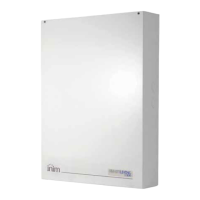
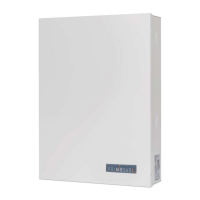
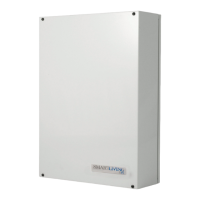
Describes the SmartLiving intrusion control panel and its different models.
Lists the Installation Manual and User's Manual for the system.
Defines the roles and responsibilities of installers and users.
Refers to Appendix A for technical terms and definitions.
Introduces the SmartLiving intrusion control system and its features.
Explains the technologies behind the SmartLiving system, including EASY4U and VOIB.
Describes the features and functions of JOY and nCode/G keypads.
Explains the display layout and icons on the keypad.
Describes the display status indications in various modes.
Details the typical usage of keys on the keypad.
Explains how to activate emergency calls using key combinations.
Describes the meaning of different LED signals on the keypad.
Explains the buzzer signals for entry, exit, and pre-arm times.
Shows how system errors or communication issues are displayed.
Describes the nBy proximity readers and their features.
Explains the LED signals on the nBy readers with and without keys.
Explains the structure and purpose of user codes and PINs.
Details methods to access the customized user menu.
Describes the types of digital keys and their programming.
Provides technical specifications for the wireless keyfob.
Explains how to access multiple systems with a single code/key.
Describes how the system handles telephone calls and commands.
Details the system's capabilities for sending emails and web access.
Explains how to program and activate shortcuts using keypads.
Describes how to use shortcuts with user codes.
Explains shortcuts activated via keys and proximity readers.
Details shortcuts specific to JOY/MAX keypads and readers.
Explains how to activate keyfob shortcuts.
Refers to Appendix B for a complete list of default shortcuts.
Describes voice recording, playback, delete, and intercom features.
Covers system access via Keypad, Reader, and Wireless Keyfob.
Includes Over-the-Phone, Web, and Command Zone access methods.
Explains how to arm and disarm system partitions via various methods.
Describes actions for managing alarm and tamper conditions.
Details voice functions like record, playback, delete, and intercom.
Explains how to activate/deactivate system peripherals and elements.
Describes how to view system status, logs, and panel information.
Continues the explanation of viewing system status and partitions.
Details viewing partition zones, outputs, timers, and event logs.
Explains how to manually activate or deactivate system outputs.
Describes how to set the system's date and time.
Explains how to adjust keypad display and buzzer settings.
Details how users can change their PIN codes.
Explains how to send a teleservice request to the installer.
Describes how to postpone auto-arming operations.
Explains how to use the listen-in function for eavesdropping.
Describes how to get voice announcements of partition status.
Details commands that can be sent to the system via phone.
Explains how event-related emails are sent via the SmartLAN/G board.
Provides an example of an event-associated email.
Guides users on how to access the web-server for remote management.
Defines access codes (PINs) for users and installers.
Defines an alarm as unauthorized entry detection.
Explains visual signals for alarm/tamper events.
Describes the command to clear alarm/tamper memory.
Explains the device for sending report calls to ARC.
Defines the time allowed to disarm after a zone violation.
Defines a zone monitoring the inside of a building.
Describes control devices (card, keyfob) for system access.
Explains devices for accessing and controlling the system.
Describes proximity readers for system access.
Defines a pre-set arming configuration.
Explains the interval for wireless device signaling.
Applies a pre-set scenario for arming/disarming.
Deactivates outputs related to alarm/tamper events.
Cancels call queue and stops ongoing calls.
Indicates excessive current draw on '+AUX' terminals.
Indicates excessive current draw on '+' terminal.
Signals a low or disconnected backup battery.
 General
| Brand | INIM |
|---|---|
| Model | snartliving |
| Category | Security System |
| Language | English |

 To Next Page