Need help?
Do you have a question about the INNOVASON SY80 and is the answer not in the manual?
Overview of the Sensoft 8.1 system and its design philosophy for live sound production.
Explains how to define the number and position of faders for mixing functions.
Details the various functions that console faders can handle.
Concept of exploiting physical inputs and mix busses beyond physical fader count.
Introduction to the Sy80 platform, including control surface and audio racks.
Details how systems can be adapted with latest performances and options.
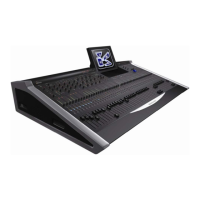
Provides a visual and descriptive overview of the Sy80 console's components.
Specifies the physical dimensions and general technical information of the Sy80.
Describes the Quadfad module, featuring 4 motorized faders with labels.
Details the panel centralizing channel parameter controllers like gain, EQ, and compressor.
Explains the panel for managing pages, files, copy/paste, and monitoring circuits.
Identifies front panel features like brightness control, floppy drive, and talkback connectors.
Details the rear connections, including MIDI, power supply, and PC access.
Provides a visual layout of the control surface, including Channel Control and Desk Control panels.
Provides crucial safety instructions for console operation and handling.
Offers guidance on safely moving and handling the console.
Covers power supply requirements, grounding, and EC standards compliance.
Explains how to connect the control surface and external PCs for operation.
Details standard audio connection procedures and important startup practices.
Provides instructions for connecting the Mix Box to the control surface via Jaeger connectors.
Explains how to connect an external screen for console display optimization.
Describes requirements and procedures for connecting an external PC to control the Sy80 platform.
Details how to connect MIDI compatible devices to the Sy80 console.
Explains how to connect USB storage devices for file import/export.
Describes coaxial and optical transmission systems for audio rack connections.
Explains methods for synchronizing digital audio clocks using SRC, Word-Clock, or AES links.
Provides guidance on connecting headphones and notes on headphone jack usage.
Details the correct sequence for powering up the console and audio racks.
Guides users on performing initial checks via the console screen after powering up.
A practical guide to creating a basic mix using Sensoft 8, focusing on core actions.
Explains how to assign faders and check audio rack configuration in the Hardware Configuration window.
Guides on assigning physical inputs to faders and physical outputs to master faders via the Patch IN window.
Demonstrates routing input MIC1 to master busses and checking level meters.
Explains how to route a signal to a subgroup and patch DSP resources to groups.
Explains the 'spread' inputs function using a CD player example, assigning inputs to faders.
Details creating and assigning channels to VCAs for remote control of fader levels and mutes.
Explains spreading master busses for single-finger control and individual bus access.
Explains spreading aux busses for stereo use and routing CD channel to aux busses.
Details setting up faders for matrix function and routing/mixing resources to matrix busses.
Explains how the console elements work together and how the interface reflects actions.
Outlines the five main sections of the console: faders, Channel Control, Desk Control, keyboard/mouse, and floppy drive.
Details how to assign functions to faders using the Hardware Configuration window.
Introduces the concept of audio inputs, their separation from processing stages, and input module housing.
Describes InnovaSON's input concept: preamp/conversion separation and comprehensive processing.
Explains how XLR inputs are identified by their position in audio racks, with Stage Box input module rules.
Details universal analog inputs, phantom power, gain control, and signal/clip LEDs.
Describes analog line inputs via SUB-D25 connectors and their specifications.
Explains Stage Box capacity, connection to Mix Box, and rules for adding modules.
Guides the user through following a normal signal path, from microphone to fader assignment.
Explains the XFAD function for creating compound fader banks and spreading inputs.
Shows how input channel parameters affect XFAD channels and how to select processing.
Explains the empty patch configuration and how to access the input distribution matrix.
Describes accessing the three Sensoft patch grids: Patch IN, Patch OUT, and Direct I/O.
Explains assigning a fader to a single input or a bank of XFAD inputs.
Describes how input labels are named and displayed on the console.
Explains how to name inputs directly within the Patch IN window.
Details how to modify input labels from the main Mix window.
Explains preamp configuration, including gain and 48V phantom power, and their assignment.
Details how to activate and deactivate phantom power using console buttons or keyboard commands.
Explains how to adjust preamp gain and interpret signal level meters for optimal modulation.
Describes the adjustable delay function for console channels and how to set values.
Covers phase inversion and low-cut filter parameters, controlled by the Mix Box DSP module.
Details how to invert the phase of an input signal using console buttons or trackball.
Explains how to activate and adjust the low-cut filter on input signals.
Introduces the channel's built-in processing for noise gate and compressor, with parameter control.
Explains the Gate/Expander function, its parameters, and how to adjust them.
Details the compressor/limiter function for signal dynamics reduction and its parameters.
Describes the on-screen graphic representation of dynamics curve and gain reduction.
Explains the equalizer section with parametric bands, controls, and default parameters.
Details designating input/output pairs as insert points for external processing.
Guides on setting up insert points by accessing the Direct I/O window.
Explains connecting devices to console channels via insert points using software selection.
Illustrates where signal is taken from and re-injected in the input channel path for external devices.
Introduces the Mute and Cue functions for controlling signal routing to mix busses and monitor busses.
Explains the Mute function's behavior for direct and spread channels.
Explains the Cue function for sending signals to monitor busses for direct and spread channels.
Introduces mix busses, how faders are allocated to them, and the routing gateway.
Highlights key aspects of DSP resources, mix busses, and their allocation via the PATCH OUT grid.
Details mix resources, channels, and their distribution to outputs and monitoring.
Explains how busses can be spread using the same principle as inputs for easier control.
Shows how parameter adjustments on an Aux channel echo on XBUS channels in the spread zone.
Describes the PATCH OUT grid for assigning mix busses to module physical outputs or line-level outputs.
Explains the PATCH OUT grid's function for assigning mix busses to various physical outputs.
Guides on creating patches between faders and physical outputs using the PATCH OUT window.
Explains how to personalize default output labels using the main Mix or Patch OUT windows.
Covers basic principles of routing input channels to master, group, aux, and matrix mix busses.
Details how to send input channels to busses, including spread groups and independent panning.
Explains how busses can be routed to other busses, like Auxes to Masters and Masters to Matrixes.
Explains the supplementary level control for Auxes and Matrixes, known as send levels.
Defines 'pre/post fader' and 'independent pan' functions for Master busses, Auxes, and Groups.
Explains pre/post fader and independent pan concepts related to Master, Aux, and Group busses.
Represents the configuration window for Aux Sends and Pans, detailing display variations.
Explains how Pan settings act on Master busses and the 'independent' parameter for Aux/Groups.
Shows precise stereo positioning of inputs relative to mix busses in the Aux Send/Pan config window.
Describes the behavior of Pan when acting on channel inputs assigned to XFAD or Aux/Groups to XBUS.
Introduces Matrix busses for routing and mixing all console channels, with two function modes.
Explains which channels, including inputs, can be routed to Matrix busses.
Details the 'Active Select' and 'Static' function modes for Matrix Sends.
Describes the stereo monitor bus and its distribution to three separate circuits.
Guides on accessing monitor circuits, selection, level adjustment, and patching via the DESK CONTROL panel.
Explains control operations for listen modes (AFL/PFL), general levels, and SOLO modes.
Describes the APL function for controlling output processing and its conditions for use.
Explains automatic monitor circuit switching based on channel selection for different listen destinations.
Details the console's headphone circuit, its parallel wiring, and feeding options from monitor or select bus.
Describes Solo in Place mode for listening to a single channel, and Solo Safe functionality.
Explains automatic monitoring of track returns corresponding to selected busses via a grid.
Describes functions within the MONITORING CONFIGURATION window, including input priority and headphone settings.
Explains setting up multiple Masters, their shared spread zone, and individual processing.
Discusses limitations of processing on local busses and the unavailability of bus inserts.
Details controlling Hyperdrive output processing (dynamics, EQ, etc.) when a bus is selected.
Explains console VU meters and bargraphs modulation, and limitations regarding Hyperdrive processing.
Covers specific adjustments for Hyperdrive outputs, including parametric equalizer and rotary gain.
Explains fader functions, motorized faders, and how fader states allow bus assignment.
Details FADER MODE options (In, Aux, Dual) and their behavior when Inputs or Auxes are selected.
Explains the Mute and Cue functions for channels, and their behavior with spread sets.
Details the Mute function for direct and spread channels, including external mute control.
Explains the Cue function for sending signals to monitor busses for direct and spread channels.
Introduces the MUXIPAIRE bus and the Direct I/O grid for signal exchange between racks.
Explains the DIRECT I/O grid for programming local/distant outputs and creating patch points.
Introduces the VCA function for controlling fader levels and mutes of assigned channels.
Details VCA function logic modes: Additional (AND) and Priority (OR).
Explains how to assign channels to VCAs and the specific rules for XFAD and XBUS channels.
Describes the console's talkback microphone inputs and their assignment to output busses.
Details talkback routing configurations, preference check boxes, and its utility for line checking.
Introduces InnovaSON consoles' modular structure for pro-audio operations and its design for speed and security.
Explains the organization of files and pages for managing events and console data.
Details how to open the file management window for creating and modifying files and pages.
Describes the three operations involved in loading a file: page availability, RAM update, and backup.
Explains how to save the current state of all pages in a file.
Explains the Export, Import, and Delete functions for managing files on floppy disks and hard drives.
Introduces page management, including saving and duplicating pages.
Details saving the current page to HD and duplicating it under a different name using 'Save As'.
Explains the Load and Goto functions for recalling pages from RAM or HD.
Describes page insertion types: blank page and identical page with a new name.
Explains navigation functions: Next, Previous, Load, and Goto for accessing pages.
Introduces automation functions for calling up pages via MIDI Program Changes and chaining pages.
Provides general points on using the AUTOMATION window with keyboard and trackball.
Explains how to send MIDI Program Changes to update external devices when changing pages.
Explains how external devices can control console page changes via MIDI Program Changes.
Describes synchronizing page changes to MTC addresses and MTC operation modes.
Explains the Crossfade function for defining transition times between chained pages.
Describes the Cross Time fader for manual control of programmed crossfade times.
Details the console's white/pink noise generator and variable frequency oscillator.
Explains the Flat function for resetting channel parameters (Gate, Compressor, EQ) to default values.
Describes the Copy and Paste functions for duplicating and applying channel settings.
Explains OverRam feature for updating parameters across all pages in RAM for the current event.
Explains the Relax Mode to disconnect channel parameters from automation, making them manual.
Introduces I/O parameters and how to set up links between input/output modules.
Defines I/O parameters for input and output modules and their characteristics.
Explains how to set up I/O links using the Link I/O grid.
Introduces channel parameter links and defines channel parameters calculated by the DSP module.
Defines channel parameters as DSP module values for processing, distinct from I/O parameters.
Explains how to link channel parameters using the Channel link grid.
Describes a procedure to modify a parameter on a linked channel without affecting others.
Explains the MUXI window for viewing and adjusting Hyperdrive parameters and Mute of outputs.
Details the Off Line mode for working on pages without affecting live audio, with display modifications.
Introduces processing libraries for recording and recalling processing settings on Hyperdrive inputs/outputs.
Explains access to library functions: Save, Load, Delete, Export, and Import processing settings.
Describes shortcuts for quick access to Save and Load functions from the BANK menu.
Explains Request mode for displaying and acting on console functions like +48V, Phase, Gate, etc.
Details the ADJ function for automatic preamp gain adjustment to a maximum defined value.
Explains sending MIDI Control Change messages via MUTE buttons and receiving them.
Describes sending MIDI Note ON/OFF messages when faders leave or regain the - position.
Explains password protection for files and output processing against accidental modification.
Covers various options in the GENERAL PREFERENCES window, including fader mode and meter settings.
Describes mouse and keyboard operations for navigating Sensoft patch grids and configuration windows.
Provides detailed operation and access methods for Sensoft windows, starting with HARDWARE CONFIGURATION.
Explains the HARDWARE CONFIGURATION window's two parts: audio rack configuration and fader assignment.
Explains how to access the PATCH IN GRID window for patching inputs.
Explains how to create patch points for spread outputs using the PATCH OUT GRID window.
Details the DIRECT I/O and INSERT GRID window for programming direct outputs and insert points.
Explains how to make links between Aux, Group, Input channels, and within spread XFAD/XBUS.
Explains creating patch points in the LINK I/O grid to link physical inputs and outputs.
Describes setting configurations in RELAX, FADER START, and MUTE MIDI MESSAGE windows using mouse or keyboard.
Details accessing and setting up the PAN window when an input or output is selected.
Details accessing the PASTE and OVERRAM windows for parameter management of spread channels.
Explains accessing and using the MUXI window for output parameter adjustments.
Details switches, rotary controls, digital values, and fader selection in the main MIX window.
Provides detailed explanations of interactive elements within the Mix window for various functions.
Summarizes function access methods via Keyboard, Mouse, and Console buttons.
Guides on downloading Sensoft ZIP file, preparing installation, and understanding USB key content.
Details the procedure for installing or re-installing Sensoft, including USB key preparation.
Explains when re-installation is necessary and the process for installing new Sensoft versions.
Explains the procedure for updating Sensoft, noting requirements for versions 8.x and 9.x.
Details the procedure for re-installing the console's Windows XPE operating system.
Explains how to configure the console's elements for data exchange between PC, Mix Box, and control surface.
Explains importing files from Grand Live (Sensoft 7.1.x) and Sy40 (Sensoft 7.3.x) consoles.
Guides on transferring new Firmware versions to the DSP card using DSPLOAD.EXE and DSPxxx.LDn files.
Provides step-by-step instructions for launching the DSP Loader software from the USB key.
Guides on installing Sensoft on an external PC for offline show preparation.
Introduces InnovaSON's modular structure, adapting configurations for pro-audio operations.
Describes the standard 19-inch rack format, ventilation, power supplies, and backplane connections.
Details the SI-8D module's front panel, analogue signal characteristics, and installation.
Describes the SI-8D3 module's front panel, analogue signal characteristics, and installation.
Details the MO-8D3 module's function, analogue output characteristics, and installation.
Describes the XO-8D2 card's analogue outputs with Hyperdrive processing, including delay and equalizer.
Details the DI-8S module for synchronous AES digital inputs, including sensitivity and delay.
Describes the DI-8Src module for asynchronous AES digital inputs and its characteristics.
Details the DO-8A module for synchronous digital AES outputs, including patch and mute.
Describes the DO-8X module with AES outputs, signal processing, and Hyperdrive features.
Details the DO-8XES module for EtherSound network applications, including its features and configuration.
Describes the DSP Sy80 module, its functions, connectors, and software update procedure.
Details the DSP Sy40-8 module, its functions, connectors, and installation.
Describes the DM-Mk9 module as the processing core for Sensory Live consoles.
Details the MC-64 module's role as a relay for remote control and transmission in Mix Boxes.
Explains the MCSC Optical module's role in module control and data transmission via optical fiber and coaxial cable.
Details the SC-64 module's functions for Stage Box control and transmission splitting.
Describes the SC-64 3tx module for Stage Box control and transmission splitting on three directions.
Details the Sync-A module for receiving and converting AES synchronization signals.
Explains the modular structure of InnovaSON consoles and the configuration with inputs/outputs.
Provides rules for using Stage Box, including input/output limits and module placement.
Details the procedure for configuring racks and installing modules, including powering up.
Explains the MASTER console's role in Stage Box connection and remote control.
Provides a summary of the power-up sequence for the entire system, including Stage Box and Mix Box.
Discusses coaxial cable transmission for digital links, quality, attenuation, and connectors.
Details BNC connector types and the importance of proper installation and avoiding T-BNC connectors.
Emphasizes the importance of grounding and avoiding electromagnetic interference for secure operation.
Describes checking RX LEDs and troubleshooting transmission errors, including a procedure for coax cable adjustment.
Lists general characteristics of audio racks, including dimensions, weight, power supply, and consumption.
Provides typical audio characteristics for general console configurations (SI-8D2, DSP, XO-8D2).
Lists technical characteristics for DO-8A, DO-8X, and DO-8XES modules, including signal processing.
Describes EtherSound applications and the DO-8XES module, including network setup and examples.
Presents general safety precautions in French, English, and German regarding console connection.
Explains hazard symbols (Danger, Warning, Caution) and their meanings in multiple languages.
Lists specific dangers and warnings related to electrical shock, liquid exposure, and console modification.
Lists cautions regarding operating environment (splashes, heat, humidity, dust) and proper installation.
Provides operating notes on component wear, mobile phone interference, cleaning, and air filters.
 General
| Brand | INNOVASON |
|---|---|
| Model | SY80 |
| Category | Music Mixer |
| Language | English |

 To Next Page