Technical Reference
59
• Back and front panel host-powered USB devices (other than keyboard and
mouse)
Load: continuous read/write activity on external drive/peripheral
• LAN linked at 1000 Mb/s
Load: continuous read/write benchmark on remote share
• All on board peripherals enabled (serial, parallel, audio, …)
Table 26. Maximum Load Configuration Current and Power Results
Output Voltage
3.3 V 5 V 12 V -12 V 5 VSB
Maximum Load
5 A 7.83 A 2.34 A 0.1 A 0.68 A
2.8 Reliability
The Mean Time Between Failures (MTBF) prediction is calculated using component and
subassembly random failure rates. The calculation is based on the Telcordia SR-332,
Method I Case 1 50% electrical stress, 55 ºC ambient. The MTBF prediction is used to
estimate repair rates and spare parts requirements.
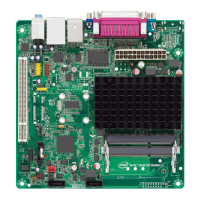
The MTBF data was calculated from predicted data at 55 ºC. The Intel Desktop Board
D2700DC has an MTBF of at least 394,528 hours.
2.9 Environmental
Table 27 lists the environmental specifications for the board.
Table 27. Intel Desktop Board D2700DC Environmental Specifications
°
°
°
°
50 g trapezoidal waveform
Velocity change of 170 inches/second²
Velocity change (inches/s²)
Vibration
5 Hz to 20 Hz: 0.01 g² Hz sloping up to 0.02 g² Hz
20 Hz to 500 Hz: 0.02 g² Hz (flat)
10 Hz to 40 Hz: 0.015 g² Hz (flat)
40 Hz to 500 Hz: 0.015 g² Hz sloping down to 0.00015 g² Hz



 To Next Page