
 Need help?
Do you have a question about the Intel NUC Kit NUC11PAHi7 and is the answer not in the manual?
Guidance and precautions before starting installation.
Warnings and cautions to avoid injury during installation.
Importance of following instructions for safety and regulatory compliance.
Detailed steps for inserting SO-DIMM memory modules into the slots.
Detailed steps for removing SO-DIMM memory modules from the sockets.
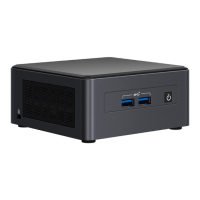
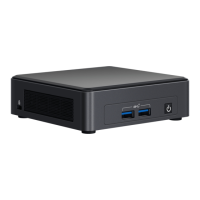
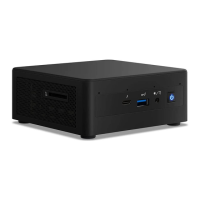
This document serves as a comprehensive user guide for various Intel® NUC Kit models, specifically NUC11PAHi7, NUC11PAHi5, NUC11PAHi3, NUC11PAHi70Z, NUC11PAHi50Z, and NUC11PAHi30Z. It provides detailed, step-by-step instructions for the installation, configuration, and maintenance of these compact computing devices. The guide is designed to assist users in setting up their Intel NUC Kits, from initial unboxing to the installation of an operating system and necessary drivers.
The Intel NUC Kits covered in this guide are small form factor computers designed for a variety of uses, including home entertainment, office productivity, and specialized applications. These kits provide a barebones system, meaning users typically need to supply their own memory, storage, and operating system to complete the build. The NUC Kits are built around Intel processors, offering a balance of performance and energy efficiency in a compact design. Their small footprint makes them ideal for environments where space is at a premium, such as behind a monitor or mounted on a wall.
The core function of these Intel NUC Kits is to provide a versatile and customizable computing platform. They support various types of memory and storage, allowing users to tailor the system to their specific needs and budget. The inclusion of multiple connectivity options, such as USB ports, video outputs, and network interfaces, ensures broad compatibility with peripherals and external devices. The "Z" models (NUC11PAHi70Z, NUC11PAHi50Z, NUC11PAHi30Z) are noted as "defeatured" products, implying potential variations in their capabilities or included components compared to the standard "i" models.
The Intel NUC Kits offer several features that enhance their usability and adaptability. The guide details the process of opening the chassis, which is a straightforward procedure involving the removal of four corner screws on the bottom of the unit. This ease of access is crucial for users to install internal components.
Memory installation is a key usage feature. The NUC Kits support two 260-pin DDR4 SO-DIMM memory slots, requiring 1.2V low voltage, 3200 MHz SO-DIMMs, and specifically non-ECC memory. The guide provides clear instructions for installing these modules, including a note that if only one memory module is used, it should be installed in the lower memory socket. This ensures optimal performance and compatibility. The process involves aligning the SO-DIMM's notch with the socket's key, inserting the module, and pushing down until the retaining clips snap into place. Removal is equally simple, requiring gentle spreading of the retaining clips.
Storage options are another significant usage feature. The NUC Kits support both M.2 SSDs and traditional 2.5-inch SSDs or Hard Disk Drives (HDDs). For M.2 SSDs, the kits accommodate both 80mm and 42mm form factors. The installation process for M.2 SSDs involves removing a small silver screw from a metal standoff, aligning the card with the connector, inserting it, and then securing it with the screw. For 42mm M.2 SSDs, an additional step of moving the standoff to the correct position is required. The guide also mentions support for Intel® Optane™ Memory Modules, with a link to separate installation instructions for these specialized modules.
For 2.5-inch storage, the guide outlines how to slide the drive into the drive bay, ensuring the SATA connectors are fully seated, and then securing it with two small silver screws. This flexibility in storage allows users to choose between high-speed M.2 NVMe drives for the operating system and applications, and larger capacity 2.5-inch drives for data storage, or a combination of both.
Once internal components are installed, the guide instructs users on closing the chassis, recommending manual tightening of screws to prevent over-tightening and potential damage.
An optional usage feature is the VESA bracket, which allows the NUC Kit to be mounted to the back of a monitor or TV. The guide provides instructions for attaching the bracket to the display using four small black screws and then attaching the NUC Kit to the bracket using two slightly larger black screws on the bottom chassis cover. Finally, the NUC Kit slides onto the VESA mount bracket, providing a clean and integrated setup.
Power connection is also detailed, with country-specific power cords included in the box for various regions (US, UK, AU, EU, CN, IN). The guide clarifies that some models may not include a power cord, requiring users to purchase one separately. The power adapter uses a C5 type connector.
The guide emphasizes several maintenance-related practices to ensure the longevity and proper functioning of the Intel NUC Kits. Before any installation or modification, users are advised to observe safety precautions, including disconnecting the computer from its power source and any network. This is crucial to prevent personal injury or equipment damage, as some circuitry can remain active even when the power button is off.
Electrostatic discharge (ESD) is highlighted as a potential threat to components. Users are recommended to perform procedures at an ESD workstation with an antistatic wrist strap and a conductive foam pad. If such a setup is unavailable, wearing an antistatic wrist strap attached to a metal part of the chassis can provide some protection.
The guide also stresses the importance of following steps in the correct order and creating a log to record information about the computer, such as model, serial numbers, installed options, and configuration. This documentation can be invaluable for troubleshooting and future maintenance.
For ongoing software maintenance, the guide provides options for keeping device drivers current. Users can utilize the Intel® Driver & Support Assistant (Intel® DSA) for automatic detection and updates of out-of-date drivers. Alternatively, drivers, BIOS, and software can be manually downloaded from the Intel Download Center. A list of available drivers is provided, including Intel® Chipset Device Software, Intel® HD Graphics, Intel® Management Engine, Intel® Gigabit Ethernet, Intel® Wireless, Intel® Bluetooth, Intel® USB 3.0 (for Windows 7* only), Intel® Serial IO, ITE Tech* Consumer Infrared, Intel® Rapid Storage Technology, and Intel® Software Guard Extensions. It's noted that Realtek* High Definition Audio is only available for NUC11PAQ/H/K[x] models, and not for the NUC11PAH[x]Z products.
Finally, the guide directs users to resources for installing an operating system, including a list of Intel-validated Windows* operating systems and information on Linux* compatibility through the Intel Product Compatibility Tool. This ensures that users can properly install and configure their chosen operating system, which is a fundamental aspect of system maintenance and functionality.
 General
| Number of Internal Drives Supported | 2 |
|---|---|
| Processor | Intel Core i7-1165G7 |
| Processor Cores | 4 |
| Processor Threads | 8 |
| Processor Base Frequency | 2.8 GHz |
| Processor Max Turbo Frequency | 4.7 GHz |
| Intel vPro Platform Eligibility | Yes |
| Total Memory Installed | 0 GB |
| Maximum Memory Size | 64 GB |
| Max # of Memory Channels | 2 |
| Max # of DIMMs | 2 |
| ECC Memory Supported | No |
| Graphics | Intel Iris Xe Graphics |
| Graphics Execution Units | 96 |
| Graphics Max Dynamic Frequency | 1.3 GHz |
| Integrated Graphics | Yes |
| Number of Displays Supported | 4 |
| Total # of SATA Ports | 1 |
| Wireless | Intel Wi-Fi 6 AX201 |
| Number of Thunderbolt Ports | 2 |
| Integrated Wireless | Yes |
| Integrated Bluetooth | Yes |
| TPM | 2.0 |
| Intel HD Audio Technology | Yes |
| Chassis Dimensions | 117 x 112 x 51 mm |
| Supported Operating Systems | Windows 10, Linux |
| Internal Drive Form Factor | M.2 2280 |
| Memory Types | DDR4-3200 |
| Graphics Output | HDMI 2.0b |
| RAID Configuration | 0, 1 |
| Bluetooth | 5.2 |
| Audio (back channel + front channel) | 3.5mm front + rear |
| Integrated LAN | Intel Ethernet Controller i225-V |
| Additional Headers | USB 2.0 |
| Ethernet | 2.5 Gb Ethernet |
| Storage Interface | NVMe |
| Storage | M.2 and 2.5" SSD/HDD |


 To Next Page