This document serves as a user manual for Interlevin Refrigeration display coolers, specifically models PD110T and PD220T. It provides comprehensive information regarding safety, installation, operation, maintenance, and disposal.
Function Description:
The Interlevin PD110T and PD220T are beverage display coolers designed for indoor use. Their primary function is to chill beverages and display them, typically in commercial settings. The appliances operate automatically, including an automatic defrosting system that evaporates condensate water. They utilize LED lighting for internal illumination, enhancing product visibility. The refrigeration system is sealed and contains flammable refrigerant (R600a) and insulation foam, necessitating professional handling for servicing and end-of-life recycling.
Important Technical Specifications:
- Models: PD110T, PD220T
- Refrigerant: R600a (flammable)
- Lighting: LED strips powered by a low voltage transformer.
- Maximum Shelf Loading Weight: 25 kgs per shelf.
- Climate Class: Designed for Climate Class 4, which corresponds to a maximum environmental condition of 30°C ambient temperature and 55% relative humidity.
- Ventilation Space: Requires a minimum ventilation space of 20mm at the sides, top, and rear. The front grille must be completely unobstructed.
- Temperature Control: Electronic controller, factory set to approximately 2°C, with user-adjustable set point.
Usage Features:
- Indoor Use Only: The appliance is strictly for indoor use.
- Beverage Display: Intended solely for use as a beverage display cooler.
- Automatic Operation: The appliance runs automatically, including automatic defrosting.
- Temperature Adjustment: Users can adjust the set point temperature using the electronic controller. The procedure involves pressing and holding the "SET" button, then using up or down buttons to modify the temperature, and finally holding "SET" again to store the new setting.
- Shelf Adjustment: Shelves can be adjusted by moving the support clips. Users must ensure clips are securely located and the shelf is level to prevent hazards.
- Power Control: The appliance has a red power switch on the front control panel for turning it on/off, and a separate light switch.
- Positioning: The appliance should be placed on a level and even floor. Levelling feet are provided for adjustment. It should not be placed near heat or humidity sources, in direct sunlight, or near sources of static electricity or lightning. Adequate ventilation is crucial, and the room must be well-ventilated and free from ignition sources.
- Power Connection: Connects to mains power. It is crucial to ensure the power supply is sufficient and never use adaptors or multi-block extension leads. The power cord should be inspected for damage.
Maintenance Features:
- Safety First: Always disconnect the mains power supply before any maintenance, cleaning, or repairs.
- Lighting Maintenance: LED lighting strips and transformers should only be replaced with genuine parts by a qualified, skilled, and competent person.
- Interior and Exterior Cleaning: Interior walls and shelves should be cleaned and sanitised regularly using a damp or wet cloth and appropriate cleaning materials. Splashing, dripping, jetting, running water, or steam should not be used.
- Condenser Cleaning: The condenser, located at the front behind the compressor compartment cover, needs to be kept clean and dust-free for efficient operation. It is recommended to check it at least every three months.
- Cleaning Procedure:
- Empty the appliance, switch it off, unplug from mains, and pull it out from its enclosure.
- Remove screws from the front compartment cover.
- Locate and examine the condenser for dust or debris.
- Clean the condenser using a vacuum cleaner nozzle or a soft brush. Dust must be cleared away carefully, avoiding bending or deflecting fan blades. Water must never be used in this area.
- If the condenser is contaminated with grease or fat, a skilled refrigeration specialist is required for cleaning.
- Replace the cover and screws, then plug back into the mains power supply.
- Malfunction Handling: In case of a malfunction, only a suitably qualified, competent, and skilled refrigeration service engineer should be called, insisting on genuine parts. The serial number, located inside the cabinet, should be provided.
- Disposal: At end-of-life, the appliance must be recycled by a professional, competent, authorised, and regulated organisation due to the flammable refrigerant and insulation foam. Local authorities should be consulted for further information.
Safety Precautions:
- Do not store explosive substances or electrical appliances inside the refrigerated compartment.
- Do not use mechanical devices to accelerate defrosting.
- Do not damage the refrigeration circuit; if damaged, ventilate the area immediately.
- Do not overload shelves (max 25 kgs).
- Never move or tilt the appliance while the power switch is "ON".
- The appliance must always be earthed.
- Only R600a refrigerant from an authorised supplier is permitted.
- Electrical equipment should not be placed where refrigerant could gather in case of a leak.
- All electrical work must be carried out by suitably qualified persons.
- Children aged 8 and above, and persons with reduced capabilities, can use the appliance with supervision and understanding of hazards. Children should not play with the appliance or perform cleaning/maintenance without supervision.
- Ensure adequate ventilation; do not cover front grille or rear air vents.
- Do not probe openings or touch moving/hot/cold parts.
- Do not overload the power supply; consult a qualified electrician if in doubt.
- Damaged power supply cords must be replaced by the manufacturer, service agent, or suitably qualified persons.
- Handle the cabinet gently to avoid damaging delicate refrigeration pipework.
- Perform a risk assessment before moving the heavy appliance.
- Cut banding straps carefully to avoid injury.
- Recycle all packaging according to local laws.
- Be aware of the hazard of plastic bags to children.

 Need help?
 General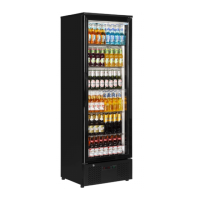

 To Next Page