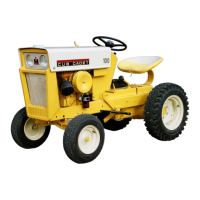
The provided document is an operator's manual for International Cub Cadet tractors (models 86, 108, 128, 129, 149, and 169) and rotary mowers. It covers operation, lubrication, and maintenance instructions.
Tractor Models and Drive Types
The manual distinguishes between two main types of tractors:
- International Cub Cadet 86, 108, and 128 Tractors: These models feature a conventional clutch and transmission.
- International Cub Cadet 129, 149, and 169 Tractors: These models are equipped with a hydrostatic drive, described as the "best hydraulic drive unit available."
Safety Rules
The manual emphasizes several safety precautions to be followed:
- Disengage all clutches and shift into neutral before starting the engine.
- Disengage power to attachments and stop the engine before leaving the operator's seat or making repairs/adjustments.
- Know controls and how to stop quickly.
- Do not allow children or unauthorized adults to operate the equipment.
- Clear the work area of objects that might be picked up and thrown.
- Disengage power to attachments when transporting or not in use.
- Do not carry passengers or give rides; keep children, pets, and bystanders away.
- Always disengage the power take-off, shift transmission into neutral, set the parking brake, stop the engine, and remove the ignition key when leaving the machine unattended.
- Reduce speed on slopes and sharp turns to prevent tipping or loss of control.
- Stay alert for holes and hidden hazards.
- Do not stop or start suddenly uphill or downhill.
- Use care when pulling loads or using heavy equipment: use approved hitch points, limit loads to what can be safely controlled, avoid sharp turns, and use counterweights/wheel weights when suggested.
- Watch out for traffic near roadways.
- When using attachments, never direct discharge toward bystanders.
- Handle gasoline with care: use approved containers, never remove the fuel tank cap or fill the tank when the engine is running, hot, or indoors. Do not smoke near flammable fuel. Wipe up spilled gasoline. Replace the cap securely. Open garage doors if the engine is running due to dangerous exhaust gases.
- Keep the machine in good operating condition and safety devices in place.
- Stop and inspect the machine for damage after striking a foreign object; repair damage before restarting.
- Always depress the brake pedal and set the brake pedal lock before working on the machine, disengage implements, and shift the transmission into neutral.
Engine Operation
The engine is air-cooled, requiring free air circulation around the cylinder head and block. Regular cleaning with compressed air is recommended to prevent overheating.
Fuel System:
- Operates on leaded gasoline (93 minimum octane) or unleaded/low lead gasoline (91 minimum octane).
- The fuel tank filler cap has an air vent that must be kept open.
- Fuel shut-off valve: Screw out the needle stem until tight against the stop for full-open position.
- Carburetor adjustments: Factory-set, but may require adjustment if the engine doesn't operate properly. A new air cleaner element should be installed first. Adjustments include high-speed and idle adjustment screws.
- Safety Caution: Never remove the fuel tank cap or fill the tank when the engine is running, hot, or indoors. Do not smoke near flammable fuel. Avoid spilling gasoline on a hot engine.
Engine Speed:
- Controlled by a throttle lever. "FAST" position is recommended for power take-off operated equipment.
- Governor: Factory-set; consult a dealer if it malfunctions.
Starting the Engine:
- Ensure adequate gasoline supply and open the fuel shut-off valve.
- Pull the choke control button out (less choking needed when warm).
- Place the throttle lever halfway between "SLOW" and "FAST."
- Press the clutch-brake pedal all the way down and ensure the power take-off clutch handle is disengaged to activate safety switches.
- For gear-driven models (86, 108, 128), check that the gearshift lever is in neutral.
- Turn the ignition key clockwise to "START" and release. Do not operate the motor-generator for more than 30 seconds.
- After starting, slowly release the clutch-brake pedal and gradually push the choke control button in.
Stopping the Engine:
- Move the throttle lever to "SLOW" and allow the engine to idle briefly.
- Turn the ignition key to "OFF."
Driving the Tractor
Adjusting the Seat:
- Tilt the seat forward, loosen four cap screws, and slide to the desired position. Retighten screws.
- Note: The battery is located under the operator's seat.
Clutch and Brake Pedal (Models 86, 108, 128):
- Used to disengage the engine from the transmission and actuate the brake.
- Must be pressed all the way down to activate the safety starting switch.
- Locking the Brake: Press the pedal down, then place the brake pedal lock in the engaged position. Always lock the brake when parked on a grade.
- Gearshift Lever: Selects three forward and one reverse speed. Do not shift gears while the engine clutch is engaged or the tractor is in motion.
- Creeper Shift Lever (Optional): Provides slower speeds (four-to-one reduction). Forward is direct drive, rearward is creeper drive. Do not use a mid-point position as neutral.
Brake Pedal (Models 129, 149, 169):
- Must be pressed all the way down to activate the safety starting switch.
- Automatically moves the speed control lever to "N" (neutral) when depressed.
- The tractor can be stopped by depressing the pedal or placing the speed control lever in "N."
- Speed Control Lever: Selects speeds from standstill "N" to eight miles per hour forward and four miles per hour reverse.
- Release Lever: Must be held in the (up) position with the speed control lever in "N" to push or move the tractor short distances.
- Caution: Never operate the engine with the release lever in the (up) position; towing or pushing for more than a few feet may damage the transmission.
Equipment Lift
Equipment Lift Handle:
- Used to lift or lower equipment. Multiple positions can be set by depressing the button on top of the handle.
- Height Adjustment: Use the cam stop to locate a desired implement height.
- Float Position: Depress the release button and lock button to allow free handle travel.
- Note: Refer to the equipment manual for hitching instructions.
Electric Lift (Optional, not on 149/169):
- Self-contained unit for fingertip control of mounted equipment.
- Operated by a control switch on the instrument panel. Push up to raise, down to lower.
- Note: Operate with the engine running to prevent premature battery failure.
- Note: Release the control switch when equipment reaches fully raised or lowered positions to avoid opening the protective switch.
- Fixed "Locked" Position: For down pressure (e.g., blade work), remove the cotter pin in the pivot, reverse the lock pin, and insert it into pre-aligned holes in the clevis and rockshaft arm.
- Caution: Stop the engine and set the brake pedal lock before making adjustments.
Hydraulic Lift (Standard on 149/169):
- Operates when the engine is running.
- The hydraulic control lever is spring-loaded: move back to raise, forward to lower.
- Float Position: Equipment normally operated in "Float" with the lock pin positioned as shown.
- Fixed "Locked" Position: Similar to the electric lift, for down pressure, remove the cotter pin in the pivot pin, reverse the lock pin, and insert it into pre-aligned holes in the clevis and rockshaft arm.
Power Take-Off (PTO)
Rear Power Take-Off (Models 86, 108, 128):
- Started and stopped by the engine clutch. Disengage the engine clutch before moving the shifter lever.
- Caution: The shifter lever should always be in the disengaged (rearward) position when not in use. Cover the exposed shaft with the guard.
- Operating with Tractor Standing Still: Move throttle to "SLOW," depress pedal, shift transmission to neutral, move shifter lever forward to engaged, advance throttle to "FAST," and slowly release pedal.
- Operating with Tractor in Motion: Follow steps above, but keep pedal depressed, select desired transmission speed, advance throttle, and slowly release clutch pedal.
Front Power Take-Off:
- Operating: Move throttle to medium/slow, move control lever forward slowly to engaged, advance throttle to operating speed.
- Adjusting: Factory-adjusted. If clutch slips or fails to disengage, consult a dealer. If readjustment is needed, loosen the jam nut on the turnbuckle, adjust for minimal clearance (A and B minimal when engaged, B moves 1/10 inch when disengaged), then tighten the jam nut.
- Caution: Do not adjust with the engine running.
Electrical System
- Twelve-volt system: motor-generator, voltage regulator, twelve-volt battery.
- All connections must be clean and securely fastened.
- Ignition Switch: Turn clockwise for ignition "ON," further for motor-generator. Key cannot be removed when "ON."
- Safety Starting Switch: Activated by clutch-brake pedal and power take-off clutch lever to prevent accidental starting.
- Charge Indicator: Shows if the motor-generator is charging or discharging. Investigate continuous discharge.
- Hour Meter (Standard on Model 169 only): Indicates actual engine operating hours for lubrication, oil changes, and inspections.
- Spark Plug: Check gap every 100 hours (.025-inch). Remove dirt before removing.
- Motor Generator: Functions as a cranking motor when the ignition key is turned to "START" and as a generator when the engine is operating.
- Motor-Generator Belt: Check tension after 10 hours, then every 50 hours. Correct tension allows 1/4-inch deflection with a ten-pound force.
- Voltage Regulator: Maintains generator charging rate. Consult a dealer if it fails.
- Lights (Optional on 86, 108, 128; Standard on 149, 169): Headlights are sealed-beam units. Taillight lamp replacement involves removing the lens.
- Fuse (Electric Lighting): Located in a fuse housing at the back of the instrument panel. Use the same capacity fuse for replacement.
- Battery: Negative (-) grounded system. Check water level monthly. Add pure, distilled water if below ring level. Never add acid or special "dopes."
- Connecting Booster Batteries: Connect positive (+) terminals first, then negative (-) of booster to a good ground point on the tractor frame (away from the battery).
- Caution: Gas discharged by batteries is explosive. Avoid sparks.
- Caution: If the tractor is tipped, remove batteries to avoid spilling electrolyte. Electrolyte is poisonous. Flush spills with a solution of one part baking soda to four parts water.
Pneumatic Tires
- Rear Tires:
- 6-12 standard on 86, 108.
- 23 x 8.50-12 high floatation standard on 128, 129, 149 (optional on 86, 108).
- 23 x 10.5-12 standard on 169.
- Care of Tires: Avoid stumps, stones, deep ruts, curbs. Repair cuts immediately. Keep free from oil and grease. Wash off chemicals after spraying.
- Inflation: Keep properly inflated. Over-inflation causes discomfort, under-inflation shortens tire life. Ensure valve caps are in place.
- Operating Pressure: Front and rear tires: 12 PSI for normal and heavy loads.
- Mounting Tires: Inflate to 20 PSI to seat the bead, then deflate to operating pressure.
- Rear Wheel Weights: Increase traction, reduce slippage. Approximately 26 pounds each. Attached with two bolts, lock washers, and hex nuts. A second set can be added with longer bolts.
- Tire Chains: Provide additional traction for wet ground, plowing snow, or heavy loads. Rear wheel weights are recommended with chains.
- Overloading: Do not exceed the load capacity of the tires.
Front Wheels
- Front Quick Attaching Latch: Used for front and center-mounted equipment.
- Front Wheel Toe-in: Approximately 1/8-inch closer in front than in the rear. Measure by chalk marks on tire centerlines. Adjust by removing one ball joint, loosening the lock nut, and turning the tie rod ball joint.
- Turning Radius: Front wheels should have equal angle for left and right turns. Adjust by removing the ball joint, loosening the lock nut, and turning the drag link ball joint.
- Caution: Reassemble all parts tight with cotter pins in place and spread.
Clutch-Brake (Models 86, 108, 128)
- Adjusting the Clutch: Maintain a .050-inch clearance between the clutch release lever and bearing. This corresponds to approximately 9/32-inch free movement of the pedal. Adjust by turning the adjusting nut on the clutch release rod.
- Adjusting the Brakes: Adjust to 100 ft. lbs. per wheel. Disc brakes should engage when the pedal is pressed down to the point where the engine clutch begins to release. Adjust jam nuts on both brake rods until brakes just begin to clamp. Ensure brakes fully release when the pedal is up.
- Equalization: Drive in third gear on concrete/blacktop. Both wheels should slide simultaneously during a sudden stop. Adjust brake rods if one wheel stops before the other.
- Caution: Be careful and take necessary precautions when raising the tractor off the ground for adjustment.
Brakes (Models 129, 149, 169)
- Adjusting the Brakes: Disc brakes should engage within a maximum of 1-3/16 inches and a minimum of 3/4 inch above the pedal stop.
- Equalization: With rear wheels off the ground and the brake pedal locked, disconnect one brake rod, rotate the wheel by hand, and adjust jam nuts until the wheel brakes firmly. Repeat for the other side.
Storing the Tractor
- Store in a dry, protected place.
- Clean and lubricate the tractor.
- Protect tires from light. Jack up the tractor or inflate tires regularly.
- Drain engine oil when warm, refill with fresh oil, and run for five minutes.
- Drain the fuel tank and run the engine until fuel is exhausted.
- After cooling, remove the spark plug, pour two tablespoons of rust-inhibited oil into the cylinder, crank the engine slowly, and replace the spark plug.
- Clean the engine exterior.
- Remove the battery and store it in a cool, dry place above +32°F. Check monthly.
- For gear-driven models, press the clutch and brake pedal all the way down and engage the brake pedal lock to prevent clutch lining from sticking.
- Disengage the PTO clutch.
Removing from Storage
- Fill the fuel tank with the correct grade of oil.
- Install a fully charged battery and connect it properly.
- Start the engine and let it run slowly; do not accelerate rapidly.
- Caution: Keep doors wide open or move the machine outside before starting the engine to avoid exhaust gas danger.
- Check tire air pressure.
Lubrication
- Use high-quality lubricating oils and greases as specified in the "Lubrication Table."
- Check oil levels of the engine crankcase and transmission regularly when the engine is stopped.
- Keep the oil level between "FULL" and "LOW" marks.
- Keep lubricating oil clean and free from dust.
Lubrication Guide (Models 86, 108, 128):
- Every 10 Hours: Check engine oil level. Lubricate steering knuckles and front axle pivot pin with IH 251H EP grease.
- Every 30 Hours: Drain and refill engine crankcase oil.
- Every 150 Hours: Lubricate power take-off shafting bearing with IH 251H EP grease.
- Periodic: Check transmission oil level. Check creeper drive housing oil level. Annually apply IH 251H EP grease to steering gear housing. Lubricate clutch pedal shaft and linkage with engine oil.
Lubrication Guide (Models 129, 149, 169):
- Every 10 Hours: Check engine oil level. Lubricate steering knuckles and front axle pivot pin with IH 251H EP grease.
- Every 30 Hours: Drain and refill engine crankcase oil.
- Every 50 Hours: Change transmission oil filter (after first 10 hours only, then every 100 hours).
- Every 100 Hours: Change transmission oil filter.
- Periodic: Check transmission oil level. Annually apply IH 251H EP grease to steering gear housing, speed control rod, and cam plates. Lubricate brake pedal shaft and linkage with engine oil. If equipped with a Three-Point Hitch, annually lubricate the Lift Bar.
Rotary Mowers (38, 44, 50-inch, 3 spindle)
- Function: Center-mounted, quick-detachable mowers designed for International Cub Cadet Tractors (serial number 400,001 and higher). They extend beyond tractor wheels for close cutting.
- Drive: Driven by a V-belt from the engine-mounted power take-off clutch. A heavy-duty V-belt connects the three spindles, allowing independent blade turning if an obstruction is struck. A spring-loaded belt tightener maintains tension.
- Blades: Designed to create suction for an even cut.
- Lift: Raised and lowered by the tractor lift handle or power lift. Lift linkage provides true parallel lift.
- Cutting Height: Ranges from approximately 1 to 4 inches, depending on tire and mower combinations.
- Gauge Wheels and Front Roller: Aid in setting cutting height, following ground contour, and minimizing scalping.
- Discharge Chute: Tapered with a large, protected opening to minimize clogging.
- Blade Spindle Bearings: Automotive type double row ball bearings, relubricable, enclosed, and protected by seals.
- Safety: Keep in good operating condition, use guards/shields.
- Operating:
- Mower must be supported by the tractor.
- Level the mower.
- Operate the engine at full throttle.
- Choose a ground speed that handles the material to be cut.
- Starting: With the engine at idle speed, slowly engage the power take-off clutch lever, then advance the throttle to full throttle.
- Stopping: Disengage the power take-off clutch lever (rear position) and reduce engine speed.
- Level Adjustment:
- Check tires for proper inflation.
- Place the tractor on a level surface.
- Set the lift handle stop for the desired mowing height.
- Side to Side: Lower the mower, remove the quick attachable cotter pin and flat washer securing the right lift link, and turn the lift link until the height from the top of the mower housing to the surface is equal on each side. For 38-inch mowers, if needed, add flat washers under the left or right mower support bracket.
- Front to Rear: Lower the mower to the preset cutting height. Rotate the center and one outer blade parallel to the front and rear. Adjust the two support clevises at the front of the mower so the front edge of the center blade is level with the back edge of the outer blade.
- V-Belt (Main Drive Belt):
- 38-inch mower: Adjusted by the V-belt tension bolt. Initial tension is approximately 3-1/2 inches from the pulley center to the inner face of the front hanger cover. Properly tensioned when extension spring coils are spread approximately 1/16 inch. Readjust after first half hour of mowing.
- 44-inch and 50-inch mowers: Properly tensioned when the idler ratchet is positioned as shown on the decal on the front cover of the lift frame. Adjust by tightening the V-belt tension bolt until the notch on the idler ratchet aligns with the slot on the cover. Readjust after first half hour of mowing.
- Note: Always check pulley condition when installing a new belt.
- Height of Cut: Set the lift stop for the desired height.
- Cleaning: Clean the underside of the mower and belt cover at the end of the mowing season or when material builds up.
- Blade Care: Keep blades sharp. Sharpen on the mower with a file or remove and use a grinding wheel. Sharpen ends evenly for balance. Replace blades if the cutting edge is within 3/8 inch of the wind wing.
- Caution: Be careful not to cut yourself when sharpening or cleaning blades.
- Removing Blades: Hold hex nuts on pulleys with a 1-1/4-inch socket wrench.
- Replacing Blades: Grease the threaded end of the shaft. Assemble with cutting edges in the direction of rotation, wind wings upward, and washers on top and bottom. Tighten spindle nuts to 55-60 foot-pounds torque.
- Lubrication:
- Every 16 hours and before winter storage: Lubricate spindle bearings with IH 251H EP grease.
- Before winter storage: Remove idler pivot shaft and grease the area where the torsion spring and idler arm tube ride.
- After first 1/2 hour and every 4 hours thereafter: Check V-belt tension.
- General Maintenance: After the first 10 hours, check and retighten all nuts and bolts, especially those securing blades to spindles and cap screws/hex nuts at the top of the spindle. Check and retighten annually.
- Attaching and Detaching:
- To detach: Pull out and turn spring-loaded support pins, move the mower forward to free clevises, lower to the ground, and remove the V-belt. Raise the lift linkage, turn front wheels right, and slide the mower out from the right.
- To attach: Reverse the procedure. Install the belt before attaching the mower. Readjust main drive belt tension.
- Mowing: For best results, cut the first two laps with discharge towards the center, then reverse direction for the rest of the cutting to throw discharge to the outside. Do not cut grass too short.
Specifications
Capacities (Approximate - U.S. Measure):
- Fuel Tank: 8 qt. (all models)
- Engine Crankcase: 2-1/2 pt. (Model 86), 3 pt. (all other models)
- Transmission Case: 7 pt. (Models 86, 108, 128), 14 pt. (Models 129, 149, 169)
- Steering Gear Housing: 1/4 lb. (all models)
- Creeper Drive Housing: 1/2 pt. (Models 86, 108, 128)
Transmission Gears (Models 86, 108, 128):
- Speed: 1st: 2.3 mph, 2nd: 3.5 mph, 3rd: 6.9 mph, Reverse: 2.5 mph
Hydrostatic Drive (Models 129, 149, 169):
- Speed: Forward: 0 to 8 mph, Reverse: 0 to 4 mph
Engine:
- Make and Model: Kohler (K181, K241A, K301A, K321A, K341)
- Cylinders: 1 (all models)
- Bore: 2.938 to 3.750 inches
- Stroke: 2.750 to 3.250 inches
- Displacement: 16.23 to 35.90 cubic inches
- Engine Speed (governed): Low Speed: 1000 rpm, High Idle Speed (no load): 3780-3800 rpm, Full Load: 3400-3600 rpm
- Valve Clearance (engine cold): Intake: .006-.010 inch, Exhaust: .017-.020 inch
Electrical System:
- System Voltage: 12 volt negative ground (all models)
- Battery: 9943X (Model 86), 9948X (all other models)
- Motor Generator, Delco-Remy: 15 amp (all models)
- Voltage Regulator, Delco-Remy: 2 unit (all models)
- Fuse (cartridge type): AGC-10 amp (all models)
- Headlights: Lamp No. 4411, IH Part No. 373 662 R91
- Taillight: Lamp No. 67, IH Part No. 142 450
Foot Brake:
- Type: Rear wheel disc type, mechanical, on both rear wheels.
- Diameter: 8 in. dia.
Clutch (Models 86, 108, 128):
- Type: Double-plate, dry disc, spring loaded.
- Size: 4-1/2-in.
Tire Sizes:
- Front: 4.80/4.00-8 (Models 86, 108, 128, 129), 16 x 6.50-8 (Models 149, 169)
- Rear: 6-12 (Models 86, 108), 23 x 8.50-12 (Models 128, 129, 149), 23 x 10.50-12 (Model 169)
Dimensions:
- Tread Front: 27.0-in. (with 4.80/4.00-8 tires), 28.6-in. (with 16 x 6.50-8 floatation tires)
- Tread Rear: 27.0-in.
- Wheelbase: 44-in.
- Length, over-all: 69-in.
- Width, over-all: 33-in. (Models 86, 108), 36-in. (Models 128, 129, 149), 38-in. (Model 169)
- Height, over-all (to top of steering wheel): 41-in.
- Ground Clearance: 6-in.
- Turning Radius: 6.6 ft.
Rear Power Take-Off Shaft Spline Dimensions (Models 86, 108, 128):
- Connection: 15/16-inch pitch diameter, ten-tooth involute spline with a 30-degree pressure angle, machined for outside diameter fit.
- Governed Speed: 515 r.p.m.
- Direction of Rotation (looking at rear of tractor): Counterclockwise
- Center line of power take-off shaft above rear axle center: 3-1/4-in.
- End of power take-off shaft to rear of rear axle center line: 7-7/16-in.

 Need help?
 General

 To Next Page