
 Need help?
Do you have a question about the Intertek 4327FTB and is the answer not in the manual?
Detailed listing of all components (A-L) with images, descriptions, and quantities required for assembly.
Attaches the gas cylinder base (E) to the door (F) with bolts (Q) and washers (R), and installs the knob (T).
Connects brackets (H) to the gas cylinder base (E) and door (F) using bolts (O) and washers (R).
Screws the caster (I) into the gas cylinder base (E) for mobility.
Attaches right side panel (B) and left side panel (C) to the table top (A) using bolts (O) and washers (R).
Connects the rear panel (D) to the side panels (B, C) using bolts (O) and washers (R).
Attaches the stiffener panel (G) to side panels (B, C) using bolts (P) and washers (R).
Secures the burner (J) to the table top (A) using bolts (O) and washers (R).
Inserts the door/base assembly into the guide rail and pours glass stones (U) into the burner.
Attaches the pull ring (L) to the burner lid (K) using bolts (M) and washers (N).
Lists additional part quantities (M-R) and provides critical advice on part placement and approved components.
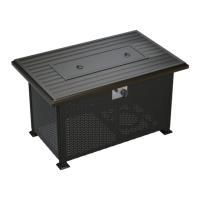
This document outlines the assembly and care instructions for a gas fire pit table, model 4327FTB. The device is designed to provide warmth and ambiance for outdoor spaces, functioning as both a fire pit and a table. Its construction allows for a relatively straightforward assembly process, with clear steps and visual aids provided to guide the user.
The gas fire pit table serves as an outdoor heating appliance that utilizes a gas burner to produce a flame, creating a warm and inviting atmosphere. The design incorporates a table-top surface, making it a versatile piece of outdoor furniture that can be used for holding drinks, snacks, or decorative items while simultaneously providing heat. The central burner area is designed to hold glass stones, which enhance the aesthetic appeal of the flames and help distribute heat. The unit is designed to house a gas cylinder within its base, ensuring a clean and integrated look without visible gas lines. A burner lid is included to cover the burner when not in use, transforming the fire pit into a full table surface and protecting the burner components from the elements.
The fire pit table is designed for ease of use and safety. The assembly process begins with the attachment of the gas cylinder base to the door, followed by securing brackets to these components. This foundational step ensures the stability of the enclosure that will house the gas cylinder. Casters are then screwed into the gas cylinder base, allowing for mobility of the unit, which is a significant convenience for repositioning the fire pit table as needed. The main structure of the table is formed by attaching the right and left side panels to the table top, and then securing the rear panel to the side panels. Stiffener panels are incorporated to enhance the structural integrity of the unit, ensuring it remains robust during use.
Once the main structure is assembled, the burner is attached to the table top. This is a critical step that ensures the proper placement and secure connection of the flame-producing component. The door and gas cylinder base assembly are then inserted into a guide rail and pushed into place, completing the enclosure for the gas cylinder. A key aesthetic and functional feature is the pouring of glass stones into the burner. These stones are not only decorative but also play a role in heat distribution and flame appearance. The final step in preparing the fire pit for use involves attaching a pull ring to the burner lid. This pull ring facilitates easy removal and placement of the lid, allowing the user to switch between fire pit and table modes effortlessly.
The design emphasizes a clean and integrated look, with the gas cylinder discreetly stored within the table's base. The inclusion of casters means the unit can be easily moved, offering flexibility in outdoor space arrangement. The burner lid provides versatility, allowing the unit to function as a regular outdoor table when the fire pit is not in use, protecting the burner from debris and weather.
The manual provides guidance on maintenance, primarily through the recommendation of using furniture covers. It explicitly states that furniture covers should be used to protect the patio fire pit when not in use. This is a crucial maintenance feature, as it helps shield the unit from environmental factors such as rain, dust, and UV radiation, which can cause wear and tear over time. By covering the fire pit, users can extend its lifespan and maintain its aesthetic appeal.
Additionally, the manual advises removing the wind guard before using a waterproof table cover. While a wind guard is not explicitly listed as an assembly part in the provided excerpts, this instruction implies that such an accessory might be used with the fire pit. If a wind guard is present, removing it before covering the table ensures that the waterproof cover fits properly and provides maximum protection. This detail highlights the importance of proper covering techniques to prevent water accumulation and potential damage to the burner or other components.
The overall design, with its robust construction and the provision for protective covers, suggests a focus on durability and ease of long-term care. The use of glass stones, while enhancing aesthetics, also simplifies cleaning compared to traditional wood-burning fire pits, as there is no ash or soot to manage. The ability to cover the burner with a lid further protects it from debris, reducing the frequency of internal cleaning. The clear assembly instructions, coupled with the emphasis on protective measures, aim to ensure that the fire pit table remains a functional and attractive addition to an outdoor space for many years.
 General
| Model | 4327FTB |
|---|---|
| Category | Outdoor Fireplace |
| Fuel Type | Propane |
| Material | Steel |
| Shape | Square |
| Color | Black |
| BTU | 50, 000 |

 To Next Page