The Z1 Pilot is a hydraulic pilot designed to ensure optimal operation of high-power heat pumps. It features an integrated 78-liter wall tank that serves multiple functions: decoupling heat pump circuits, air bleeding, and sludge evacuation. This design allows the Z1 Pilot to manage complex heating installations efficiently.
Function Description:
The primary function of the Z1 Pilot is to act as a central control unit for heat pump systems, particularly those requiring high power. It monitors and regulates the installation, ensuring that the heat pumps operate effectively. In scenarios where the installation's power demand exceeds the heat pump's output, the Z1 Pilot can optionally activate an electric booster or an external boiler to supplement heating.
The device is capable of managing various configurations, including installations with up to three heat pumps and up to four sanitary or heating circuits. For heat pumps with their own circulators (e.g., HRC70 40kW models), the Z1 Pilot's distribution branches, which are typically used for circulation, are not connected.
Important Technical Specifications:
- Buffer Tank: 78 liters capacity.
- Electrical Supply: 230 V mono.
- Power Supply Cable Cross-section: 3G 2.5 mm².
- Circuit Breaker: 10 A.
- Dimensions (W x H x D): 410 x 1512 x 536 mm.
- Weight (empty): 50 kg.
- Hydraulic Connection: 1" 1/2.
- Back-up: Electric or simultaneous operation of an external boiler.
- Electrical Back-up Output: 0 to 6 kW.
- Maximum Hydraulic Pressure: 6 bar.
- Operating Temperature Range: Admissible storage and transport temperatures are from -20°C to +60°C.
- Water Temperature in Operation: Maximum water temperature is indicated by a specific symbol.
- Maximum Working Pressure (PS max): Indicated by a specific symbol.
The Z1 Pilot complies with CEI 60335-1, CEI 60335-2-40 electrical safety international norms, and CE marking directives including Low Voltage (2014/35/UE), Electromagnetic Compatibility (2014/30/UE), Eco-design (2009/125/CE), and Restriction of Hazardous Substances (2011/65/UE).
Usage Features:
- Installation Flexibility: The Z1 Pilot can be integrated into various hydraulic configurations, with connections for heat pump and emitter circuits configurable to either the left or right side of the unit.
- Placement Requirements: Must be installed in a frost-free area, close to the heat pump, and at least 200mm above the floor for drainage and 400mm below the ceiling for access to air bleed and electrical back-up.
- Hydraulic Network Balancing: Requires installation of control devices (balancing valve, flow meter) on each heat pump and emitter circuit to ensure proper flow rates.
- Water Treatment: Emphasizes the importance of proper water treatment for the heating circuit to prevent corrosion, limescale, and microbiological growth. It recommends using specific products and provides guidelines for water quality (pH, chlorides, conductivity, and hardness).
- DHW Circuit Installation: Mandates the installation of a safety group on the cold water inlet of each domestic hot water tank and recommends anti-limescale devices in hard water regions.
- Purging Function: Features an automatic purging cycle to remove air bubbles from the system, which is crucial for preventing corrosion. The cycle runs for 30 minutes, with pressure monitoring and automatic pausing if pressure drops.
- Back-up Options: Allows selection of electrical back-up, boiler back-up, or simultaneous operation of both, providing flexibility for supplementary heating.
- Control Panel: Equipped with a keypad and display for user interaction. The keypad offers primary functions (menu access, temperature adjustment, confirmation) and secondary functions (keypad lock/unlock, standby, scheduled comfort modes, temporary comfort mode, information display, holiday mode). The display shows current operating state symbols (defrosting, circulator working, DHW activated, heating activated, ventilator working, compressor working, power level, keypad locked, electrical back-up, installer menu, back-up boiler), a 29-character message, current comfort mode (programming active, frost protection, comfort, eco, holiday), day of the week, and various temperatures, pressure, settings, and time.
- Menus: Organized into "USER" and "EXPERT" menus, allowing access to various settings such as HP circulator speed, outdoor temperature setpoints, heat curve settings for radiators and underfloor heating, priority sharing, and anti-bacteria functions. The "EXPERT" menu provides access to all parameters, display of operating state, data calculations, counters, configuration, air bleed activation, manual component operation, commissioning, Modbus settings, and software version management.
- Adjustable Parameters: A comprehensive list of parameters (P202-P291) allows fine-tuning of the system, including maximum/minimum exterior temperatures, summer/winter changeover methods, reactivity, holiday anticipation, minimum HP operating temperature, back-up type, heat pump time-out, temperature differences, and DHW production settings.
- AUTO Temperature (Heat Curve): Automatically adjusts heating setpoint based on exterior temperature for optimal seasonal efficiency.
- Temperature Lowering: Allows reducing the heating setpoint in Eco or Frost protection modes to improve heat pump performance.
- Auto-adaptability: Continuously corrects the heat curve based on household needs, with primary (24h cycles) and complementary (3h cycles) modes.
- Ambient Temperature Reactivity: Increases heating setpoint when ambient temperature deviates significantly, accelerating heating when returning to comfort mode.
- Anticipation of Return from Holiday: Resumes heating in advance of a planned return from holiday, adjusting based on heating circuit inertia and exterior temperature.
- Automatic Summer/Winter Changeover: Automatically switches between seasons based on observed exterior temperature and predefined setpoints.
- Ambient Temperature Sensor Hysteresis: Defines the temperature differential for activating/deactivating a heating request.
- Circulator Pump Speed: Adjustable for both heat pump and heating/DHW circuit circulators.
- Heating Circulator Control: Can be set for permanent operation or controlled by an ambient temperature control.
- Anti-cold Radiators: Maintains circulation at a lower water temperature to prevent radiators from becoming cold when the set ambient temperature is reached.
- Domestic Priority Sharing: Allows heating circuit operation during DHW heating cycles when the tank temperature is sufficient.
- Anti-legionellosis Protection: Activates a cycle to raise DHW tank temperature at regular intervals to eliminate bacteria.
Maintenance Features:
- Qualified Professional Requirement: All maintenance work must be carried out by a qualified professional.
- Safety Precautions: Emphasizes disconnecting electrical supply, ensuring no power re-activation, and waiting 5 minutes for capacitors to discharge before any electrical work. Water must be kept away from control and electrical components.
- Pressure Relief Valves: Mandatory installation and regular checks of pressure relief valves to prevent dangerous pressure build-up.
- Filter Cleaning: The water inlet filter for each heat pump must be cleaned several times during initial operation and at least once a year.
- Operating History: The system saves operating history to an electronic board, which can be downloaded via a USB stick for diagnostics.
- Diagnostics Menu: Provides access to current operating state, water sensor readings, exterior sensor readings, counters, and manual forcing of components (circulator pump, electrical back-up, back-up boiler) for diagnostic purposes.
- Error Indication: The pilot displays various error messages (e.g., T_air error, circulator pump blocked, BUS communication error, pressure sensor error, inverter communication error, overheatings) to assist in troubleshooting.
- Regular Annual Maintenance: Essential for sustained use and durability, to be performed by an installer or AUER-approved technical center.
- Spare Parts Availability: Spare parts are available for 10 years from the end of mass production, except in unforeseen circumstances.

 Need help?
 General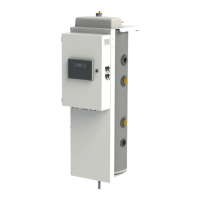

 To Next Page