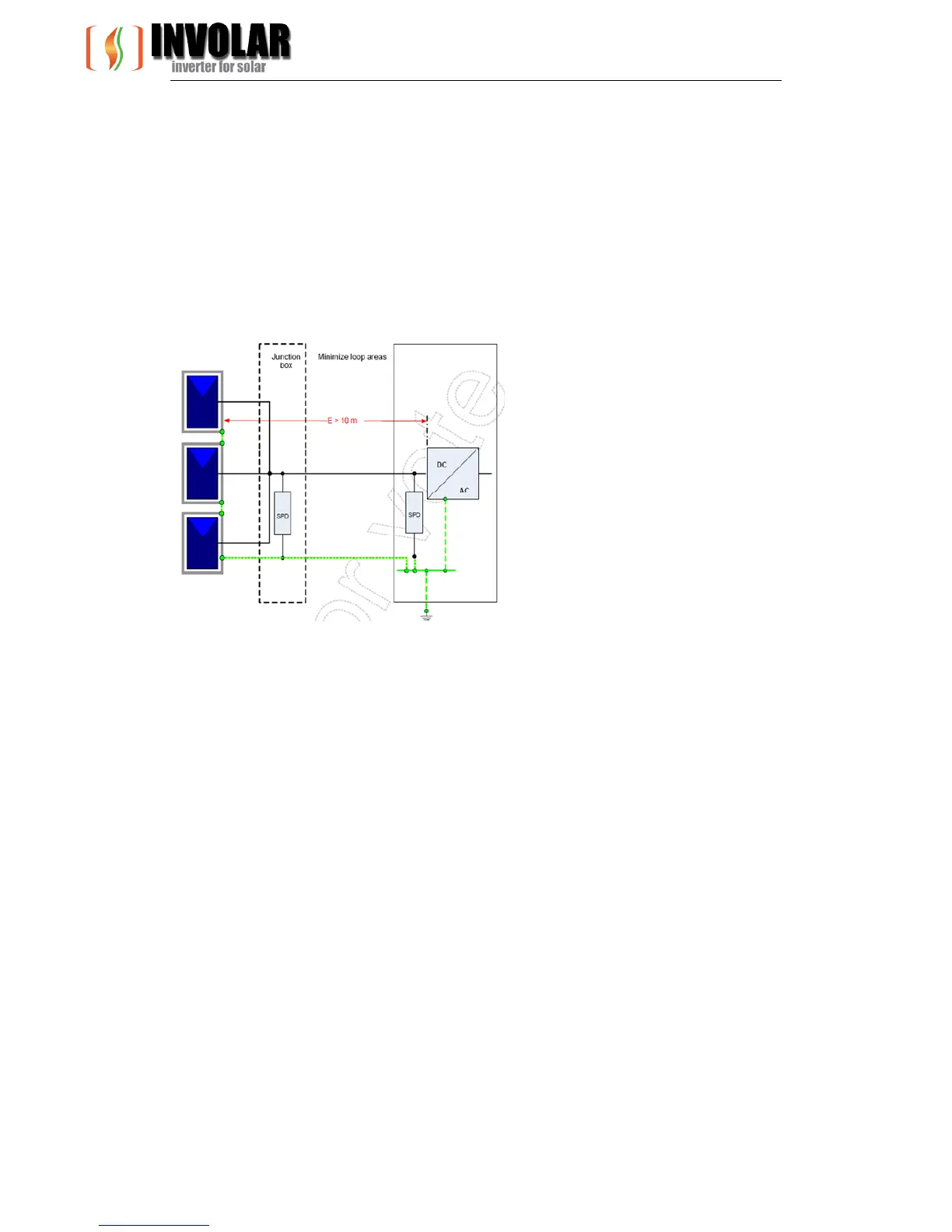
Lightning can cause damage either from a direct strike or from surges due to a
nearby strike. Induced surges are the more likely cause of lightning damage in the
majority of installations, especially in rural areas where electricity supplies are
usually by long overhead lines. Surges may be induced on both the PV array
conductors and the A.C. cables leading to the building.
Specialists in lightning protection should be consulted during the endues application.
Using appropriate external lightning protection, the effect of a direct lightning strike
into a building can be mitigated in a controlled way, and the lightning current can be
discharged into the ground.
Installation of SPDs to protect the inverter against mechanical damage and excessive
stress include a surge arrester in case of a building with external lightning protection
system (LPS) when separation distance s is kept:
To protect the D.C. system, surge suppression devices (SPD Type 2) should be fitted
at the inverter end of the D.C. cabling and at the array, located between the inverter
and the PV generator, if the voltage protection level (VP) of the surge arresters is
greater than 1100 V, an additional SPD Type 3 required for surge protection for
electrical devices.
To protect the A.C. system, surge suppression devices (SPD, type 2) should be fitted
at the main incoming point of A.C. supply (at the consumer’s cutout), located
between the inverter and the meter/distribution system;
SPD (test impulse D1) for signal line according to EN 61643-21
All D.C. cables should be installed to provide as short run as possible, and positive
and negative cables of the same string or main D.C. supply should be bundled
together, avoiding the creation of loops in the system.
This requirement for short runs and bundling includes any associated earth/bonding
conductors.
Spark gap devices are not suitable for use in D.C. circuits as once conducting, they
won’t stop conducting until the voltage across their terminals is typically less than 30
volts.


 To Next Page