Dynamic Braking Unit Manual
-2-
Safety precautions
Read the manual carefully before installing, operating, servicing, and inspecting the dynamic
braking unit.
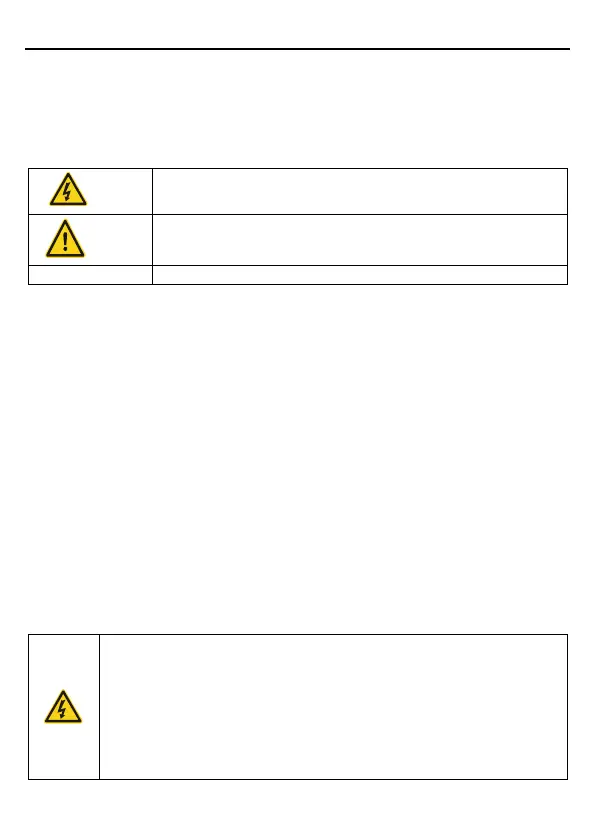
Safety precautions in the manual are classified as "Danger" and "Warning".
Serious physical injury or even death may occur if related
requirements are not followed.
Physical injury or damage to the equipment may occur if related
requirements are not followed.
Actions taken to ensure proper running.
Warnings caution you about conditions that can result in severe injury or death and/or
equipment damage and advice on how to prevent dangers.
Note:
Do not use any incomplete or damaged braking unit or braking resistor.
Confirm that the braking unit and braking resistor are set properly.
Do not carry out a voltage-endurance test on the braking unit, otherwise, damage to the
semiconductor devices of the braking main circuit may occur.
Screws shall be tightened during wiring, otherwise, fire or leakage may occur.
When multiple braking units are installed in the same one chassis and used in parallel
connection, a fan or other cooling device shall be installed.
After the braking unit is wired, there is high voltage DC power supply inside it. Do not
touch the braking unit, internal components and printed boards with your hands,
otherwise, electric shock may occur.
The braking resistor shall be equipped with temperature protection and other
protections.
The braking unit and braking resistor shall be mounted on
flame-retardant mediums (e.g. metal).
Ensure all the power supplies are disconnected and fully discharged
before wiring.
Only professionals are allowed to carry out the wiring operation.
Check whether the wiring is proper before operation.
Check whether the master/slave selection and voltage class settings are
proper before operation.



 To Next Page