EasyManua.ls Logo

ION Damper Control - User Manual

ION Damper Control
8 pages
Print Icon
To Next Page IconTo Next Page
Loading...
SYST0101ZP
Ion™ Damper Control
Installat i on and Start---Up Instruct i ons
A97040I
NOTE: Read the entire instruction manual before starting the
installation.
SAFETY CONSIDERATIONS
Improper installation, adjustment, alteration, service, maintenance,
or use can cause explosion, fire, electrical shock, or other
conditions which may cause death, personal injury or property
damage. Consult a qualified installer, service agency or your
distributor or branch for information or assistance. The qualified
installer or agency must use factory--authorized kits or accessories
when modifying this product. Refer to the individual instructions
packaged with the kits or accessories when installing.
Follow all safety codes. Wear safety glasses, protective clothing,
and work gloves. Have a fire extinguisher available. Read these
instructions thoroughly and follow all warnings and cautions
included in literature and attached to the unit. Consult local
building codes and the current edition of the National Electrical
Code (NEC) NFPA 70. In Canada, refer to the current editions of
the Canadian Electrical Code CSA C22.1.
Recognize safety information. When you see this symbol
on
the unit and in instructions or manuals, be alert to the potential for
personal injury. Understand the signal words DANGER,
WARNING,andCAUTION. These words are used with the
safety--alert symbol. DANGER identifies the most serious hazards,
which will result in severe personal injury or death. WARNING
signifies hazards, which could result in personal injury or death.
CAUTION is used to identify unsafe practices, which may result
in minor personal injury or product and property damage. NOTE
is used to highlight suggestions which will result in enhanced
installation, reliability, or operation.
INSTALLATION CONSIDERATIONS
Before the actual installation of a zoning system can begin,
decisions need to be made to determine the number and location of
zones and sensors. This affects duct and damper selections.
See the Iont System Zoning Design Guide for more
information on specifying and designing zoning systems.
This instruction covers the physical installation and start up of the
Iont Damper Control. Use this instruction to guide the actual
installation process after all the air side decisions have been made.
One Damper Control is capable of handling up to four zones of
operation. When greater than four zones are required, a second
Damper Control Module is needed for zones 5 through 8 (8 zones
maximum).
S NOTE: The Iont Zoning System IS NOT compatible with all
ICP communicating indoor equipment. For example,
(F,G)9MV and (F,G)8MV two--stage, communicating gas
furnaces are NOT compatible with the Iont Zoning System.
See the Ion t System Control product data for more
information.
S NOTE: Only use modulating dampers provided by ICP for
use with the Iont Zoning System. Dampers provided by
other companies are NOT compatible with the Iont Zoning
System.
S NOTE: Observerr System accessories, except for certain
dampers (see damper list), are NOT compatible with the Ion
Zoning System.
Use the Observer r Zoning System, or equivalent, for
non--compatible indoor units, such as non--communicating
indoor units, or the (F,G)9MV and (F,G)8MV gas furnaces. The
Observer r ZoningSystemmayalsobeusedinretrofit
applications where it is impractical to change existing zone
dampers.
S Install the Iont System Control and Remote Room Sensors in
non--condensing areas with ambient temperatures between 32F
and 120F. Install dampers and the Iont Damper Control in
non--condensing areas with ambient temperatures between --4F
to 158F(--20 to 70C).
S A TXV is required on the indoor coil when used with all
residential split system equipment.
S Proper equipment selection and duct sizing are important in a
zoned system. See the Ion Zoning System Design Guide for more
information.
S DO NOT USE a bypass damper with the Iont Zoning System.
Addition of a bypass will cause improper operation. Airflow
management will be performed by the Iont System Control
algorithms. The Iont System Control will monitor the system
and will maintain proper airflow through the heating / cooling
equipment.
INTRODUCTION
The Iont Zoning System allows air conditioning and heating
equipment to control temperatures and humidity in up to 8 distinct
spaces, or zones, within a building. Each zone has independent
temperature settings. The comfort temperature settings can change
automatically through the use of schedules. This allows the Iont
System to change temperature settings in zones to reflect
occupancy or usage. For example, the end user can condition
bedrooms in a home from 5:00 PM through 7:00 AM or the
kitchen from 3:00 PM through 6:00 PM. The Iont System uses
motorized air volume control dampers (also called zone dampers)
to regulate flow of conditioned air into zones. In this manner, the
system can selectively heat or cool certain portions of a building
depending upon space temperature requirements.
Each zone requires a motorized, modulating zone damper to
control the air supplied to it and a zone sensor to sense temperature
in each zone. There are two types of zone sensors available and
may be used in combination:
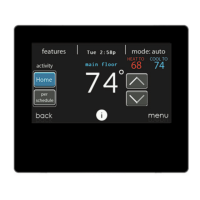
S Iont System Control (p/n SYST0101CW) Each installation
has only one Master wall/zoning control. This is the command
center for the entire system. It will typically be located in Zone 1
to sense and control the temperature in this zone. If desired, a
Remote Room Sensor may be used to sense the Zone 1
temperature. This can give the installer some flexibility in locating
the Master Iont System Control wall control to another area.
Question and Answer IconNeed help?

Do you have a question about the ION Damper Control and is the answer not in the manual?

ION Damper Control Specifications

General IconGeneral
BrandION
ModelDamper Control
CategoryControl Unit
LanguageEnglish

Summary

Safety Considerations

Safety Information and Signal Words

Understand signal words like DANGER, WARNING, CAUTION, and NOTE.

System Introduction and Planning

Compatibility and Requirements

Notes on compatibility with ICP equipment and TXV requirement.

Installation Procedures

Step 1: Equipment & Job Site Check

Inspect equipment for damage or incompleteness before installation.

Step 2: Component Location, Wiring & Safety

Covers electrical safety, wiring compliance, component placement, and wiring considerations.

Component Installation

Install Damper Control, System Control, & Sensors

Instructions for installing the Damper Control, System Control, and Room Sensors.

Zone Damper Installation

Covers damper compatibility, placement, and electrical safety.

Ductwork Installation Types

Instructions for installing dampers in various ductwork types.

Ductwork Damper Installation

Rectangular & Flexible Ductwork

Steps for connecting dampers to rectangular and flexible ductwork.

Fibrous Glass Ductwork Installation

Steps for connecting dampers to fibrous glass ductwork.

Step 5: Final Wiring

System Wiring Diagram Reference

Reference to wiring diagrams for connecting components.

System Wiring Diagrams

Zones 1-4 Wiring Diagram

Diagram showing wiring for zones 1 through 4.

Zones 5-8 Wiring Diagram

Diagram for setting up additional zones 5 through 8.

System Indicators and Configuration

LED Indicators and Fuse Information

Explanation of status LEDs and details about the system fuse.

Additional Zone Setup

Guide for setting up additional zones using a second damper control module.

Power Requirements and Start-up

Information on transformer requirements and system start-up procedures.

Troubleshooting Common Issues

System Power and Communication Problems

Steps to resolve power-up and indoor unit communication errors.

Zone Detection Issues

Steps to resolve issues with zones 5-8 or zones 1-4 not being detected.

Zone Damper Malfunctions

Troubleshooting steps for non-responsive zone dampers.

Related product manuals