5
1. INTRODUCTION
congratulations. You have purchased an excellent do-
mestic water treatment equipment.
This equipment will help you to improve the properties
of your water.
2. WHAT IS OSMOSIS?
The natural or direct osmosis is the most common in
nature, given that semi-permeable membranes are part
of the vast majority of organisms (for example plant
roots, organs of our own body, cell membranes, etc ...).
When two solutions of different salt concentrations are
separated by a semi-permeable membrane, in a natural
way, a flow of water is produced from the solution with
the lowest concentration to the one with the highest
concentration. This flow continues until concentrations
on both sides of the membrane are equal.
When this process is reversed to achieve a flow of water
with a lower salt concentration from a higher concen-
tration, sufficient pressure must be applied to the wa-
ter with the highest concentration on the membrane to
overcome the tendency and natural flow of the system.
This process is what we call reverse osmosis. Nowadays,
reverse osmosis is among the best methods to improve
the properties of water by means of a physical system
(without the use of chemical products).
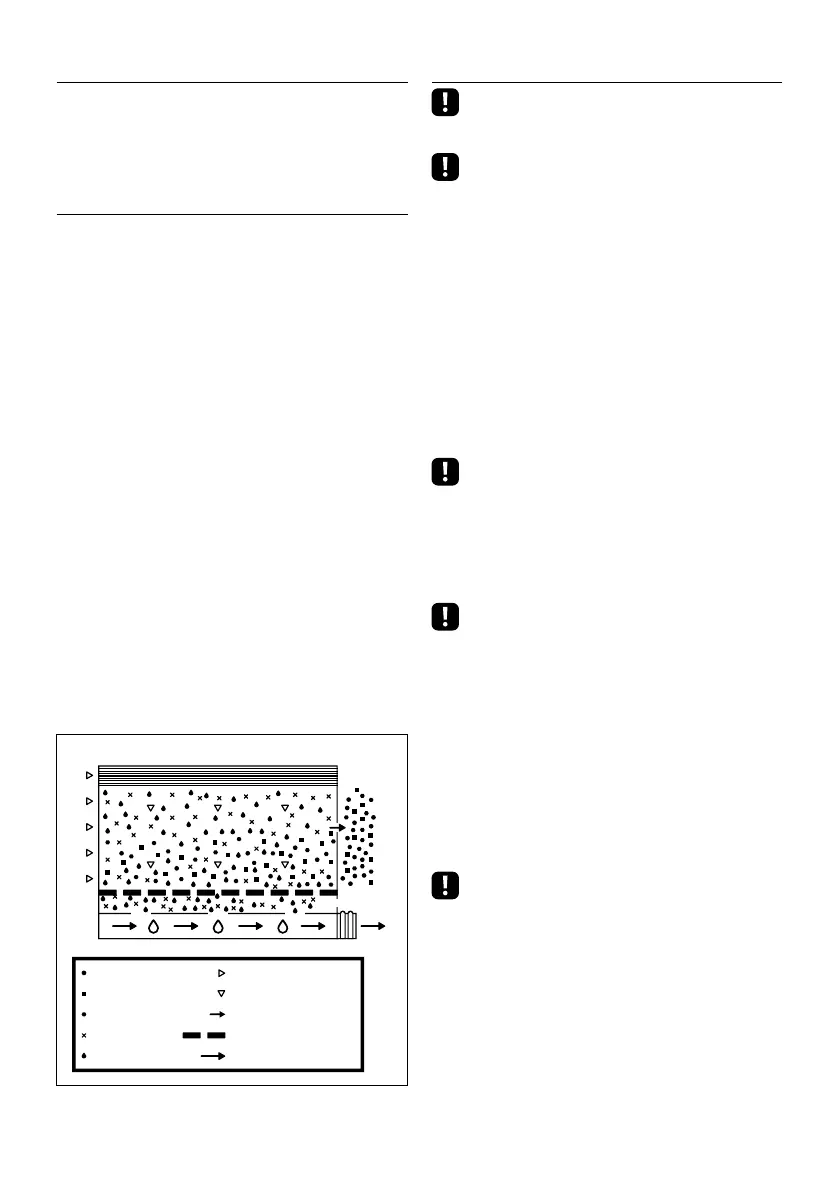
The water to be treated exerts pressure on the se-
mi-permeable membrane, so that part of it will be able
to pass through the pores of the membrane (osmosis
water), while the rest of the water (rejected or with a
high concentration of salts) will be diverted to the drain
(Fig. 1).
3. PRECAUTIONS
ATTENTION: Read carefully the warnings des-
cribed in the corresponding section of the Tech-
nical Manual.
ATTENTION: This equipment is not a water puri-
fier. If the water to be treated comes from a pu-
blic supply (and therefore complies with current
legislation), this equipment will substantially improve
the quality of the water.
The water treatment plants require periodic mainte-
nance by qualified technical personnel in order to gua-
rantee the quality of the water produced and supplied.
3.1. USAGE OF EQUIPMENT
- When you will be gone for more than a week, close the
water inlet tap to the equipment, empty it and discon-
nect it from the power supply (PUMP model). When you
return, connect the power supply, open the entrance
tap and the faucet. Let the water flow for at least 5 mi-
nutes before consuming water.
ATTENTION: After an extended period (more than
one month) in which the equipment has been
found to be inoperative or not producing water,
contact your dealer for proper sanitation and mainte-
nance.
- Remove jars or full bottles and avoid occasional cup
extraction for better performance of the equipment.
ATTENTION: Special attention should be devoted
to the cleanliness and hygiene of the osmosis fau-
cet, as usual and especially at the time of periodic
maintenance and sanitization. To do this, use a dispo-
sable single-use sanitizing spray and kitchen towel.
Under no circumstances should the hand wipe or mul-
tipurpose cloth used for cleaning the kitchen be used.
3.2. RECOMMENDATIONS FOR THE APPROPRIATE USE OF
OSMOSIS WATER
- If you wish to feed any other consumption point with
osmosed water (such as a fridge with a bucket dispen-
ser, another tap, etc...), the channelling should not be
carried out with a metal tube, as this would give the
water a bad taste. Always use plastic tube.
ATTENTION: The water provided by the domestic
osmosis equipment is LOW MINERALIZATION. The
mineral salts needed by the human body are provided
mainly by food, especially dairy products and to a less
extent by drinking water.
- We recommend not to use aluminium utensils to cook
with osmosed water.
Membrana de ósmosis
Membrana
Contaminación Entrada de agua
Bacterias Presión sobre la membrana
Compuestos químicos Flujo del rechazo
Sales minerales Membrana
Agua Flujo del agua purificada
Agua purificada
Entrada Presión
Rechazo: agua con sales
y elementos retenidos



 To Next Page
 Loading...