The iProtect 1217 is an anti-tracking mobile system and detector of mobile and wireless signals, designed for counter-surveillance sweeping. It aims to detect various covert surveillance devices that transmit information via mobile networks or other wireless standards.
Function Description:
The device's primary function is to detect mobile and wireless signals, including GSM, 3G, 4G/LTE, 5G, Wi-Fi (2.4 GHz and 5 GHz), Bluetooth, DECT, and ISM bands (434 MHz, 868 MHz, 915 MHz). Unlike wide-range RF detectors, the iProtect 1217 is a selective detector, offering higher sensitivity and the ability to identify specific signal types. This selectivity helps distinguish suspicious signals from external interferences and aids in physically locating transmitters.
The iProtect 1217 offers several operation modes:
- ALL BANDS: This is the main searching mode for detecting all mobile and wireless signals. It displays signal levels by groups on bargraphs, allowing the user to choose a group and view its constituent bands.
- GROUP: Used for inspecting bands within a selected group, especially when a high signal level is detected. It displays signal levels by individual bands, and the user can select a band to see its frequency.
- BAND: In this mode, the signal is measured in one specific band only. This is useful for detailed exploration of a band and for performing a physical search for a transmitter. It displays a histogram, showing the history of the signal level over a certain period, which helps in detecting non-continuous or short-time signals.
- TRACKER: This specialized mode is for detecting GPS trackers (beacons) on vehicles or other mobile devices. It focuses on active mobile bands (MBL1, MBL2, MBL3, MBL4 groups) and displays a histogram with an enlarged period (approximately 1 minute) to capture short-time and periodic data transmissions. It also measures the time between responses (PERIOD).
The device features an ALARM function that provides visual and/or audio warnings when a signal exceeds a user-defined threshold. It has 43 threshold levels for optimal sensitivity adjustment. The iProtect 1217 can be configured for specific tasks, such as detecting only Wi-Fi signals.
Important Technical Specifications:
- Number of bands: 26
- Antenna inputs:
- Input 1: SMA, 2400 – 6000 MHz (for high-band directional antenna)
- Input 2: SMA, 600 – 2400 MHz (for low-band rod antenna)
- Average sensitivity: -60 dBm
- Operation modes: ALL BANDS, GROUP, BAND, TRACKER
- Alarm function: Visual or audio
- Number of alarm threshold levels: 43
- Sound signals: Alarm, depression of buttons
- Regions: US (bands of the USA), EU (European bands), TOTAL (all bands)
- Power supply source: USB 5V
- Power: Built-in rechargeable battery 6800 mA*h 3.7 V
- Battery operational resource: Up to 5 hours
- Mass:
- Device without antenna: 750 g
- Packed: 1500 g
- Dimensions:
- Device without antenna: 208 x 86 x 41 mm
- Packed: 27 x 22 x 10 cm
- Operating temperature range: -5...50 °C
Supported Frequency Bands:
- MBL1 (Mobile Communication Group 1): B8 (880-915 MHz), B20 (832-862 MHz), B20 (703-748 MHz), B12/17 (699-716 MHz), B13 (777-787 MHz), B71 (663-698 MHz)
- MBL2 (Mobile Communication Group 2): B1/65 (1920-2010 MHz), B3 (1710-1785 MHz), B14 (788-798 MHz), B5/26 (814-849 MHz)
- MBL3 (Mobile Communication Group 3): B7 (2500-2570 MHz), B34 (2010-2025 MHz), B38 (2570-2620 MHz), B4/66 (1710-1780 MHz), B2/25 (1850-1915 MHz)
- MBL4 (Mobile Communication Group 4): B42 (3400-3600 MHz), B43 (3600-3800 MHz), B30/40 (2300-2400 MHz), B7/41 (2496-2690 MHz)
- DECT (Cordless Phones): DECT-EU (1880-1900 MHz), DECT-US (1920-1930 MHz)
- ISM (Industrial, Scientific, Medical): ISM433 (433-435 MHz), ISM868 (863-870 MHz), ISM915 (902-928 MHz)
- BT-WIFI (Bluetooth/Wi-Fi): WIFI2.4 (2400-2484 MHz), WIFI5.8 (5150-5875 MHz)
Usage Features:
- Band Adjustment: The device can be adjusted to the frequency allocation of the country of use (US, EU, or TOTAL for manual selection). This ensures maximum detection probability and speed while avoiding false positives. Users can activate or deactivate individual bands or groups.
- Antenna Connection: The high-band directional antenna (Micro-Pointer LPDA-12) connects to the left SMA input (2400-6000 MHz), and the low-band rod antenna connects to the right SMA input (600-2400 MHz).
- Physical Search: For locating transmitters, the device should be moved around the target area. For signals above 2400 MHz, the directional microwave antenna helps pinpoint the source by observing signal level changes as the antenna is directed. For signals under 2400 MHz, localization is done by successive approximation, dividing the area and focusing on parts with the highest signal levels.
- Alarm Threshold Adjustment: The alarm threshold can be adjusted using the joystick (up/down) to narrow the search area during physical localization.
- GPS Tracker Detection: In TRACKER mode, it's recommended to switch off all known mobile phones and, if possible, deactivate car alarm systems with mobile communication to reduce false responses. The device should be moved along a route, observing signal presence and periodicity.
- Interference Reduction: To avoid interference and false responses, it is recommended to switch off all known radio frequency devices (mobile phones, Wi-Fi routers, Bluetooth devices, etc.) in the target premises and nearby during a search.
- External Signals: Users should be aware of potential external signals from adjacent premises or outdoors. If a signal increases when approaching a wall or window and decreases elsewhere, it might be an external source.
Maintenance Features:
- Recharging: The iProtect 1217 is powered by a built-in rechargeable battery and can be recharged via USB (using a mobile phone charger, computer USB socket, or power bank). The device can operate while charging.
- Saving Settings: After adjusting bands, pressing the SAVE button stores the new settings. If not saved, the settings will revert to previous ones after power-off.
The iProtect 1217 is supplied with the device itself, a high-band antenna (Micro-Pointer LPDA-12), a low-band rod antenna, a USB Type C charging cable, two SMA angle adapters, and a case for transportation.

 Need help?
 General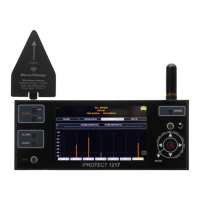

 To Next Page