This document is the owner's manual for the Ironton 420CC Engine, Item #45752. It provides essential information for the safe and effective operation, maintenance, and troubleshooting of the engine.
Function Description
The Ironton 420CC Engine is a small, internal combustion engine designed for various applications. It is intended to power equipment, though the specific applications are not detailed in this manual. The manual emphasizes that the engine should not be modified or used for applications other than its designed purpose, and specifically warns against its use in 3-wheel All Terrain Vehicles (ATVs), motorbikes, fun/recreational go-karts, aircraft products, or vehicles intended for competitive events due to the risk of property damage, serious injury, or death. The engine is designed to run on clean, fresh, unleaded gasoline with a minimum of 87 octane/87 AKI (91 RON). It incorporates an emissions control system to comply with U.S. EPA regulations.
Important Technical Specifications
- Model: 190F
- Displacement: 420CC
- Bore: 3.54 inches (90mm)
- Stroke: 2.60 inches (66mm)
- Oil Capacity: 0.29 gallons (1.1L)
- Net Weight: 68.34 lbs (31kg)
- Fuel Type: Unleaded gasoline, minimum 87 octane/87 AKI (91 RON). Acceptable with up to 10% ethanol (gasohol) or up to 15% MTBE (methyl tertiary butyl ether).
- Oil Type: Recommended suitable oils for best performance, classified for service SF, SG, SH, SJ or higher. Viscosity depends on outdoor temperature (e.g., SAE 30 for temperatures above 40°F/4°C, 10W-30 for a wider range, Synthetic 5W-30 for very cold conditions).
- Battery (if applicable): 12-volt battery with at least 18 Ah ampere-hour rating.
- High Altitude Operation: At altitudes over 5,000 feet (1524 meters), a minimum 85 octane/85 AKI (89 RON) gasoline is acceptable. High altitude adjustment is required for emissions compliance and optimal performance. Operation below 2,500 feet (762 meters) with the high altitude kit is not recommended.
- Engine Power Decrease: Engine power will decrease 3.5% for each 1,000 feet (300 meters) above sea level and 1% for each 10°F (5.6°C) above 77°F (25°C).
- Operating Angle: The engine can operate satisfactorily at an angle up to 15°.
Usage Features
The manual details the steps for starting and stopping the engine, along with critical safety warnings.
- Starting the Engine:
- Check oil level.
- Move fuel shutoff to ON.
- Move choke lever to the choke position (usually unnecessary for warm engines).
- Move throttle lever away from MIN position, about 1/3 of the way toward MAX.
- Turn the engine switch to ON.
- For recoil start, pull the starter cord handle slowly until resistance is felt, then pull rapidly to avoid kickback.
- Stopping the Engine:
- Move throttle lever to MIN position.
- Turn engine switch to OFF.
- Turn fuel shutoff to OFF.
- Fueling: Fueling should be done outdoors or in a well-ventilated area with the engine off and cooled. The fuel tank should not be overfilled, leaving about 1.5 inches (38 mm) below the top of the neck for expansion. Gasoline must be kept away from sparks, open flames, and other ignition sources.
- Safety Precautions: The manual extensively covers safety, including warnings about flammable and explosive gasoline vapors, carbon monoxide poisoning, hot surfaces, rotating parts, and kickback from the starter cord. It emphasizes operating the engine outdoors, keeping guards in place, tying up long hair, removing jewelry, and not wearing loose clothing. A spark arrester is required for use on forest-covered, grass-covered, or brush-covered unimproved land.
- Engine Components (Features and Controls): The manual identifies key components such as the air cleaner, muffler, spark plug, throttle lever, recoil starter, starting handle, fuel shutoff, choke lever, fuel filler cap, fuel tank, engine identification dipstick, and drain plug.
Maintenance Features
The manual outlines a maintenance schedule and procedures to ensure the engine's longevity and safe operation.
- Oil:
- Checking/Adding Oil: Place the engine on a level surface, clean the oil fill area, remove the dipstick, insert it without screwing it in, remove and check the oil level against the FULL mark. Add oil slowly to the engine oil fill if needed, waiting one minute before rechecking.
- Changing Oil: Change oil after the first 5 hours of operation, and then every 50 hours or annually. The manual specifies draining oil from the oil drain plug, ensuring the fuel tank is empty beforehand to prevent leaks and fire/explosion. Used oil is a hazardous waste and must be disposed of properly.
- Spark Plug:
- Replacement: Replace annually. Check the gap with a wire gauge and reset if necessary. Use a resistor spark plug if originally equipped.
- Air Filter:
- Service: Remove the air cleaner cover, separate the air filter from its housing, inspect, and clean with warm water and mild soap. Allow to dry thoroughly before re-installation. Do not use pressurized air or solvents.
- Muffler and Spark Arrester:
- Inspection: Check muffler and muffler guard and spark arrester (if applicable) every 50 hours or annually. Remove accumulated debris from the muffler and cylinder area.
- Carburetor Adjustment: The carburetor is factory-set and should not be adjusted. If adjustments are needed, an authorized dealer should be consulted.
- Fuse (if applicable): The manual describes how to remove, inspect, and reinstall the fuse, warning against using a fuse with a higher rating.
- Battery (if applicable): Instructions are provided for connecting a 12-volt battery (at least 18 Ah) to the starter solenoid and engine ground, emphasizing correct polarity.
- Storage: For storage exceeding 30 days, change oil while warm, clean the engine, drain all fuel from the tank, remove the spark plug, add 1 teaspoon (5 ml) of oil into the spark plug hole, pull the starter rope slowly 8-10 times, and replace the spark plug. Store in a clean, dry area. Use fresh gasoline when removing from storage.
- Warranty: The engine comes with a 90-day limited warranty for noncommercial/nonrental use, covering defects in material or workmanship. The U.S. EPA emissions control system is warranted for two years. Warranty may be voided by misuse, abuse, alteration, improper installation, or lack of proper maintenance.

 Need help?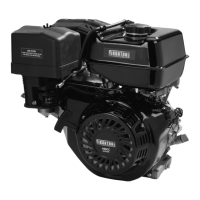

 To Next Page
 General