Need help?
Do you have a question about the Irrigatia SOL-C60 and is the answer not in the manual?
Lists and diagrams of components for the standard setup configuration.
Lists and diagrams of components for the submersible pump setup.
Details on the internal diaphragm pump's performance and positioning requirements.
Information on the submersible pump, its water delivery, and quiet operation.
Instructions for mounting the controller case near the water source.
Guidance on mounting the solar panel to face the sun.
Instructions for installing the foot strainer for the standard pump.
How to secure and connect the water level sensor for pump control.
Details on fitting the fine mesh filter and valve for the outlet tube.
Explanation of the anti-siphon device and its installation.
Information on the supplement pump for dosing plant feed.
Details on using 13mm tubes, joiners, and valves for distribution.
Guidelines for using seep hose for seedlings and small plants.
Instructions for using micro-porous hose for even watering.
Steps to open valves, unplug pumps, and check the switch position.
Instructions for installing the battery and connecting the solar panel.
How to prime the system and adjust the bypass valve for dripper flow.
Explanation of the first watering cycle length and control.
How the circuit board switch controls solar panel charging.
How the supplementary pump operates with the main pump for feeding.
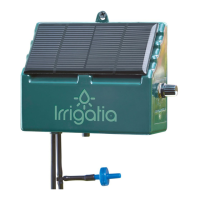
The Irrigatia Solar Automatic Watering System is an innovative solution for automated garden irrigation, designed and manufactured in Britain. This system is primarily intended for use with a water tank, though it can also be connected to a tap, offering flexibility for various garden setups. Its core function is to provide consistent and efficient watering to plants, leveraging solar power for sustainable operation.
The Irrigatia system operates on a solar-powered mechanism, which means it harnesses energy from the sun to power its pumps and control unit. A key feature of this system is its intelligent watering schedule: it waters every three hours. This frequent, small-volume watering approach is beneficial for plant health, ensuring a steady supply of moisture without over-saturating the soil. Furthermore, the system adapts its watering duration based on solar intensity – "more sun equals more water." This adaptive feature ensures that plants receive more water during hotter, sunnier periods when they need it most, and less during cooler, cloudier times, optimizing water usage and preventing wastage.
The system includes a main pump for water delivery and, in some models like the C120, a secondary feed pump. This secondary pump is designed for administering soluble supplements to plants, dosing at a rate of approximately 1:100. This allows for precise nutrient delivery directly through the irrigation system, simplifying plant feeding. The controller unit, which houses the circuit board and battery pack, manages the entire operation, from solar charging to pump activation and water distribution.
The Irrigatia system is designed for ease of setup and use, with clear instructions provided for both standard and submersible pump configurations. The controller should be mounted close to the water source, ideally low down for the standard pump to facilitate self-priming, or at a convenient height for the submersible pump. The solar panel, equipped with a 5m lead (extendable if needed), should be positioned to face the midday sun for optimal charging.
Water delivery is managed through a network of 13mm main distribution tubes and 4mm smaller bore tubes, connected to drippers, seep hoses, or micro-porous hoses. The system supports a significant number of drippers, with models like the C180 capable of handling up to 180 drippers, making it suitable for gardens of various sizes. The inclusion of T-pieces, elbows, end plugs, stakes, and clamps allows for a customizable and secure irrigation layout tailored to the specific needs of the garden.
An important component is the anti-siphon device, which prevents continuous water flow when the pump stops, especially if the first emitter is lower than the water source. This device must be fitted higher than the water source to function correctly. Isolation and regulating valves are also integral, allowing users to control water flow and fine-tune the system's output. The bypass valve, in particular, is crucial for adjusting the amount of water directed to the drippers versus returning to the tank, aiding in system priming and flow regulation.
The system incorporates a water level sensor to prevent the pump from running dry. If the water level drops below a certain point, the pump will stop, and an audible beeper will sound, alerting the user to refill the tank. This feature protects the pump from damage and ensures continuous operation when water is available.
Maintenance of the Irrigatia system is straightforward, focusing on ensuring optimal performance and longevity. The system includes an inline filter to protect drippers from debris. This filter can be fitted on either side of the pump, but it is essential to have a valve between it and the tank to turn off water flow during cleaning. Regular cleaning of this filter is recommended to prevent blockages and maintain efficient water delivery.
The controller unit is weather-resistant, allowing for outdoor mounting, but can also be placed indoors if preferred. The battery pack, containing rechargeable AA batteries, is housed within the controller and is charged by the solar panel. Users can adjust the solar panel's charging duration via a switch on the circuit board, which controls the amount of charge available for subsequent watering cycles. This adjustment, along with fine-tuning the bypass valve, allows for precise control over pumping duration and water application.
Initial setup involves clearing air from the system by running the pump with the bypass valve wide open, gradually closing it to direct water to the drippers. After installation, it is advisable to monitor the system for 24-48 hours to ensure it has settled down and is operating correctly. Regular checks for leaks and proper dripper function are also recommended. For micro-porous hose, re-adjustment may be necessary a few days after installation as the hose becomes wetted and emits less water.
The modular design, with various components like pumps, sensors, and tubing, allows for easy replacement or extension of parts as needed. Detailed video instructions are available online, providing visual guidance for setup and troubleshooting, further simplifying maintenance and ensuring users can maximize the system's efficiency.
 General
| Watering Capacity | Up to 60 plants |
|---|---|
| Solar Panel | Yes, Integrated |
| Irrigation Method | Drip irrigation |
| Type | Solar Automatic Irrigation System |
| Water Source | External container (e.g., water butt) |
| Pump Type | Submersible pump |
| Programming | Automatic, weather-adaptive |
| Water Output | Adjustable |
| Suitable For | Gardens, greenhouses, allotments |
| Weather Sensitivity | Weather resistant |

 To Next Page