12. DIST MID (0.1 to 2.5 OCT): The approximate width in octaves of
the midrange boost or cut. Beyond this width, the curve will slowly
transition back to 0 if the bass and treble are set flat.
13. DIST TREBLE (-15 dB to +15 dB): The level of pre-clip treble EQ.
14. DIST TREBLE (2000 Hz to 12.0kHz): The lower frequency at
which the amount of pre treble boost or cut begins to lose effect.
Frequencies below this point will still be boosted or cut, just not as
much, and as the frequency in the signal decreases, the amount
will diminish to 0. This is a ‘shelf eq’ type section that remains
nominally flat at high frequencies.
C) MASTER EQ Function
1. MASTER EQ (OFF or ON): Turns off or on the 5-band parametric
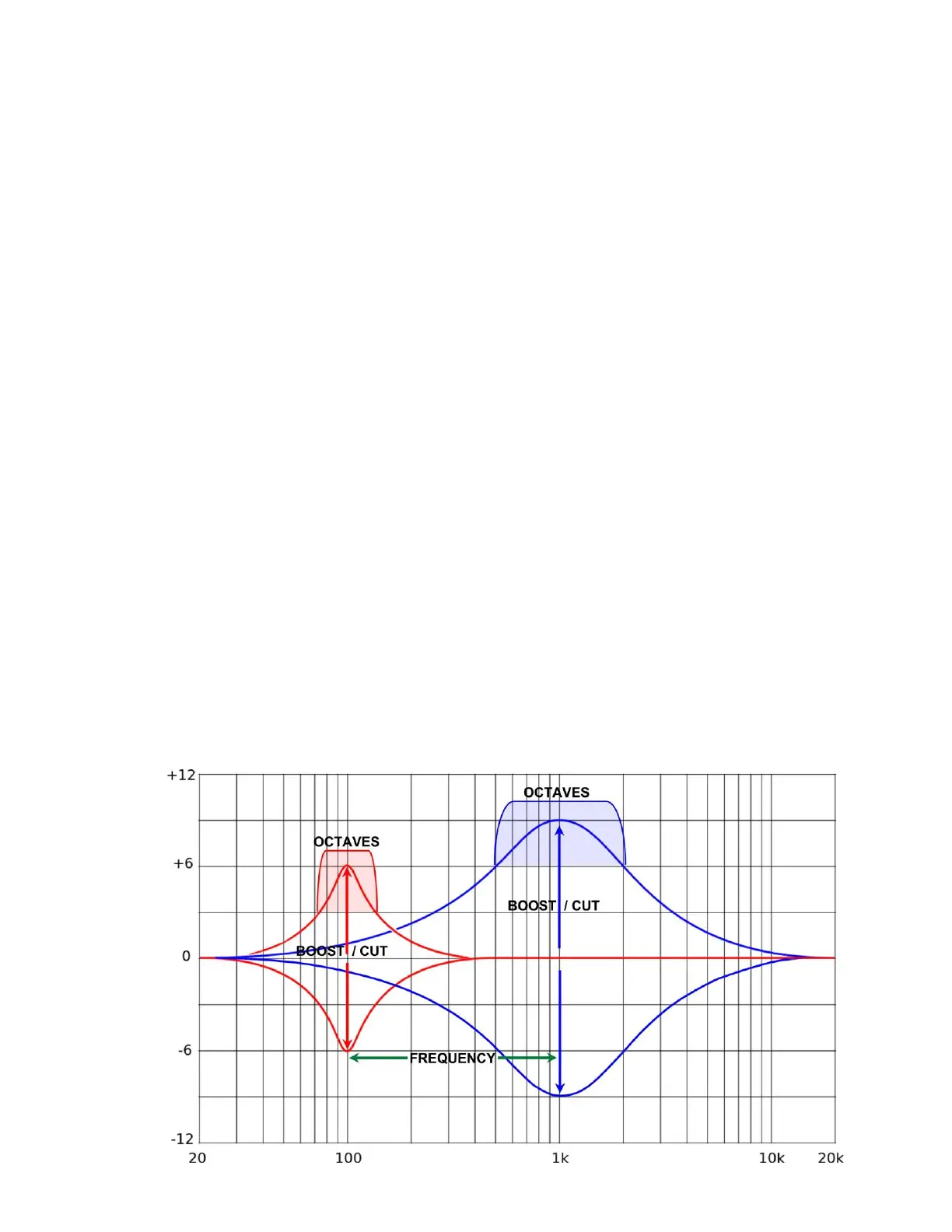
eq section that follows the clipper. See the graph below for an
explanation of how a parametric equalizer works.
The graph below shows an EQ response curve with a center frequency
of 100Hz and also at 1KHz. The MID “LEVEL” on the BETA BASS
DSP will adjust the amount of Boost or Cut applied to the signal. The
MID FREQUENCY, “FREQ” adjusts the center frequency as shown
below allowing you to select the center point or peak frequency you are
boosting or cutting. The MID BANDWIDTH “BW” is the bandwidth of
the frequencies being boosted or cut and is selected as OCTAVES.
An OCTAVE setting of .1 will be a narrow band of frequencies that are
affected by the boost or cut approximately .1 octaves at 3bd down from
the peak frequency. An OCTAVE setting of 2.5 will be a much broader
portion of the spectrum that is affected by the boost or cut
approximately 2.5 octaves at 3db down from the peak frequency. This
type of equalization allows much more precise adjustment of tone
shaping than typical Bass, Mid, Treble controls


 To Next Page
 Loading...