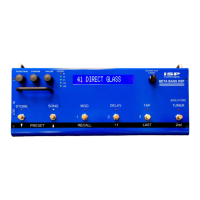
B) PREAMP Function
1. DISTORT MIX (0 to 100): Varies the relative amounts of clean and
distorted signal. 0 means full clean signal, 100 means full distortion
signal.
2. GAIN (1 to 60 dB): Dials up the gain before the clipper stage.
Additionally, there is gain available in the Pre EQ (labeled DIST
BASS, DIST MID, DIST TREBLE).
3. HIGH PASS (20 to 240 Hz): Varies the corner frequency (-3 dB
point) of a high pass filter the precedes the clipper. This allows the
low frequency component of your signal to stay clean.
4. SAG (0 to 100): Emulates the sag of the supply voltage rails in a
tube amp. Higher values result in more sag. This means that as
you play harder, the rails sag down resulting in more clipping of the
signal. Play softer and the rails move higher, resulting in a cleaner
sound. This is most effective with moderate levels of GAIN.
5. OUTPUT LEVEL (OFF to +10 dB): This is the same parameter as
in the mixer function. It is just repeated here for convenience
because as preamp parameters are changed, it is typical that the
output level will need to be readjusted.
6. COMPRESSOR (OFF or ON): Turns on the compressor, which is
positioned before the clipper stage. Compression is useful for
making clean or low gain settings sound louder, as it reduces the
level of loud passages and increases the level of soft passages.
The downside is the more compression used via lowering the
threshold, the more noise is added to the signal.
7. COMP THRESH (-30 to 0): The lower the setting, the more the
compression.
8. DIST BASS (-15 dB to +15 dB): The level of the pre-distort bass
EQ. Note that this only controls the tone of the distorted
component of the signal, not the clean. So if DISTORT MIX is set
to 0, these DIST eq controls have no effect. For higher gains,
these pre-eq sections do not so much affect the tone of the output,
but rather affect the character of the distortion.
9. DIST BASS (20 Hz to 240 Hz): The ‘turnover’ or upper frequency
at which the amount of pre distort bass boost or cut begins to lose
effect. Frequencies above this point will still be boosted or cut, just
not as much, and as frequency in the signal increases, the amount
will diminish to 0. This is a ‘shelf eq’ type section that remains
nominally flat at low frequencies.
10. DIST MID (-15 dB to +15 dB): The level of pre-clip midrange EQ.
( See the graph on the next page for a better understanding of the
operation of a parametric equalizer ... )
11. DIST MID (31 Hz to 6000 Hz): The center frequency of the
midrange boost or cut


 To Next Page
 Loading...