EasyManua.ls Logo

ITE K-3000 - Control Circuit Components; Undervoltage Trip Device

Default Icon
14 pages
Print Icon
To Next Page IconTo Next Page
To Previous Page IconTo Previous Page
Loading...
9.1
.
7
-
4
LOW
-
VOLT
AGE
POWER
CIRCUIT
BREAKERS
iE
I
nfr
~
t
Relay
the
breaker
closed
,
the
a
contacts
are
closed
.
With
the
circuit
breaker
open
,
the
b
contacts
are
closed
.
Undervoltage
Trip
Device
The
electrically
reset
undervoltage
trip
device
is
a
single
-
phase
device
which
automatical
!
/
trips
the
circuit
breaker
when
the
line
voltage
decreases
to
30
to
60
percent
of
the
rated
voltage
.
This
device
may
be
fur
-
nished
either
for
instantaneous
trip
operation
or
with
adjustable
time
delay
tripping
of
0
-
15
seconds
.
The
undervoltage
trip
device
is
an
integral
unit
which
may
be
added
to
the
circuit
breaker
either
at
the
factory
or
in
the
field
(
evice
is
contained
in
the
black
insulated
mold
-
A
6
"
approximate
,
located
at
the
lower
nt
of
the
mechanism
and
is
used
on
all
electrically
;
rafed
mechanisms
.
The
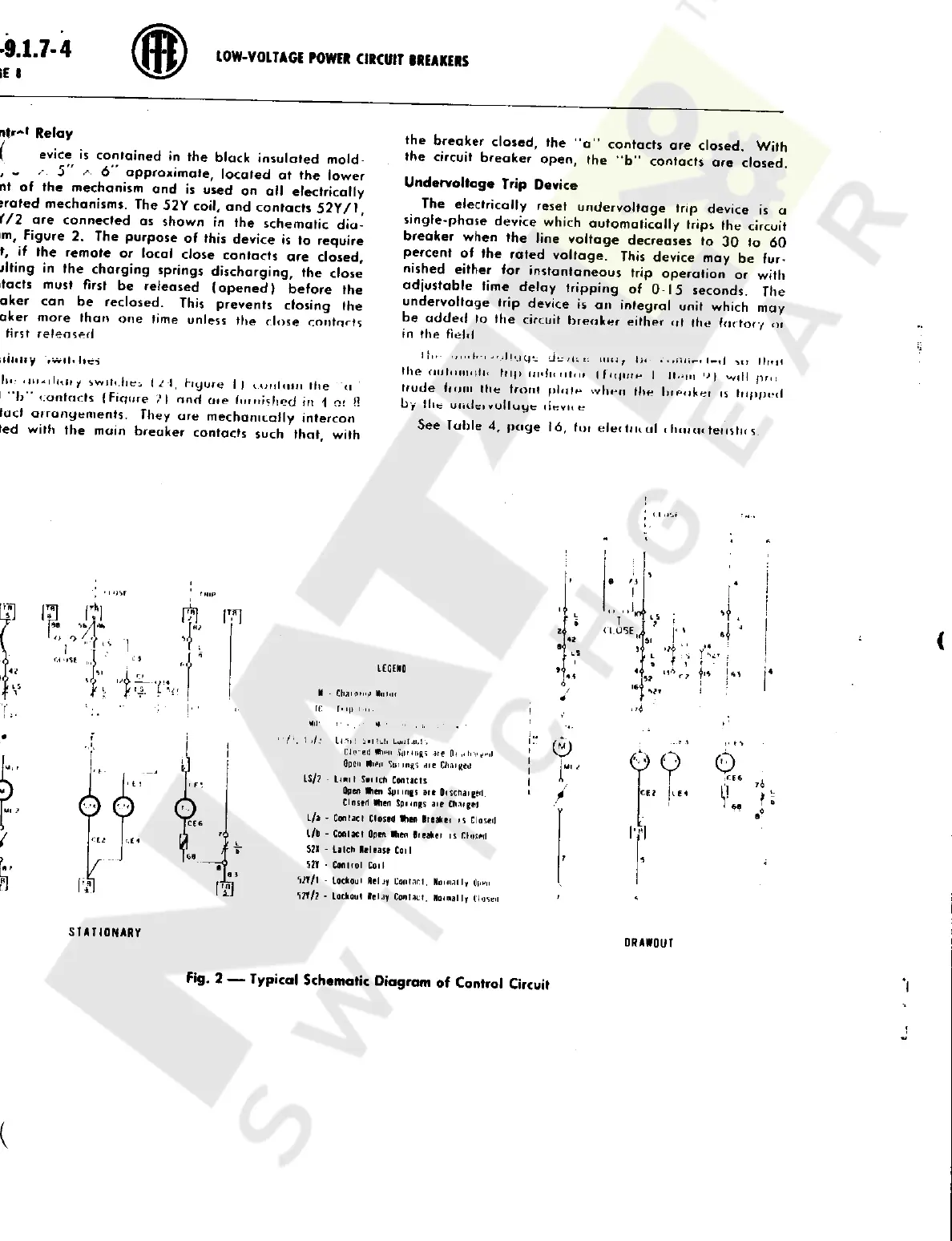
52
Y
coil
,
and
contacts
52
Y
/
1
,
i
/
2
are
connected
as
shown
in
the
schematic
diu
-
m
.
Figure
2
.
The
purpose
of
this
device
is
to
require
t
,
if
the
remote
or
local
close
contacts
are
dosed
,
ilting
in
the
charging
springs
discharging
,
the
close
tacts
must
First
be
released
(
opened
)
before
the
aker
can
be
reclosed
.
This
prevents
closing
the
aker
more
than
one
time
unless
the
close
contacts
first
released
5
"
/
la
"
dl Ug t
:
dir
/
U
:
:
HI U
,
l
>
4
*
.
I
*
11
-
ju
11
(
Ml
I
tie
(
lutninotif
trip
indhnlcu
Ifujian
I
than
'
>
}
will
pr
frude
f
#
cjin
Itie
trout
plate
when
the
breaker
is
tupped
by
the
UIKICI
volluytr
devH
e
See
Table
4
,
page
16
,
for
ele
<
tmul
c
hcncn
tenstir
s
.
I
hr
,
a
,
-
i
1
jinny
'
Wit
«
lies
hi
:
miAilun
/
switches
I
l
i
,
f
igure
if
tunlotn
the
<
i
1
"
b
contacts
(
Figure
*
\
and
cue
furnished
in
\
ot
I
?
tact
arrangements
.
They
are
mechanically
intercon
ted
with
the
main
breaker
contacts
such
that
,
with
11
(
.
1
H
'
ai
t
.
H
I
:
>
y
a
M
i
4
I
,
>
I
<
)
Sf
HUP
i
'
1
l
«
TLS
:
«
'
»
-
05
Ek
"
41
i
I
i
a
m
t
?
i
p
*
1
o
r
>
nh
I
*
3
H
i
7
1
4
0
(
I
1
2
<
S
*
>
t
/
i
i
S
L
4
}
/
.
.
'
I
,
W
'
*
*
4
?
r
?
4
'
l
J
LS
i
4
L
I
HJ
f
t
<
}
i
4
{
M
C
5
i
*
UGENO
»
?
41
12
'
(
c
>
SO
ISO
*
)
\
y
'
±
i
!
4
/
IS
M
-
Giaip
'
xp
Hniiit
t
(
'
f
*
HJ
i
n
4
1
i
i
i
:
M
-
Mil
*
4
»
t
.
i
«
.
.
.
f
.
A
<
t
7
l
.
\
>
t
:
f
11
;
*
t
l
?
!
_
li
Luil
141.1
>
CJo
-
eil
«
h
*
»
n
.
Silting
?
0
>
.
<
h
Open
Mien
Springs
Hie
Cii
.
ngei
)
LS
/
7
-
Liati
I
Seiich
Contacts
Open
Mien
Spnngs
are
Oischaiged
.
Closed
When
Spitngs
aie
Cti
.
i
#
geil
L
/
a
-
Contact
Closed
Mien
lieaket
is
Closed
l
/
b
-
Contact
Open
Mien
Breaker
is
Rinsed
o
9
o
.
J
,
Ml
3
i
I
CE
6
Mi
i
J
I
Cl
*
IL
E
4
*
"
T
t
>
t
J
r
FT
L
M
I
GO
I
o
Ml
3
L
CE
6
'
H
r
<
t
<
:
E
i
t
.
H
52
X
-
Latch
Release
Coil
S
2
Y
-
Control
Coil
ri
/
Y
/
l
lockoui
Reljy
Canton
,
Noimoily
Oiini
5
?
Y
/
2
-
lockout
Belay
Contour
,
Noinally
Closeii
r
4
<
r
4
f
I
®
B
r
S T ATI O N A R Y
ORAWOUT
*
1
Fig
.
2
Typical
Schematic
Diagram
of
Control
Circuit
»
»
Courtesy of NationalSwitchgear.com

Related product manuals