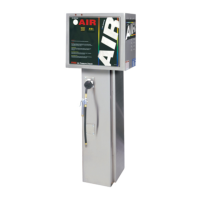
The J.E. Adams 8670 Series Manual describes a commercial air and air/water machine designed for public use, typically found at service stations or other commercial establishments. These units provide pressurized air for inflating tires and, in some models, water for various uses. The manual covers product information, specifications, safety instructions, installation, timer setup, maintenance, parts breakdown, schematics, and basic troubleshooting.
Function Description
The primary function of the 8670 Series machine is to provide pressurized air, and for certain models, water, to users for a fee. The machine is coin-operated, allowing users to insert coins to activate a timer that controls the duration of air or water availability. The internal compressor generates the pressurized air, which is then delivered through a hose and tire inflator with a gauge. Models that include water functionality also incorporate a solenoid to control water flow, delivered through a separate spout. The design emphasizes commercial use, with robust construction and features suitable for high-traffic environments.
The machine operates on a timed basis, meaning that once activated by coins, it provides air or water for a predetermined period. This period can be adjusted by the owner through internal timer settings. The unit is designed to be self-contained, housing the compressor, coin acceptor, timer, and dispensing components within a durable cabinet.
Usage Features
The 8670 Series machines are designed for straightforward public use.
- Coin-Operated Activation: Users insert coins into the coin acceptor to initiate the service. The amount of time provided is directly proportional to the number of coins inserted, based on the configured timer settings.
- Air Dispensing: For air-only or air/water models, a hose with a tire inflator and gauge is provided. Users can attach this to their vehicle tires to inflate them to the desired pressure. The integrated gauge allows for real-time pressure monitoring during inflation.
- Water Dispensing (Air/Water Models): Models equipped with water functionality include a separate water spout. Once activated, water flows from this spout for the duration of the timed cycle, suitable for tasks like washing hands or filling small containers.
- Accumulating Timers: Some SSAC timers (AE and AN models) are "accumulating," meaning that if additional coins are inserted during an active cycle, the timing can be extended proportionately, allowing users to add more time without restarting the service.
- Adjustable Timer Settings: The owner can configure the "time per coin" and "coins to start" settings. This flexibility allows operators to customize the service duration and cost to suit their business model and local market conditions. The timer can be set for precise durations, ranging from seconds to several minutes, depending on the timer type (SSAC or Infitec).
- Durable Components: The machines are built with commercial-grade components, including robust compressors, coin acceptors, and hoses, designed to withstand frequent public use and varying environmental conditions.
Maintenance Features
Regular maintenance is crucial for the longevity and optimal performance of the 8670 Series machines. The manual outlines several key maintenance tasks:
- Air Nozzle Inspection: Regularly check the air nozzle for signs of wear and abuse. Damaged nozzles should be replaced promptly to ensure effective and safe operation.
- Cabinet Cleaning: The stainless steel cabinet should be cleaned as needed using a non-abrasive cleaner. This helps maintain the unit's appearance and prevents corrosion.
- Air Hose Examination: Inspect the air hose for any cuts or signs of wear. A damaged hose can lead to air leaks and reduced performance, necessitating replacement.
- Compressor Filter Cleaning: Monthly, the filter from the compressor should be removed and cleaned. This prevents debris from entering the compressor, ensuring efficient operation and extending the life of the unit.
- Troubleshooting Guide: The manual includes a troubleshooting section to assist in diagnosing common issues, such as the machine starting but producing no pressure. This guide helps identify problems related to system leaks, clogged chucks, unloader malfunctions, or damaged internal parts, often indicating when a repair kit might be needed.
- Safety During Servicing: A prominent warning emphasizes disconnecting power before performing any servicing to prevent electric shock or injury. This highlights the importance of safety protocols during maintenance.
- Parts Breakdown and Schematics: Detailed parts breakdowns and electrical schematics are provided, which are invaluable for identifying specific components for replacement and understanding the internal wiring for repair and maintenance purposes. This allows for precise ordering of parts and aids technicians in troubleshooting electrical issues.


 To Next Page
 General