Maintenance manual for sunray hfc4da1-2c china-IV diesel engines
65
Section VIII Turbocharger and Inter-Cooler System
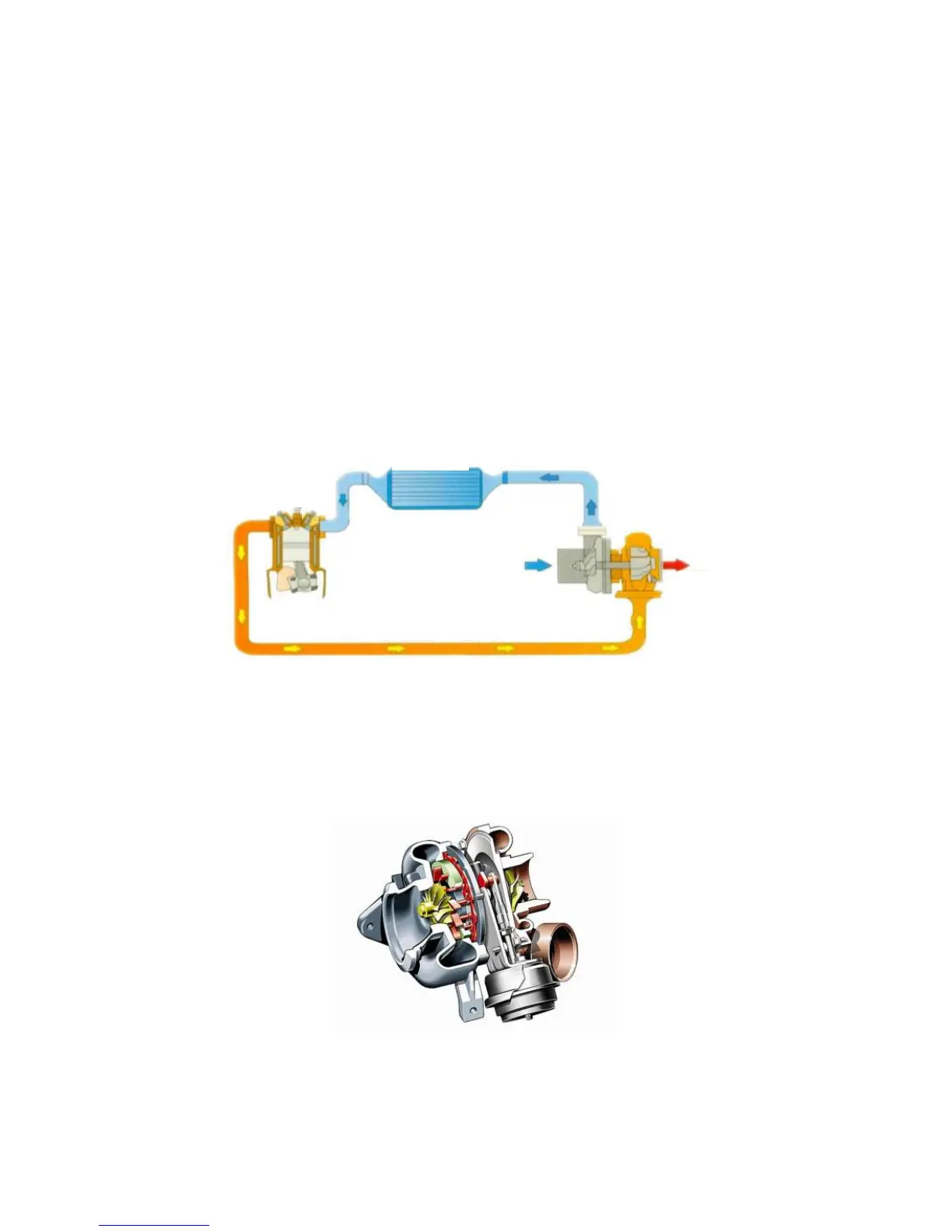
The turbocharger technology utilizes the motion energy of engine exhaust gas to drive the rotation of turbine. At the
same time, the coaxial air compressor compresses the air and provides more air to the cylinder so that more fuel can
combust to generate higher power, promote the engine torque, and reduce the fuel consumption.
The common turbocharger is of bypass valve turbocharger, which can’t provide sufficient pressure while the engine is
running at low speed and thus restrains the torque output at low speed and influences the engine performance. To
change this situation, the 1.9CTI engine adopts variable nozzle turbocharger (VNT) control system to promote the
turbocharger pressure at low speed of engine and at the same time adopts inter-cooler system to exert higher torque at
low speed of engine and promote the engine performance.
Theory of inter-cooler: The temperature of the air compressed at high speed may reach 100~120ºC. The high
temperature air will impair the intake efficiency of the engine and lead to power drop of the engine. Therefore, it’s
necessary to cool down the air to approximate 60ºC. The inter-cooler is located in front of the radiator or at windward
position easily arranged, in order to reduce the temperature of air entering into the cylinder, further improve the
combustion of diesel engine, and promote the performance and emission of the diesel engine.
Variable nozzle turbocharger (VNT): The VNT is functioned similar to one turbine housing in which the size is
varying steplessly. The VNT actuator can accurately control the nozzle area within the entire working condition range
so that the engine can not only maintain the turbine efficiency at high speed, but also increase the turbine efficiency at
low speed, promote the torques at low speed, maximum torque output, and nominal working condition, improve the
cold start performance and low speed performance of turbocharged diesel engine, realize high specific power and low
speed torque of the engine simultaneously, and greatly reduce the smoke intensity and improve the economy.
Meanwhile, the VNT can reduce the turbine lag, improve the engine response, and enhance the braking capability and
safety.
Adjustment theory for variable nozzle turbocharger (VNT): There are two passages, one is in constant section and one
is in variable section. If the pressure is same for two passages, the speed of airflow passing through the variable
Engine
Inter-cooler
Compressed air
Intake
Exhaust gas of engine
Exhaust
Turbochar


 To Next Page
 Loading...