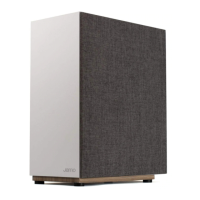
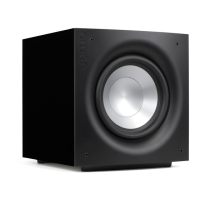
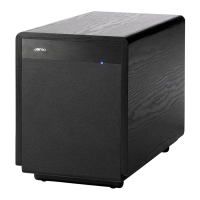
This document is a user manual for the Jamo Studio8 Series S 810 SUB and S 808 SUB powered subwoofers. It provides essential information for inspection, care, placement, connections, and controls of these devices.
Function Description:
The Jamo Studio8 Series subwoofers are designed to enhance audio systems by reproducing deep bass frequencies, adding impact to both movies and music. These are "powered" subwoofers, meaning they have a built-in amplifier that drives the speaker, eliminating the need for an external amplifier for the subwoofer itself. They are intended to be integrated into a home audio setup, typically connected to a surround sound receiver or pre-amplifier. The subwoofers work by taking a low-frequency effects (LFE) signal or a full-range signal from the main audio system and amplifying it to drive their internal speaker, producing the low-end sound that main speakers often cannot reproduce effectively. The controls on the subwoofer allow users to fine-tune its performance to blend seamlessly with the main speakers and suit the acoustics of the listening room.
Usage Features:
The manual outlines several key usage features and controls:
- "LINE IN" Connection: This is the primary input for connecting the subwoofer to a surround receiver or pre-amplifier. Most modern receivers have a dedicated "Subwoofer Pre Out," "Sub Out," or "SW Out" for this purpose. Connecting to this input allows the subwoofer to receive the low-frequency signal for both music and surround sound movie playback.
- Level Control (Volume/Gain): This control adjusts the output volume of the subwoofer. When integrating with a surround receiver, it's recommended to first set the receiver's subwoofer volume to a neutral position (e.g., "half way" or "0 dB") and then adjust the subwoofer's own level control until its output matches that of the main speakers. After this initial setup, the main system's volume control will manage the overall volume of both the subwoofer and the main speakers.
- "LOWPASS" Control (Crossover Point): This knob determines the frequency at which low bass frequencies are "handed off" from the main speakers to the subwoofer. If the receiver handles the crossover, the subwoofer's Lowpass Filter should be set to its highest point (160Hz) to bypass it. Otherwise, the crossover point should be set based on the size of the main left/right speakers:
- For larger, floorstanding speakers, a setting between 50Hz-90Hz is generally recommended.
- For smaller bookshelf or "satellite" speakers, a higher setting between 90Hz-150Hz is suggested.
The goal is to find a setting where the bass frequencies blend smoothly between the speakers and the subwoofer.
- "PHASE" 0/180 Control: This control helps acoustically match the subwoofer's output with the main speakers. Users can toggle between 0° and 180° to find the position that yields the most bass output at the listening position, optimizing the integration of the subwoofer's sound waves with those of the main speakers.
- "POWER" AUTO/ON/OFF Switch: This switch manages the subwoofer's power state:
- "AUTO" Position: In this mode, the subwoofer automatically turns on when it detects an audio signal and enters a "standby mode" after 15-20 minutes of no signal, conserving power.
- "ON" Position: The subwoofer remains continuously on.
- "OFF" Position: The subwoofer is manually turned off and will not operate until switched back to "ON" or "AUTO."
- Power LED Indicator: Located on the front baffle, this LED provides visual feedback on the amplifier's operating status. A green light indicates that the amplifier is on and receiving a signal. If the LED is dark, the amplifier is off.
- Placement Recommendations: For optimal performance, the manual suggests placing the subwoofer in a corner of the room on the same wall as the front channel speakers. Corner placement generally increases bass output. Placing it along the middle of a wall or out in the room will decrease bass output. Experimentation with different placements and control settings is encouraged to find the best sound for a particular room. It's crucial to remember that the subwoofer's built-in amplifier requires connection to an AC power outlet.
- Rubber Feet: The subwoofers are equipped with rubber feet, which likely serve to isolate the subwoofer from the floor, reducing unwanted vibrations and improving sound clarity.
Maintenance Features:
The manual provides simple guidelines for maintaining the subwoofer:
- Inspection: Upon receiving the product, users should promptly inspect it for any transit damage and verify all components against the packing list. Any damage should be reported to the delivery service and dealer, and the original shipping carton should be retained for potential returns or inspections.
- Care and Cleaning: The subwoofer features a durable vinyl finish. For cleaning, only dry dusting or wiping with a dry cloth is recommended. A brush attachment on a vacuum cleaner can be used to remove dust from the enclosure. Users are advised to avoid abrasive or solvent-based cleaners and harsh detergents, as these could damage the finish.
- Safety Precaution: Before making any connections to the subwoofer, it is crucial to ensure that the subwoofer is unplugged from the AC wall outlet to prevent electrical hazards.

 Need help?
 General

 To Next Page