35
value in well planted aquariums and ponds towards the end of the light period (towards evening in garden ponds).
In aquariums and ponds with few plants or with no plants at all, or in marine aquariums, the oxygen level should
always be maintained at the appropriate equilibrium level using technical equipment.
Help for low levels
Aquarium:
Since plants cannot produce oxygen at night, but instead breathe normally, the oxygen content gradually
decreases at night until the lighting is switched on the next morning. However, there is no danger to the sh as
far more oxygen is produced during the day than is used at night. Shortly before the lighting is switched on, the
oxygen content should not normally have dropped below 4 mg/l. If it is below this level, this indicates that there
are either too few plants in the aquarium, the plants are not being correctly looked after or that the aquarium is
over-stocked with sh.
Possible remedies: add more plants; improve the care of the existing plants, e.g. by installing a CO
2
supply (JBL
PROFLORA CO
2
set); in the case of overstocking with sh, gentle aerating at night e.g. with an air pump of the
JBL ProSilent a range (regulated by a time switch) will help.
In aquariums without plants, the situation can also be improved by increasing water movement at the surface
and/or installing an aerator (JBL Pro Silent a range). In marine aquariums, increasing water movement also
helps, by using ow pumps (JBL ProFlow) and tting a skimmer.
Garden pond:
An oxygen deciency may especially arise in ponds in the warm season. A strong water movement helps here.
Use strong pumps (pond lters), e.g. in conjunction with a waterfall or a watercourse. Aeration kits for ponds
also can remedy the situation. Adding oxygenating aquatic plants, such as waterweed and hornwort, helps
increase the oxygen level naturally.
Instructions:
1. Swill out the test jar several times with the water you wish to test.
2. Fill the test jar to the brim with this water by submerging it in the water. Place it on a water-resistant surface.
3. Add 6 drops O
2
reagent 1 drop by drop and slowly add 6 drops O
2
reagent 2. The test jar will overow.
4. Close the test jar using the enclosed lid, ensuring there are no air bubbles, and shake vigorously for about
30 seconds.
5. Remove test jar lid and add 6 drops O
2
reagent 3.
6. Close test jar again (trapped bubbles are no longer an issue) and shake vigorously for about 30 seconds.
7. Allow to stand for 10 minutes for the colour development.
8. Move the test jar backwards and forwards over the white section of the colour scale at distances of approx.
3 – 5 cm. Select the colour which matches most closely.
9. Read off the oxygen content on the colour chart.
Our tip for the environmentally-friendly user:
All reagents for JBL test sets are available from your retailer as reasonably-priced rell packs!
The instructions are repeated in a series of simple diagrams on the reverse of the colour chart.
Risks and safety precautions:
O
2
reagent 1:
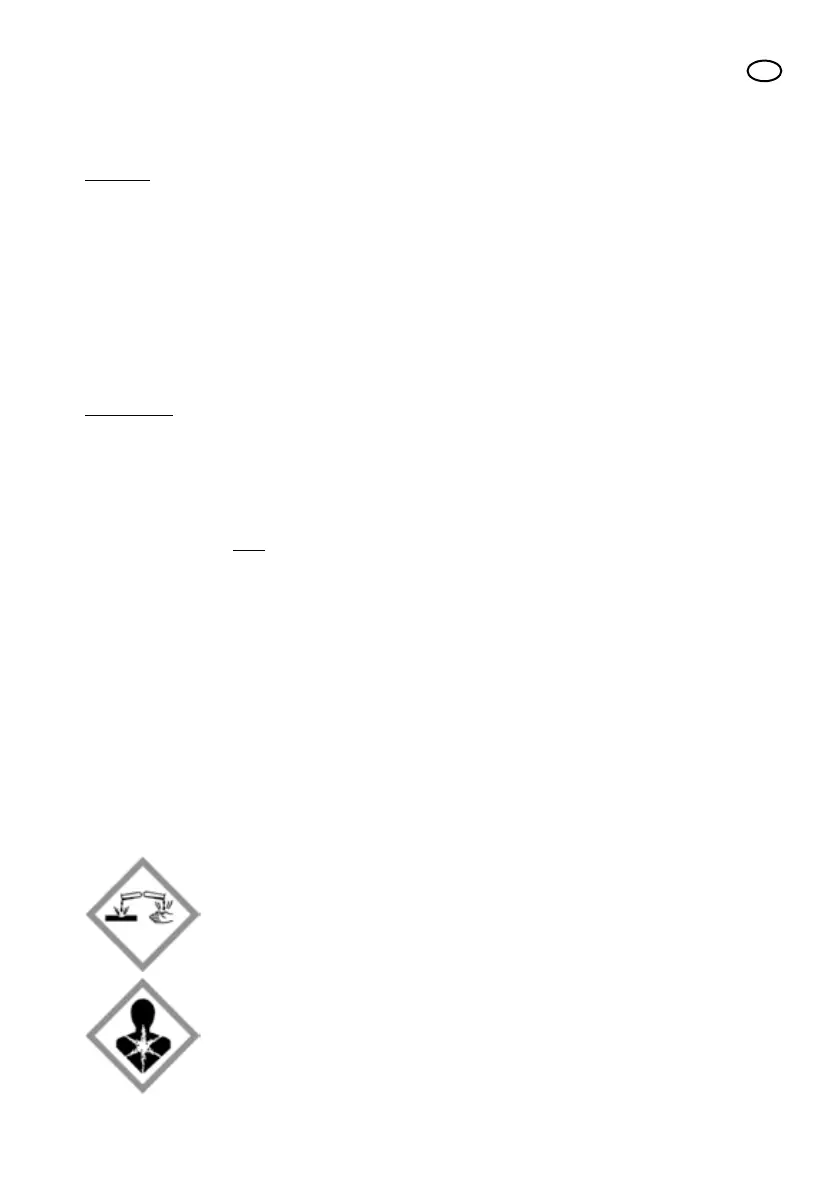
Danger
H318 Causes serious eye damage. H373 May cause damage to organs through prolonged
or repeated exposure. H412 Harmful to aquatic life with long lasting effects.
P101 If medical advice is needed, have product container or label at hand. P102 Keep out
of reach of children. P305+P351+P338 IF IN EYES: Rinse cautiously with water for several
minutes. Remove contact lenses, if present and easy to do. Continue rinsing. P501 Dispose
of contents/container in accordance with local regulations.
Hazard-determining component of labelling: Manganese(II) chloride
GB


 To Next Page
 Loading...