36
GB
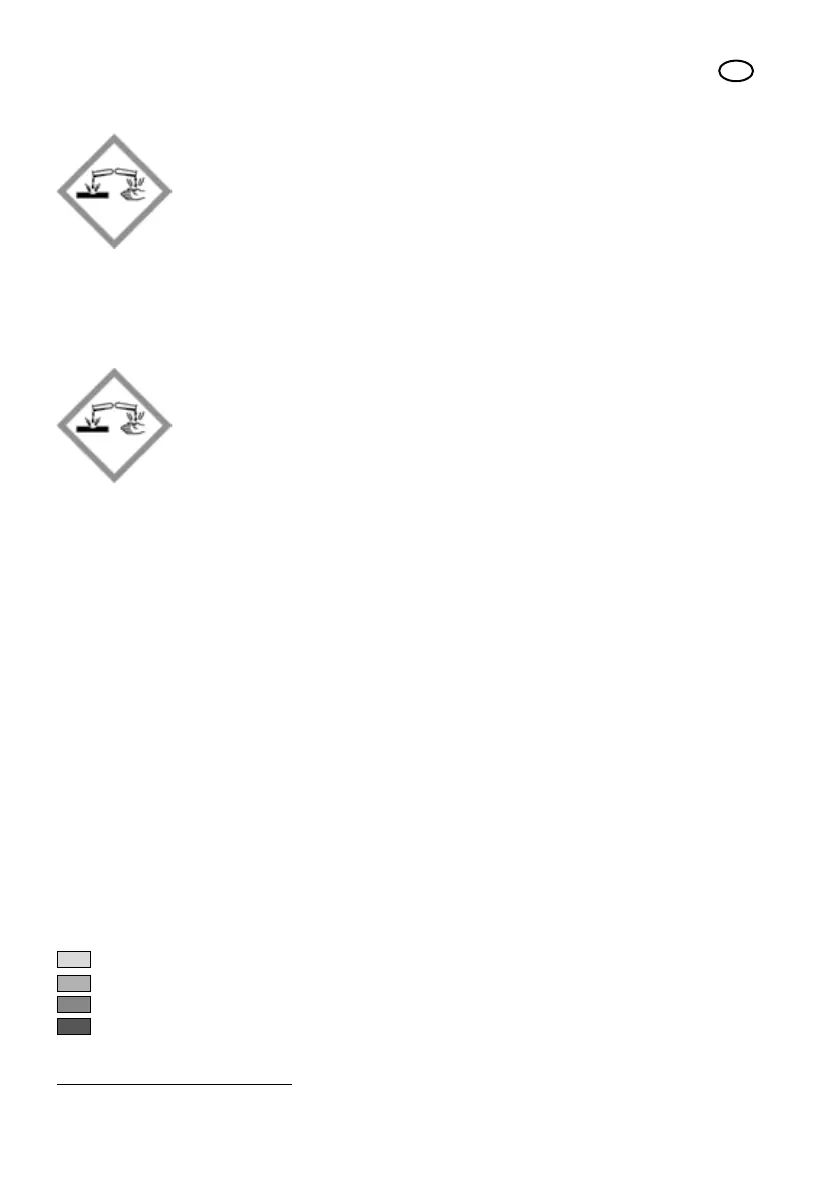
Risks and safety precautions:
O
2
reagent 2:
Danger
H314 Causes severe skin burns and eye damage.
P101 If medical advice is needed, have product container or label at hand. P102 Keep out
of reach of children. P303 + P361 + P353 IF ON SKIN (or hair): Take off immediately all
contaminated clothing. Rinse skin with water [or shower]. P305+P351+P338 IF IN EYES:
Rinse cautiously with water for several minutes. Remove contact lenses, if present and
easy to do. Continue rinsing. P501 Dispose of contents/container in accordance with local
regulations.
Hazard-determining component of labelling: sodium hydroxide.
Risks and safety precautions:
O
2
reagent 3:
Danger
H314 Causes severe skin burns and eye damage.
P101 If medical advice is needed, have product container or label at hand. P102 Keep out
of reach of children. P303 + P361 + P353 IF ON SKIN (or hair): Take off immediately all
contaminated clothing. Rinse skin with water [or shower]. P305+P351+P338 IF IN EYES:
Rinse cautiously with water for several minutes. Remove contact lenses, if present and
easy to do. Continue rinsing. P501 Dispose of contents/container in accordance with local
regulations.
Hazard-determining component of labelling: sodium hydroxide.
Ammonium / Ammonia Test Set (NH
4
+
/ NH
3
)
Special features:
The JBL ammonium test set is for the measurement and routine control of the ammonium/ammonia content in
freshwater and saltwater as well as in garden ponds (koi ponds) within a range of 0.1 to 5.0 mg/l (ppm). Using
the compensation method specially developed by JBL, precise and reliable results can be obtained even in
moderately discoloured water, e.g. as a result of peat lters and disease treatment.
Why test?
The following applies to freshwater and saltwater as well as to garden ponds (koi ponds):
The process involved in the breakdown or the mineralization of organic matter in the aquarium and pond (feed
and plant debris, sh excrement) follows the following stages: proteins - ammonium - nitrite - nitrate. Certain
bacteria are responsible for this process. Measuring the intermediate stages ammonium, nitrite and nitrate
allows certain conclusions to be made about the “function” of the system “aquarium” or the system “pond”.
Normally, ammonium and nitrite should not be allowed to enrich concentrations of above 0.2 mg/l (ppm). If they
do, the bacterial balance may be disturbed. Many of the medications used to treat sh diseases can damage
benecial cleansing bacteria, leading to an increase in ammonium levels. As a rule, ammonium is not found in
measurable amounts in a well-maintained aquarium with an efcient biological lter or in a correctly planted
garden pond. Ammonium is an important plant nutrient and is normally non-toxic to sh. But, depending on
the pH value, the ammonium ion (NH
4
+
) may convert into ammonia (NH
3
) which is toxic to sh. This is why any
ammonia measurement should always be accompanied by pH measurements. The following table shows the
toxicity as factor of the pH value (at 25°C):
May be harmful to sensitive sh and small fry.
May be harmful to adult sh, very harmful to young fry.
Very harmful to adult sh, lethal for small fry.
Absolutely lethal for all species of sh.
Remedy:
Short-term measure (aquarium only) :
Change about 50 % of the water. Do not allow the pH level of the freshwater to exceed the pH level of the
aquarium.


 To Next Page
 Loading...