
 Need help?
Do you have a question about the Jeanneau SUN ODYSSEY 36I and is the answer not in the manual?
Detailed technical specifications for the boat, including dimensions and capacities.
Fields to record personal boat information such as name, owner, and serial numbers.
Explanation of CE design categories (A, B, C, D) related to sea conditions.
Details the location of the liferaft and notes regarding the number of liferafts required.
Provides warnings and recommendations for essential safety equipment and general boat safety.
Covers gas valve operation and detailed safety instructions for the boat's gas system.
Specifies extinguisher locations and provides instructions for responding to a fire.
Details the operation and maintenance of both electric and manual bilge pumps.
Explains the operation, location, and limitations of the emergency tiller.
Describes the boat's hull construction material (GRP) and structural components.
Provides guidelines for washing, cleaning agents, and precautions for hull maintenance.
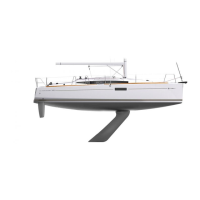
Illustrates the boat's profile with key measurements and mentions the wetted area.
Provides detailed steps, warnings, and dangers for repairing gel coat surfaces.
Emphasizes wearing life jackets and harnesses in heavy weather and securing doors.
Provides advice on using mooring lines, fenders, and post-mooring care.
Details procedures for towing other boats and for being towed, including stability notes.
Explains anchoring rules, precautions, and windlass operation warnings.
Covers cleaning and maintenance of deck fittings, wood, plexiglas, cushions, and stainless steel.
Details the steering gear components, access, and maintenance requirements.
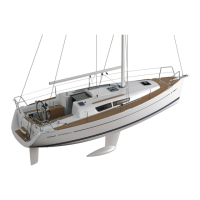
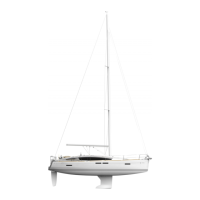
Illustrates standing rigging components and provides mast installation/uninstallation instructions.
Details running rigging for mainsail, furling mainsail, genoa, and spinnakers.
Offers recommendations for winch maintenance and warnings regarding improper refitting.
Provides instructions for fitting and hoisting the mainsail onto the deck.
Provides instructions for hoisting and furling the genoa, including maintenance.
Explains how to spread, hank, and use the lazy-bag for mainsail storage.
Provides instructions for setting and adjusting an optional furling mainsail.
Covers sail maintenance, cleaning, storage, folding, and protection against UV.
Offers advice on maintaining interior upholstery, blinds, bilges, and varnish.
Provides guidance on stain removal and maintenance for various fabric types.
Covers precautions for filling water tanks and recommendations for tank sterilization and cleaning.
Offers precautions for operating the fresh water system.
Provides recommendations for the safe use of the gas system.
Explains water drainage and bilge pump system, with maintenance and warnings.
Details marine head, washbasin, shower use, and environmental considerations for waste disposal.
Details the battery switch panel and its components for managing the boat's electrical supply.
Explains the 12V DC system, battery types, charging methods, and maintenance precautions.
Provides guidance on operating the electrical system and precautions for electrical work.
Explains how to connect the mast harness after stepping the mast.
Details the 230V system, shore power socket connection, and grounding.
Provides advice on installing electronic instruments, keeping them away from radio loudspeakers.
Covers fuel tank filling precautions, maintenance, and capacity notes.
Explains the role of the fuel filters, water decanter, and prefilter, and their maintenance.
Emphasizes the importance of not obstructing the fuel valve, especially in case of fire.
Provides recommendations and precautions for operating the engine and accessing it.
Explains the essential role of the water inlet valve for engine operation and its maintenance.
Discusses factors that can obstruct visibility from the helm and COLREG regulations.
Describes the instrument panel functions and the need to check clutch/accelerator cables.
Details the stuffing box location, lubrication intervals, and advice for air removal.
Provides advice on propeller replacement, anode checks for corrosion, and cutlass bearing.
Lists precautions to take before launching the boat, including checking fittings and valves.
Refers to chapter 5 for instructions on stepping the mast.
Details hoisting procedures, safety warnings, and checks required after launching the boat.
Provides a checklist for preparing the boat for storage, including taking ashore equipment and checking dates.
Details interior and exterior maintenance tasks for winter storage, including draining pipes and greasing parts.
Outlines key tasks for engine winterization, differentiating between afloat and ashore procedures.
 General
| Fuel Capacity | 130 L |
|---|---|
| Engine | Yanmar 29 HP |
| Berths | 6 |
| Cabins | 2 |
| Builder | Jeanneau |
| Designer | Marc Lombard |
| Length Overall | 10.94 m |
| Beam | 3.59 m |
| Draft | 1.94 m |
| Water Capacity | 355 L |
| Ballast | 1, 790 kg / 3, 946 lbs (Standard) / 1, 950 kg / 4, 299 lbs (Shoal) |


 To Next Page