
 Need help?
Do you have a question about the Jebao WP-40 and is the answer not in the manual?
Highlights key attributes like high flow rate, multi-mode controller, low-voltage DC pump, and wide voltage input.
Lists all items included in the wave maker package, such as the pump, controller, and accessories.
Provides critical warnings for product operation, including keeping the controller dry and voiding warranty if opened.
Advises on optimal wavemaker positioning for best wave reflection and avoiding sand disturbance or air suction.
Details the steps for attaching the pump using magnets and suction cups to the aquarium glass.
Explains how to connect the pump, controller, light sensor, and power adapter.
Describes three constant flow settings: High (13,000 LPH), Medium (9,750 LPH), and Low (6,500 LPH).
Details how to adjust pulse duration and speed (S1, S2, S3) for variable wave patterns.
Explains the mode that gradually increases and decreases flow in steps for varied patterns.
Introduces a random flow cycle mimicking natural reef currents by varying speed and duration.
Explains how to activate a 10-minute pump pause for feeding, indicated by a light.
Describes how to lock the control knob to prevent accidental changes and how to unlock it.
Details automatic pump speed reduction at night via a light sensor, and how to disable it.
Provides instructions for cleaning the wave maker and disassembling/reassembling the pump.
Advises against disposing of the product as unsorted municipal waste, recommending special treatment.
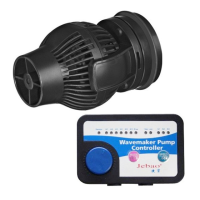
This document describes the Jebao WP-40 and WP-25 Wave Makers, devices designed to simulate natural waves and whirlpools in marine environments. These wave makers are intended for indoor use in water only, and it is crucial to ensure the pump is always submerged to prevent motor damage. The controller, however, is not waterproof and should be positioned to avoid water splashes.
The wave makers are equipped with a unique multi-mode controller, allowing users to adjust the device to suit their specific aquarium requirements. The pump itself is a low-voltage, low-power DC variable-speed unit, which minimizes heat transfer to the aquarium and maximizes user safety. The pump housing is adjustable, enabling easy alteration of the flow direction. The device also features a wide voltage input (AC100 ~ 240V 50/60Hz), making it versatile for various aquarium setups. It is suitable for aquariums with glass up to 15mm thickness.
Installation involves placing the wavemaker in the desired location within the aquarium. The magnet should be removed from the pump for installation. The rubber suction cup cylinder is placed on the inside wall, and the rear magnet plate (with attached rubber damper) is positioned on the outer wall of the aquarium. Care must be taken when positioning the strong magnets to avoid trapping fingers. The controller can be affixed to a suitable location using the provided double-sided adhesive paper. Before connecting the mains cable, the 3-pin waterproof connector from the pump should be attached to the controller. If desired, a light sensor can be gently inserted into the small socket on the left of the controller. Finally, the AC/DC power adapter is connected to the controller, and the mains power cord can be connected.
The controller offers nine operational modes, which can be cycled through by pressing the "MODE" key. These modes include:
Additional features include:
Maintenance is crucial for effective performance. Users should regularly clean the outer parts of the wave maker. A dry cloth should be used to prevent water from entering the controller box. To disassemble the wave maker for cleaning, disconnect power, remove the pump from its cradle, and while holding the rear section of the pump, turn the front grid clockwise. Reassembly involves reversing these steps, ensuring the ceramic shaft is correctly located into the bearing and turning the front grid clockwise until a click is heard, indicating correct assembly.
It is important to note that if the controller or AC/DC adapter are opened, the warranty will be voided. This product should not be disposed of as unsorted municipal waste; separate collection for special treatment is necessary.
 General
| Power Consumption | 40 W |
|---|---|
| Voltage | 220-240 V |
| Weight | 1.5 kg |
| Pump Type | Submersible |
| Controller | Yes |
| Modes | Wave |
| Suitable Tank Size | Up to 1000 L |
| Cable Length | 1.5 m |

 To Next Page