This document describes the Jikel Saturn Stroller, a child restraint system designed in France, compliant with EN 1888 standards and suitable for children from birth (0+). The manual emphasizes the importance of retaining the instructions for future reference and careful reading.
Function Description
The Jikel Saturn Stroller is a versatile child restraint system designed to adapt to different age and weight groups, ensuring safety and comfort for children in vehicles. It supports various installation methods, including ISOFIX and 3-point safety belts, catering to different car seat configurations. The stroller features a rotation function for easy placement of the child and side protection for enhanced safety.
Important Technical Specifications
The Jikel Saturn Stroller is approved to Regulation No.44, 04 series of amendments, indicating its compliance with European safety standards for child restraint systems.
-
Group 0+I (0-18kg) Semi-Universal ISOFIX + Top Tether + Harness:
- Installation: Rearward facing placement.
- Car Compatibility: Applicable to all vehicles with ISOFIX anchorages.
- Front Seat: Outer position - No.
- Rear Seat: Outer position - Yes, Center position - ?.
- Important Notes:
- Only suitable for use in listed vehicles fitted with ISOFIX anchorages systems and approved to ECE Regulation No. 14.
- Installation for Group 0+I is rearward facing and applies to children from 0 to 18kg.
- This car seat for Group 0+I has one sitting posture (level 1).
- Cannot be installed in positions equipped with airbags.
- Forward facing installation is not permitted if the child's weight is lighter than 9kg.
- Cannot be used laterally while driving.
- Children less than 9kg require 0+ group and 1 group cushion.
- Children between 9-12kg require 1 group cushion without 0+ group cushion.
- Children larger than 12kg do not require 0+ group cushion and 1 group cushion.
-
Group I (9-18kg) Semi-Universal ISOFIX + Top Tether + Harness:
- Installation: Forward facing placement.
- Car Compatibility: Applicable to all vehicles with ISOFIX anchorages.
- Front Seat: Outer position - No.
- Rear Seat: Outer position - Yes, Center position - ?.
- Important Notes:
- Only suitable for use in listed vehicles fitted with ISOFIX anchorages systems and approved to ECE Regulation No. 14.
- Installation for Group I is forward facing and applies to children from 9 to 18kg.
- This car seat for Group I has four sitting postures (levels 2/3/4/5).
- Cannot be used laterally while driving.
- Forward facing is not permitted before the child's weight exceeds 9kg.
- Children less than 9kg require 0+ group and 1 group cushion.
- Children between 9-12kg require 1 group cushion without 0+ group cushion.
- Children larger than 12kg do not require 0+ group cushion and 1 group cushion.
-
Group II+III (15-36kg) Semi-Universal ISOFIT + 3-Point Belt:
- Installation: Forward facing placement.
- Car Compatibility: Applicable to all vehicles with ISOFIX anchorages and 3-point safety belts.
- Front Seat: Outer position - No.
- Rear Seat: Outer position - Yes, Center position - ?.
- Important Notes:
- Only suitable for use in listed vehicles fitted with 3-point/with retractor safety-belts, approved to ECE Regulation No. 16.
- The vehicle must be equipped with ISOFIX anchorages.
- Do not use forward facing before the child's weight exceeds 9kg.
- There is only one position level for Group II+III (level 2).
- Installation for Group II+III is forward facing and applies to children from 15 to 36kg.
- Before using Group II+III, remove the 5-point safety belt and cushion.
- Pull the belt in the buckle tightly to make sure buckle in the right position.
- Universal Installation is only suitable use in the listed vehicles fitted with 3-point belt and approved to ECE Regulation No. 16.
- Semi-Universal Installation is only suitable use in the listed vehicles fitted with ISOFIX anchorages systems and approved to ECE Regulation No. 16.
-
Group II+III (15-36kg) Universal 3-Point Belt:
- Installation: Forward facing placement.
- Car Compatibility: Applicable to all vehicles with 3-point safety belts.
- Front Seat: Outer position - Yes, Center position - Yes.
- Rear Seat: Outer position - Yes, Center position - Yes.
- Important Notes:
- Only suitable for use in listed vehicles fitted with 3-point/with retractor safety-belts, approved to ECE Regulation No. 16.
Usage Features
- Rotation Function: The car seat can be rotated using a thumb-pulled Rotation Control Handle. This allows for easy adjustment between forward and rearward facing positions. An "OK" indicator appears when the rotation is complete and locked. Important: The car seat cannot be used laterally or rotated while driving; it must be fixed in either the forward or rearward facing position.
- Side Protection: The stroller features side protection that can be opened or closed. Pressing a button opens the protection (indicated by green), and pressing it again closes it (indicated by red). It is suggested to open the side protection on the side near the car door.
- ISOFIX Installation:
- Group 0+I (Rearward Facing):
- Rotate the car seat to rearward facing and pull the Seat Position Adjustment Handle to level 1.
- Release ISOFIX connectors by pulling the ISOFIX setting key; connectors will pop up automatically.
- Insert ISOFIX connectors firmly into the car seat's fixed points until a "clicking" noise is heard and the ISOFIX indication window turns green.
- Push the car seat base to fix it firmly while pulling the ISOFIX Setting Handle.
- Group I (Forward Facing):
- Rotate the car seat to forward facing and pull the Seat Position Adjustment Handle to the suitable level.
- Release ISOFIX connectors by pulling the ISOFIX setting key; connectors will pop up automatically.
- Before ISOFIX installation, pick up the top tether from the rear cover and pull out some strap, then temporarily place them in the headrest.
- Insert ISOFIX connectors firmly into the car seat's fixed points until a "clicking" noise is heard and the ISOFIX indication window turns green.
- Push the car seat base to fix it firmly while pulling the ISOFIX Setting Handle.
- Group II+III (ISOFIT + 3-Point Belt):
- Rotate the car seat to forward facing and pull the Seat Position Adjustment Handle to level 2.
- Release ISOFIX connectors by pulling the ISOFIX setting key; connectors will pop up automatically.
- Open the Side Protection on the side near the door.
- Insert ISOFIT connectors firmly into the car seat's fixed points until a "clicking" noise is heard and the ISOFIT indication window turns green.
- Push the car seat base to fix it firmly while pulling the ISOFIT Setting Handle.
- Top Tether Installation (Group 0+I and Group I):
- Pass the top tether through the guiding slot for rearward facing (for Group 0+I) or through the middle of the car seat headrest (for Group I).
- Open the Side Protection on the side not installing the top tether.
- Hook the top tether anchorage behind the car seat (refer to the vehicle's user manual).
- Tighten the top tether until the Top Tether Adjuster shows green. Shake the car seat to ensure the tether is tightened correctly.
- Harness Installation (Group 0+I and Group I):
- Press the central adjuster and pull out the harness strap to release the shoulder belt.
- Press the red button to open the harness buckle.
- Pull out both shoulder belts to both sides of the seat.
- Place the child in the seat, ensuring the lap belt restricts the pelvis. Shoulder belts should be slightly higher than the child's shoulders.
- Guide the two buckle latches together and engage them into the harness buckle with a "click" sound. Pull the buckle latches to check for secure locking.
- Pull the harness adjustment strap outward to fix the child, ensuring a snug but comfortable fit (an adult palm should fit between the harness strap and the child's chest).
- Adjust the headrest to the appropriate height for the child.
- 5-Point Harness Removal:
- Loosen the top tether strap and rotate the car seat to 90 degrees.
- Loosen the central adjuster and shoulder belt, then adjust the headrest to a suitable position.
- Tighten the top tether and place it in the headrest temporarily, then open the rear cover.
- Separate the shoulder pads and shoulder belts from the strap yoke. Pass the strap yoke through the hole in the rear cover, then into the storage slot and draw out the belt forward.
- Open the harness buckle and put the buckle pad and cushion aside.
- Separate the harness buckle and car seat.
- Roll up the strap and place it into the groove in the base for shoulder strap storage.
- Put the top tether into the rear cover and close it. Store all removed parts.
Maintenance Features
- Regular Checks: Regularly check all important parts for damage. Ensure mechanical components are in perfect working order. Replace the safety seat if it has been subjected to violent stresses in an accident.
- Storage: Store the child safety seat in a safe, dry place when not in use for extended periods.
- Cleaning:
- Brush away loose debris from the safety belt and plastic components using a soft-bristled brush. Ventilate or dry them.
- If food or beverage drips on the seat belt, thoroughly rinse it with warm water, then ventilate or dry.
- Remove and wash the cover according to the instructions.
- Washing Instructions:
- Hand wash using water under 30°C.
- Do not bleach.
- Do not machine dry.
- Do not iron.
- Note: The cover might fade slightly during the first wash, which is normal.
- General Warnings:
- Ensure steel and plastic components are fixed according to the manual to prevent them from being stuck by car seats or doors.
- All straps holding the restraint to the vehicle and restraining the child must be tight and untwisted.
- The lap strap must be worn low down to firmly engage the pelvis.
- Do not make alterations or additions to the chair without Type Approval Authority approval.
- Keep the chair away from direct sunlight to prevent overheating.
- Never leave your child unattended in the child restraint system.
- Secure any luggage or objects that could cause injury in a collision.
- Do not use the child restraint without its cover.
- Replace the seat cover only with one recommended by the manufacturer, as it is integral to the restraint's performance.
- Retain instructions for the life of the child restraint.
- Do not use load-bearing contact points other than those described and marked in the instructions.
- Ensure rigid and plastic parts are located and installed so they are not trapped by movable seats or car doors during everyday use.
- Use the correct Group of children's seats with appropriate application methods as per the manual to avoid potential injuries.
- Do not position the child safety seat where an airbag is being deployed.
- If there is interference between the adult safety-belt buckle and the main load-bearing contact points, do not use the restraint and contact the manufacturer.
- Rearward facing installation is not possible in positions equipped with airbags.

 Need help?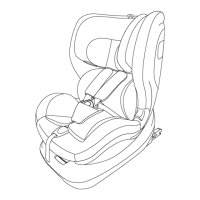

 To Next Page
 General