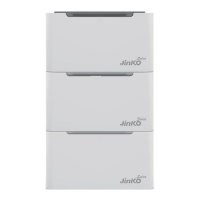
The JKS-B51100-GI is a low-voltage battery energy storage system based on lithium iron phosphate (LFP) battery technology, developed and produced by Jinko Solar Co., Ltd. It is designed to provide reliable power supply for various devices and systems, particularly suitable for home power supply systems with limited installation space, load bearing, and a long cycle life.
Function Description:
The JKS-B51100-GI system is a comprehensive energy storage solution with a rated design capacity of 5.12 kWh. It incorporates an internal Battery Management System (BMS) that actively protects the battery, manages charge and discharge states, and balances the current and voltage of each cell. The system features automatic addressing and quick plug-in terminals for convenient installation and plug-and-play functionality. It is designed with an IP65 waterproof rating, making it suitable for both indoor and outdoor (under eaves, not directly exposed to sun or heavy rain) installations.
The BMS provides several protective and monitoring functions, including:
- Protection Failure Detection: Identifies and signals potential issues within the system.
- Secondary Protection Functions: Offers an additional layer of safety.
- Cell and Overall Voltage Detection: Monitors the voltage levels of individual cells and the entire pack.
- Overcharge and Over-discharge Alarm and Protection: Prevents damage from excessive charging or discharging.
- SOC Estimation Function: Provides an estimate of the battery's State of Charge.
- Automatic Charging and Discharging Calibration Function: Ensures accurate and efficient battery operation.
- Heating Function: Automatically controlled by the battery to maintain optimal operating temperatures.
Important Technical Specifications:
- Model Type: JKS-B51100-GI
- Battery Type: LFP (LiFePO4)
- Rated Energy: 5.12 kWh
- Available Energy: 4.60 kWh
- Battery Capacity: 100 Ah
- Rated Voltage: 51.20 V
- Operating Voltage Range: 44.8 V ~ 58.4 V
- Maximum Depth of Discharge: 90%
- Maximum Short Circuit Current (fuse): 200 A
- Rated Charge and Discharge Current: 95 A/95 A
- Maximum Charge and Discharge Current: 95 A/95 A
- Rated DC Power: 5 kW
- Operating Temperature: -30 ~ 60 °C (Optimum: 18°C ~ 30°C)
- Storage Temperature: -10 ~ 45 °C
- Humidity: 0~90%
- Weight: 58 kg ± 0.5 kg
- Dimensions (width × height × depth): 660 mm × 410 mm × 210 mm
- Thickness of Housing: 5 mm
- Enclosure Rating: IP65
- Warranty Period: 10 years @ 25°C
- Internal Resistance: ≤ 20 mΩ
- Cycle Life: ≥ 5000
- Recommended Max. Parallel Number: 4
- Own Power Consumption: < 5 W
- Data Communication: CAN/RS485
- Balance Current: 30~50 mA
- Monitoring Parameters: System voltage, current, battery voltage, battery temperature, PCBA measurement.
- Compensate: Line Loss Compensation
- Installation Method: Floor/Wall Mount
- Certification Standards: IEC62619, IEC63056, IEC62477, IEC60730, IEC 61000, UN38.3
Usage Features:
- Non-toxic, Non-polluting, Environmentally Friendly: Utilizes LiFePO4 for safety and environmental benefits.
- Inner Fireproof Function: Enhances safety in operation.
- Automatic Addressing and Quick Plug-in Terminals: Simplifies installation and setup.
- External Interfaces: Includes Battery + (positive upward/downward parallel port), Indicator Light (Run, alarm & SOC), Communication port 1 & 2 (8 pin 8 cell RJ45), Battery - (negative upward/downward parallel port), SOC button, GND (downward/upward ground terminal), Pressure relief valve, and a power button (Switch).
- Indicator Light Description: An integrated LED system provides clear status indications for RUN, ALM (alarm), and SOC (State of Charge), covering normal operation, standby, charging, discharging, temperature protection, and invalid states. Pushing the SOC button displays the current SOC via an LED strip.
- Sleep and Wake Up Function:
- Wake Up: The system exits low power consumption mode and enters normal operation when a charger is connected (output voltage > 48 V), the power switch button is operated, or communication is established with upper computer software (note: this method cannot wake up from over-discharge protection sleep).
- Hibernate: The system enters low power consumption mode under conditions such as unreleased over-discharge protection within 3 minutes, minimum cell voltage below sleep voltage for a defined duration (without communication or current), standby time exceeding 1 hour (configurable, without communication, charge/discharge, or charger access), or forced shutdown via software. It's crucial that input terminals are disconnected from external voltage or communication before entering sleep mode.
- Installation: Can be floor-mounted or wall-mounted. Requires proper tools like a percussion drill, socket wrench, cross screwdriver, rubber hammer, maker pen, and horizontal ruler. Safety gear such as insulated gloves, blinkers, and work shoes are recommended during installation.
- Parallel Connection: Supports parallel connection of up to 4 units. When stacking multiple packs, communication cables are connected between packs, and an end matching resistor is inserted into the communication interface of the last pack.
Maintenance Features:
- Troubleshooting Worksheet: Provides guidance for common issues like power button not responding, short discharge time, battery overload, charge/discharge failure, communication exceptions, no response light after power on, battery not fully charged, battery overvoltage, battery under-voltage, pack temperature sensor failure, and high pack temperature. Solutions range from contacting the supplier/manufacturer to checking load status, charging the battery, or adjusting ambient temperature.
- Professional Maintenance: Maintenance of the battery should only be performed by professional authorized personnel. The battery system must be shut down before performing maintenance.
- Voltage Check: Regular checks of the battery system voltage and individual cell voltages via the host computer to ensure they are within the rated range.
- Battery Check (SOC): Regular checks of the battery system's SOC via the host computer to ensure it is normal.
- Consistency Check: If the battery system is not fully charged for a long time, it can become unbalanced. A balance maintenance (full charge) is recommended every 3 months.
- Storage Recommendations:
- Store in a dry, clean, well-ventilated environment at -10~45 °C and 5%~85% humidity.
- Charge to 50~55% SOC before long-term storage.
- Activate the battery system (charge and discharge) every 3 months. The longest storage time without charge and discharge should not exceed 6 months.
- Store correctly according to box identification, not upside down or sideways.
- Meet stacking requirements on the outer packaging when stacking battery boxes.
- Handle gently to avoid damage.
- Failure to follow storage instructions can significantly reduce the battery's cycling life.
- Shipment: Battery modules are pre-charged to 50% SOC before shipment or as per customer request. They meet the UN 38.3 certification standard and comply with ADR (European Convention on the International Carriage of Dangerous Goods by Road) regulations.


 To Next Page
 General