Jinma Tractor Introductory User Guide July 2007 Page 6
A. Drive Controls
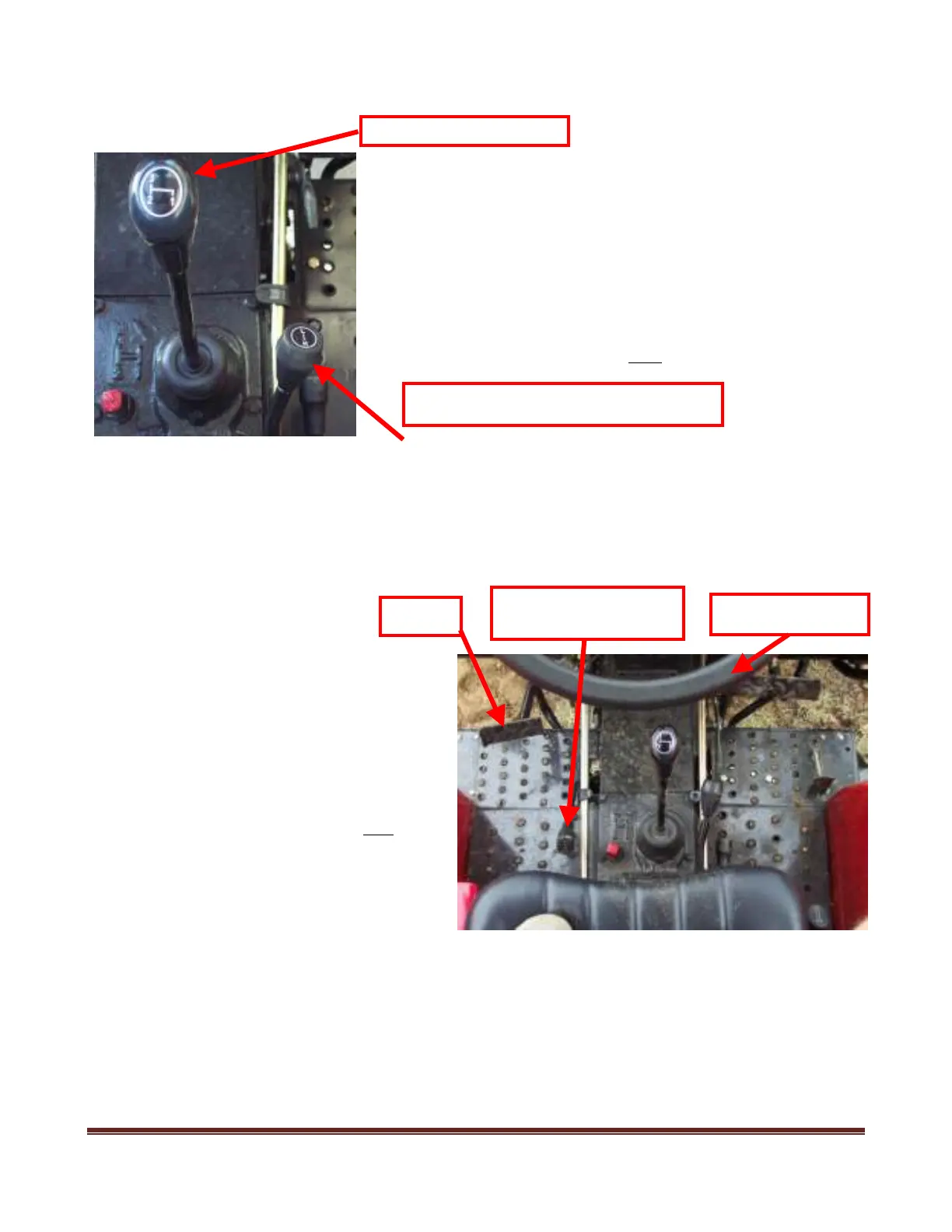
1) Auxiliary Gear Shift Lever: This controls the auxiliary speed
gear which changes the gear ranges of the Main Gears (see #2 below).
It is located very near and to the right of the Main Gear Shift. Like
some 4-wheel drive trucks, the auxiliary speed gear can be set to either
L (low - Lo) or H (high - Hi). The L range is such that L (low) and 3
rd
speed (on the Main Gear Shift) is a lower gear than H (high) and 1
st
speed (L1 < L2 < L3 < H1 < H2 < H3). Generally if you are moving
the tractor around you should be in the High gear range. When you are
working with the tractor under strain, you may be using the Low range
to work more efficiently. The clutch must
be depressed to change from
H to L or from L to H.
2) Main Gear Shift Lever: This is the primary control of the forward and reverse speeds of the tractor. It
has 3 forward speeds and one reverse speed. The Auxillary Gear Shift lever works to change the range of the
gears so that you effectively have 6 forward and 2 reverse gears. Remember to use the clutch to shift all gears.
3) Gear Shifting Pattern: On the top of the Main Gear Shift lever is the “H” pattern to reach each gear of
the Main Gear Shift. The tractor is in neutral when the gear shift lever is in the middle of the “H” pattern. The
“H” pattern may also be on a plate on the floor on some models.
4) Front Wheel Drive Axle Control Lever (4-
Wheel Drive Shift): This lever engages the front
axle to enable/disable 4-wheel drive. Move the
lever forward (up) to engage the front axle and
operate in 4-wheel drive. Move the lever
backward (down) to disengage the front axle and
have 2-wheel drive (the rear wheels are always
engaged). Use 2-wheel drive when moving the
tractor to different locations (especially on
pavement) and use 4-wheel drive only
when
working or when stuck and more traction is
needed. Generally, do not use 4-wheel drive unless
you need it.
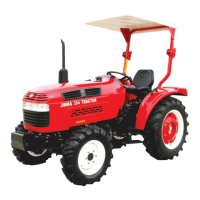
5) Steering Wheel: The steering wheel
controls the direction of the front wheels and thereby the direction the tractor will travel in both forward and
reverse gears.
6) Clutch Pedal: When you depress the Clutch Pedal, the clutch is disengaged and you can shift gears.
Depressing the Clutch Pedal is necessary whenever you shift the Main Gears, the Shuttle Shift, the Auxiliary
Gears (H-L), and the Creeper Gear. Also the Clutch must be depressed when making PTO changes.
Auxillary (High/Low) Gear Shift Lever
Clutch
Steering Wheel



 To Next Page