EasyManua.ls Logo

Jstvro Malahit Dsp - User Manual

Jstvro Malahit Dsp
8 pages
Print Icon
To Next Page IconTo Next Page
Loading...
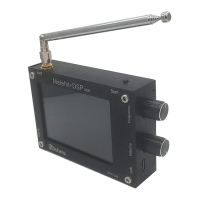
Malahit Dsp radio
--MDR2000
--50Khz~2GHz
Registered version, based on version v1.0c
Image 01
1.Stdby: Short press to turn on or off the screen, long press to enter sleep mode.
2. Usb: Type-c usb interface, charging port.
3.Audio: headphone jack
4.Frequency: Frequency encoder, scroll up and down to adjust the frequency size, short press to
enter the step value edit page. Short press to launch each menu editing page.
5.Volume: Volume encoder, scroll up and down to adjust the volume value, short press to edit
other parameters. Short press to launch each menu editing page.
6.Ant: Antenna interface
7. Menu lists: The menu items are HARD, AUDIO, VISUAL, NR, MODE, BAND. See below for
detailed description.
8.Vol: Volume value, range 0~100. It is recommended to set above 50.
9.Frequency value: Frequency value, range 50KHz~250MHz,
10.Step value: Frequency step value, the range is 1KHz~1MHz.
11.Audio indicator: Audio indicator, one to indicate earphones and one to indicate back speakers.
Green means active, gray means inactive.
12.Battery indicator: battery indicator, green represents sufficient power. Red means low battery.
When the battery is low, please charge it in time.
13.Time: Time, long press the HARD menu for 3 seconds, release it after hearing the beep, and
enter the time editing page. Use the volume encoder to adjust the time, and finally press and
hold the volume editor to confirm the modification.
Question and Answer IconNeed help?

Do you have a question about the Jstvro Malahit Dsp and is the answer not in the manual?

Summary

Malahit DSP Radio General Controls and Indicators

Standby Operation

Short press to turn screen on/off; long press for sleep mode.

USB and Charging Port

Type-C USB interface for charging.

Audio Output

Features a headphone jack for audio output.

Frequency Encoder

Adjusts frequency size and enters step value edit.

Volume Encoder

Adjusts volume and edits other parameters.

Antenna Interface

Connection point for the antenna.

Volume and Frequency Indicators

Displays current volume and frequency values.

Audio and Battery Indicators

Shows audio status and battery charge level.

Time Setting

Accessed via HARD menu for time configuration.

HARD Menu Settings

Encoder 1 (Volume) Reverse

Reverses volume encoder adjustment direction.

Encoder 2 (Frequency) Reverse

Reverses frequency encoder adjustment direction.

Time Setting Configuration

Enters time editing page via HARD menu long press.

AUDIO Menu Settings

Audio Filter Options

Configures audio filter: narrow (8kHz), normal (12kHz), wide (15kHz).

VISUAL Menu Settings

LCD Screen Sleep Function

Enables screen turn-off after a set time to save power.

LCD Sleep Timer

Sets the duration before the screen turns off when LCD SLEEP is enabled.

NR (Noise Reduction) Menu

NR Function Enable;Disable

Toggles the Noise Reduction function; gray is off, red is on.

MODE Menu Settings

Supported Radio Modes

Device supports USB, LSB, AM, NFM, and WFM modes.

CW Decoder Function

Activates or deactivates the CW encoding function.

BAND Menu Navigation

Band Menu Pages and Options

Navigates through 5 pages with 50 total band options.

Advanced Operations

Quick Frequency Setting

Enters frequency value and selects unit on a dedicated page.

Waterfall Spectrogram Range

Allows modification of the spectrogram range by clicking the waterfall.

Device Registration

Device is pre-registered; serial number adjustment available if needed.

System Reset

Resets system to factory settings while retaining registration info.

Overview

The Malahit-DSP SDR (MDR2000) is a registered version of a radio receiver, operating within a wide frequency range. This device is designed for ease of use with a clear interface and multiple functionalities for radio enthusiasts.

Function Description

The device features a main display that shows various operational parameters. At the top, you'll find the Malahit-DSP SDR logo, indicating the device type. The display includes a signal strength indicator, represented by a bar graph and numerical values (S1-S9, +20, +40 SNR), which helps in assessing the quality of the received signal. The current operating mode (e.g., WFM, NFM) is also displayed, along with the active frequency value. A battery indicator shows the power status, turning green for sufficient power and red for low battery, prompting timely charging. The current time is also visible on the main screen.

The device is equipped with an antenna interface for signal reception and a Type-C USB interface, which serves as a charging port. A headphone jack is available for private listening.

The main interface includes several menu lists: HARD, AUDIO, VISUAL, NR, MODE, and BAND, each offering specific settings and adjustments.

HARD Menu: This menu allows for fundamental hardware adjustments.

  • En1 reverse: Reverses the adjustment direction of the volume encoder. By default, turning the encoder downwards increases the volume. Enabling this setting reverses the action.
  • En2 reverse: Reverses the adjustment direction of the frequency encoder. Similar to the volume encoder, enabling this reverses the default direction for increasing frequency.
  • Time Setting: This feature allows users to set the device's internal clock. A long press on the HARD menu for 3 seconds, followed by a beep and release, enters the time editing page. The volume encoder is used to adjust the time, and a short press modifies the position. A final long press on the volume encoder confirms the changes.

AUDIO Menu: This menu focuses on audio processing and filtering.

  • Filter: This setting controls the audio filter, offering three options: "narrow" (8000Hz), "normal" (12000Hz), and "wide" (15000Hz), allowing users to tailor the audio output to their preference or signal conditions.

VISUAL Menu: This menu manages display settings and power-saving features.

  • LCD SLEEP: When enabled, this feature automatically turns off the screen after a specified "SLEEP TIME" to conserve battery power.
  • SLEEP TIME: This setting defines the duration after which the screen will turn off if "LCD SLEEP" is enabled.

NR Menu: This menu controls the noise reduction function.

  • NR: A short press on the NR menu enables or disables the noise reduction function. The NR indicator changes from gray (forbidden/disabled) to red (enabled) to show its status.

MODE Menu: This menu allows users to select different operating modes.

  • The MDR2000 supports various modes including USB, LSB, AM, NFM, and WFM, catering to different types of radio signals.
  • Decoder: This function allows users to activate or deactivate the CW (Continuous Wave) encoding function.

BAND Menu: This menu provides access to pre-defined frequency bands.

  • The BAND menu is organized into 5 pages, offering a total of 50 pre-set frequency options. Users can navigate through these pages using the frequency encoder.

Usage Features

The Malahit-DSP SDR is designed for intuitive operation through its encoders and menu system.

Encoders:

  • Frequency Encoder: This encoder is used to adjust the frequency value. Scrolling it up or down changes the frequency. A short press enters the step value edit page, allowing for precise frequency adjustments. It also serves to launch each menu editing page.
  • Volume Encoder: This encoder adjusts the volume level. Scrolling it up or down changes the volume value. A short press allows editing of other parameters and launches each menu editing page.

Quick Frequency Setting:

  • Users can quickly set a specific frequency by clicking on the frequency indicator on the main screen. This action opens a quick edit page where the desired frequency value can be entered, and the corresponding unit (MHz, kHz, Hz) can be selected.

Waterfall Display:

  • The device includes a waterfall display, which can be clicked to modify the spectrogram range, providing a visual representation of the signal spectrum over time.

Volume and Frequency Values:

  • Vol: The volume value ranges from 0 to 100, with a recommendation to set it above 50 for optimal listening.
  • Frequency Value: The device operates within a frequency range of 50KHz to 250MHz.
  • Step Value: The frequency step value, used for fine-tuning, ranges from 1KHz to 1MHz.

Indicators:

  • Audio Indicator: This indicator shows whether earphones or back speakers are active. Green signifies active, while gray indicates inactive.
  • Signal Strength: The signal strength is visually represented by the amplitude of a graph. A longer amplitude indicates a louder signal.

Maintenance Features

The device includes features for system management and restoration.

Registration:

  • All MDR2000 units are pre-registered at the factory, eliminating the need for users to enter a serial number again. If modification is necessary, the volume encoder can be used to adjust the value, a short press modifies the position, and a long press on the frequency encoder confirms the changes.

Reset:

  • To reset the system and restore factory settings (while retaining registration information), users can simultaneously press the volume and frequency encoders. This is useful for troubleshooting or reverting to default configurations.

Jstvro Malahit Dsp Specifications

General IconGeneral
Frequency Range50 kHz - 2 GHz
ChipMalahit DSP
Display3.5" TFT LCD
BatteryLithium-ion 3.7V
FirmwareMalahit DSP SDR firmware
ModeAM, SSB
Power SupplyUSB 5V
Weight300 g
TypeSoftware Defined Radio (SDR)