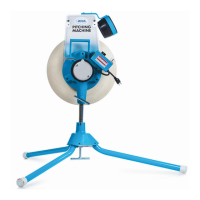
The JUGS Combination Pitching Machine (Part No. Z7100) is a versatile ball-throwing machine designed for baseball, softball, and tennis ball practice. It is engineered for quality, craftsmanship, and safety, incorporating three decades of research, development, and manufacturing experience. The machine aims to make practices more efficient and enjoyable, with a focus on ease of operation and maintenance.
Function Description:
The JUGS Combination Pitching Machine is capable of throwing various types of balls, including JUGS dimpled style, Lite-Flite®, Softie®, one-ounce polyball baseballs, high-quality leather baseballs (9-inch Wilson A1010 equal or better), softballs, and tennis balls. It can deliver straight fastballs, rising fastballs, sinking fastballs, and curveballs (right-handed and left-handed). The machine's design allows for adjustments to speed, curve, and trajectory, making it suitable for different skill levels and practice scenarios, including batting practice and fielding practice (ground balls, fly balls, and pop-ups).
Important Technical Specifications:
- Motor Specifications:
- Variable Speed
- Maximum Developed Horsepower: 1/4 hp
- Volts: 90vDC
- Amps: 3 amps
- Hertz: 50/60 Hz
- RPM (no load): 1900 rpm
- Overload Protection: Yes
- Tire Specifications:
- Size: 4.00/4.80-8
- Pressure: 16-17 lbs. (25 psi for tennis balls)
- Frame Specifications:
- Legs: Steel tubing
- Motor Mount and Leg Clamp Casting: Cast aluminum
- Ball Feed Chutes: Cast aluminum
- Overall Height (Baseball): 69 in.
- Overall Height (Softball): 50 in.
- Overall Width: 47 in.
- Overall Weight: 145 lbs.
- Recommended Generator: Yamaha® EF1000iS
- Recommended Balls: JUGS Balls or high-quality leather balls
Usage Features:
- Safety First: Operators must be at least 18 years of age and instructed in its use. The manual emphasizes reading and understanding all instructions, safety rules, and labels before operation. A pitcher's screen is mandatory to protect the operator and machine from batted balls. Safety glasses and batting helmets must be worn at all times by operators and batters. Hands and other body parts must be kept clear of moving tires and the ball feed chute.
- Setup and Conversion: The machine can be set up for baseball or softball use. Conversion involves adjusting leg positions and the distance between the tires, as well as attaching the appropriate ball-feed chute assembly. For baseball, the machine uses longer legs; for softball, shorter legs are used, and the wheels are spaced further apart.
- Electrical Connection: The machine operates on a standard 110-volt AC outlet and requires a 3-wire 16 AWG or larger grounding type extension cord. It must be connected to an appropriate GFCI outlet. The cord should be kept away from rotating tires.
- Pitching Adjustments:
- Speed Dials: Two speed dials control the rotation of the wheels. For straight fastballs, a minimum 35-digit differential between the speed dial settings of the two wheels must be maintained (e.g., 35 digits apart). To increase or decrease speed, both dials are adjusted by the same amount while maintaining the differential.
- Trajectory: The Handle Bar Lock Knob allows adjustment of the machine's tilt to achieve desired trajectory for different pitches (e.g., lower elevation for faster pitches, higher elevation for slower pitches).
- Curveballs: Curveballs are thrown by creating a speed differential between the wheels. For a right-hand curve, the right-hand speed dial is turned to full clockwise, and the left wheel turns slowly counter-clockwise. For overhand curves, the machine is tilted to a 65-degree angle with the faster turning wheel highest. The greater the speed differential, the greater the curve.
- Knuckleballs: Equal dial speeds or a dial-speed differential of less than 35 digits may result in knuckleballs, which are considered dangerous and should not be thrown.
- Ball Feeding: Balls should be held consistently (e.g., across the seams for leather balls) and placed gently into the feed chute, not dropped. The operator must ensure the batter is ready and the flight path is clear before feeding. Pitches should be spaced approximately 6 to 10 seconds apart to simulate live action.
- Fielding Practice:
- Ground Balls: Position wheels downward; a greater downward angle results in a bigger hop.
- Fly Balls and Pop-ups: Position wheels upward; a greater upward angle results in a steeper flyball or pop-up. For these, the ball chute lock knob should be loosened, and the ball chute removed to "push" the ball into the sleeve. A catcher's mask is required for the operator when throwing pop-ups.
- Experimentation: Operators are encouraged to experiment with different speed settings and wheel positions to find desired accuracy and consistency, using a wide backstop for faster speeds.
Maintenance Features:
- Tire Pressure: Maintain tire pressure at 16-17 psi for baseball/softball and 25 psi for tennis balls.
- Cleaning: Keep the machine clean and free of grit and dirt. Use a damp cloth for cleaning; avoid brake fluids, gasoline, petroleum-based products, or solvents.
- Tire Cleaning: Periodically clean the tires to maintain maximum performance. Dirty tires can be identified by a dark ring or a yellow, glossy surface. To clean, inflate tires to approximately 17 pounds, then scrub the surface with medium-grade sandpaper (or coarser if needed) until foreign substances are removed and the original white color is restored. Always sand tires with the power switch OFF and the machine unplugged.
- Tightness Checks: Regularly check the tightness of all bolts, nuts, lock knobs, and T-Clamps. Correct any looseness, vibration, or rattle immediately.
- Storage: Store the machine and extension cord in separate, clean, dry, secured areas. Cover the machine with a suitable dust cover that does not retain moisture; avoid plastic covers.
- Repairs: All repairs, whether electrical or mechanical, should be made by a qualified JUGS service technician using only JUGS replacement parts. It is recommended to return the machine to JUGS for repair.
- Water Exposure: If the machine becomes wet, turn it off immediately, transport it to a dry location, and air dry completely before next use to avoid shock hazards.

 Need help?
 General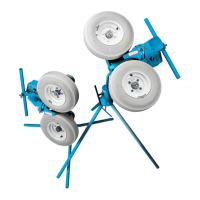

 To Next Page