Need help?
Do you have a question about the KaiDeng Wireless R3 Series and is the answer not in the manual?
Highlights the inverter's capability to optimize energy harvest by tracking the maximum power point.
Details the inverter's functionality regarding the direction of power flow.
Indicates the electrical isolation between input and output for enhanced safety.
Emphasizes the ease of use with a design requiring no installation or maintenance.
Describes the inverter's ability to adjust to varying grid voltage and frequency.
Notes the presence of an integrated meter for accurate measurements.
Refers to the availability of a system for monitoring via a mobile application.
Specifies the inverter's internal power conversion architecture.
Provides key electrical and performance parameters for the WVC-295 model.
Details the physical dimensions, weight, and environmental ratings.
Identifies the live, neutral, and ground wire connectors on the micro inverter.
Specifies the wire gauge and color coding for the connector terminals.
Explains the meaning of different LED states (on, flashing) for operational status.
Describes the typical sequence of LED indicators during startup and operation.
Diagram showing key parts like input, output, indicator, and antenna.
Lists essential accessories needed for installation, such as plugs and cables.
Outlines essential prerequisites and safety considerations before installing the inverter.
Step-by-step guide for physically mounting and connecting the micro inverter.
Specifies the maximum number of inverters per branch based on model.
Illustrates the triple-phase wiring connections for the micro inverter system.
Instructions for configuring the KDM monitoring system using a network distribution tool.
Details on connecting the collector to the network using the MxEasyLink tool.
Guide for setting up the MxEasyLink client on Android for network configuration.
Guide for setting up the MxEasyLink client on iOS for network configuration.
Steps for registering a new account on the KDM monitoring system.
Procedure for adding a new station, including filling in details and collector ID.
Instructions on how to add an inverter to a station within the monitoring system.
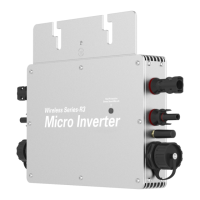
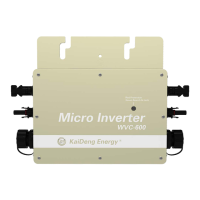
The WVC-295 Micro Inverter is a smart, grid-connected device designed for converting DC power from photovoltaic modules into AC power for use in homes or fed back into the grid. It is part of the Wireless Series-R3, emphasizing its wireless communication capabilities for monitoring and control.
The primary function of the WVC-295 is to convert direct current (DC) electricity generated by solar panels into alternating current (AC) electricity suitable for the utility grid. It incorporates Maximum Power Point Tracking (MPPT) technology to optimize power harvesting from the solar panels under varying conditions. The inverter supports reverse power transmission, allowing excess generated electricity to be fed back into the grid. It features an adaptive voltage/frequency system to ensure compatibility with grid conditions and includes an internal high-precision meter for accurate power measurement. An App monitoring system allows users to track performance and status remotely. The device utilizes a forward full-bridge topology for efficient power conversion.
Model: WVC-295 Maximum Input Power: 300 Watt Output Voltage Mode: 120/230V Auto switch PV Open Circuit Voltage: 30-60VDC Operating Voltage Range: 22-60V Starting Voltage Range: 22-60V Short-Circuit Current: 13.6A Maximum Working Current: 11.5A
The WVC-295 is designed for ease of installation and maintenance. It is a "no installation, no maintenance" device, implying a plug-and-play setup with minimal ongoing user intervention. The inverter is fully isolated (I/O), enhancing safety.
The installation process involves connecting the micro-inverter to the PV module and then to the AC bus cable. A specialized AC bus with a T-type connector is recommended for modular wiring systems, allowing multiple inverters to be connected in series. The device is designed for outdoor use with an IP67 NEMA3R waterproof rating.
The inverter communicates wirelessly via 433MHz/WiFi. A KDM (Kaden Energy Monitoring) system allows users to monitor the inverter's operational status and power generation data through a dedicated mobile application (Android and iOS). The monitoring system provides real-time data, historical trends, and fault alerts.
The micro-inverter features an LED indicator to display its operational status:
Upon connecting the micro-inverter to both AC and DC terminals and powering it on, the red light will be on for 3 seconds, then flash for 30 seconds. Following this, the green light will flash quickly during MPPT search, and finally, the green light will remain on once MPPT is locked.
The self-cooling design eliminates the need for active cooling components like fans, reducing potential points of failure and maintenance requirements. The IP67 NEMA3R rating ensures protection against dust and water, contributing to its durability and low maintenance profile in various environmental conditions. The remote monitoring system allows for proactive identification of issues, reducing the need for on-site inspections. The device is designed to be robust and reliable, adhering to various international standards for electromagnetic compatibility and grid interaction.

 To Next Page
 General