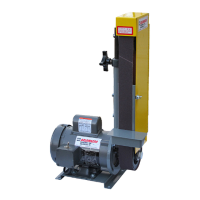
The Kalamazoo Industries 1SM Belt Sander is a robust and versatile abrasive finishing machine designed for a variety of material removal and surface preparation tasks. Manufactured in the USA, this industrial-grade belt sander is built for durability and performance in demanding workshop environments.
Function Description:
The primary function of the 1SM Belt Sander is to efficiently remove material, deburr, chamfer, and finish workpieces using an abrasive belt. It operates by rotating an abrasive belt over a platen and a series of pulleys, allowing the operator to bring a workpiece into contact with the moving abrasive surface. This process is effective for shaping, smoothing, and cleaning various materials, including metals, plastics, and composites. The design emphasizes ease of use and consistent performance for both light-duty and more intensive sanding applications.
Important Technical Specifications:
- Motor: The sander is equipped with a 1/3 HP, 1-phase motor, operating at 1725 RPM and 60 Hz. This motor, specified as a 48F frame (for 1SM 34C051-5506G14), provides sufficient power for continuous operation and effective material removal. The motor is warranted by the manufacturer for one year.
- Belt Tension System: The belt tension is pre-set by an internal spring (item 11, part number 697-020), eliminating the need for manual tension adjustments by the operator. This ensures consistent belt tension and optimal sanding performance.
- Belt Tracking: The machine features a tracking knob (item 22, part number 441-015) and a tracking collar (item 21, part number 123-015) that allow for precise adjustment of the abrasive belt's alignment. This mechanism ensures the belt runs true on the pulleys, preventing premature wear and improving sanding accuracy.
- Pulleys: Key components include an idler pulley (item 13, part number 560-018) and a drive pulley (item 18, part number 560-017), which facilitate the smooth and controlled movement of the abrasive belt.
- Platen: The 1SM Platen Weldment (item 7, part number 563-003) provides a flat, rigid surface against which the workpiece is pressed during sanding, ensuring consistent material removal and a flat finish.
- Work Table: An 1SM Work Table (item 10, part number 829-013) is included, offering a stable platform for supporting workpieces during the sanding process.
- Fasteners: The assembly utilizes various fasteners, including 1/4-20 x 3/4 HHCS GR5 Z (item 3), 1/4 USS F/W Z (item 4), 1/4 SPLIT L/W Z (item 5), 1/4-20 FHN GR5 Z (item 6), 1/4-20 x 1/2 HHCS GR5 Z (item 8), 3/8-16 x 2 HHCS GR5 Z (item 14), 3/8 USS F/W Z (item 15), and 3/8 SPLIT L/W Z (item 16). Set screws like 1/4-20 x 3/8 SOC SET KNURL PT. (item 19) and 1/4-20 x 1-1/2 SOC SET CUP PT. (item 20) are also used.
- Dimensions: The overall dimensions of the frame assembly (item 1, part number 291-007) are approximately 11.87 inches in width, 9.02 inches in depth, and 21.54 inches in height (vertical pulley center line). These compact dimensions make it suitable for various workshop layouts.
- Safety Guard: An 1SM, 1SK6 Guard for Idler Pulley (item 17, part number 342-087) is integrated to protect the operator from the moving belt and pulleys, enhancing operational safety.
Usage Features:
- Ease of Belt Change: To change the abrasive belt, the operator must first disconnect power. The process involves loosening the tracking knob (22), opening the belt guard (17), compressing the spring belt tension by pushing down on the tension shaft (12), and then removing and replacing the belt. This straightforward procedure minimizes downtime.
- Bidirectional Belt Compatibility: The sander supports both lap-spliced and butt-spliced abrasive belts. While lap-spliced belts require attention to correct rotation (counter-clockwise), butt-spliced belts are bi-directional, offering greater flexibility.
- Simple Belt Tracking: After changing a belt, tracking can be adjusted by hand-rotating the belt with power disconnected. The tracking knob (22) and tracking collar (21) are used to turn the tension shaft (12) left or right, centering the belt. Once tracked, the knob is re-locked.
- Safety First: The manual emphasizes critical safety precautions, including disconnecting power before adjustments, wearing safety glasses or a full face shield, keeping hands clear of the sanding area, avoiding loose clothing and gloves, tying back or covering hair, allowing the machine to stop completely before changing belts, and never altering safety guards.
- Ventilation and Dust Control: Operation in a well-ventilated area is crucial due to harmful dust generated during sanding. Dust masks are recommended to minimize inhalation.
- Spark Management: Sparks generated during sanding should be directed downward and away from the operator's face and body. Grinding near flammable materials is strictly prohibited.
- Electrical Safety: The machine is not intended for use in or near water, or by operators standing on wet floors or working around conductive liquids, to prevent electrical shock hazards.
Maintenance Features:
- Durable Construction: The sander features a robust frame assembly and industrial-grade components designed for longevity and minimal maintenance under normal use.
- Motor Warranty: The electric motor is covered by a one-year warranty from the motor manufacturer, with repairs handled by the nearest motor repair station. If non-repairable, Kalamazoo Industries will replace it.
- Inspection Protocol: Upon receipt, customers are advised to inspect goods for transit damage. Any damage must be noted on the freight bill, and a claim should be filed with the delivering transportation company. This protocol ensures proper handling of potential issues before the machine is put into service.
- Return Policy: A clear return policy is outlined, requiring authorization and an RGA number before returning merchandise. Returns are subject to a 10% restock charge, and used merchandise is non-returnable. This policy helps manage product returns efficiently.
- Regular Cleaning: While not explicitly detailed as a maintenance feature, the emphasis on dust control implies the need for regular cleaning to prevent dust buildup, which can affect performance and motor life.
- Component Replacement: The detailed parts list and assembly diagrams facilitate easy identification and replacement of individual components should they wear out or become damaged, ensuring the long-term serviceability of the sander.

 Need help?

 To Next Page
 General