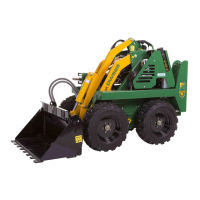
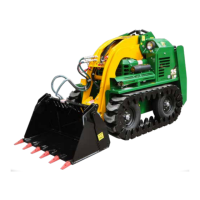
The Kanga Loader Series 216 is a versatile mini-loader designed for a wide range of applications, including civil, arbor, agricultural, landscaping, road maintenance, earthmoving, fencing, contracting, and irrigation. This operator's manual provides comprehensive information on its safe operation, maintenance, and attachment usage.
Function Description:
The Kanga Loader is a compact, stand-on mini-loader that utilizes hydraulic power to operate various attachments. Its primary function is to perform tasks requiring earthmoving, lifting, and material handling in confined or challenging spaces. The loader is controlled by spring-centered levers on the top face of the control area, allowing for push-pull actions to manage operating functions. It can be configured with either wheels or tracks, offering adaptability to different terrains and working conditions. The machine's design emphasizes operator safety with features like a standing platform for quick exit and safety decals highlighting potential hazards.
Important Technical Specifications:
The Series 216 Loader is available in two main configurations: DW825 (Wheels) and DT825 (Tracks).
- Tipping Load (No Bucket): 539 kg (1186 lb)
- Rated Operating Capacity (ROC) (No Bucket): 270 kg (593 lb) (ROC is 50% of Tipping Load for wheel loaders)
- Maximum Travel Speed (Default Mode): 7 km/hr (4.35 m/h)
- Fuel Capacity (Diesel): 43 L (11.4 US gal)
- Loader Mass (without bucket, operator, and full fluid capacity): 1095 kg (2414 lb)
- Engine: Kubota D902, Rated Power 17.5 KW (23.5 hp)
- Hydraulic System:
- Gear Pump Displacement: 11.3 cc/rev (0.69 cu in/rev)
- Pump Output: 40.6 L/min (10.73 US gal/min)
- System Pressure: 220 bar (3200 PSI)
- Hydraulic Reservoir Capacity: 92 L (24.3 US gal)
- Bucket Capacity (GP Bucket, heaped/struck): 0.12 m³/0.09 m³ (4.24 cu ft / 3.21 cu ft)
- Dimensions (with 4-in-1 1100 HD Bucket):
- Max Operating Height: 2634 mm (103.70")
- Overall Length: 2352 mm (92.60")
- Overall Track or Wheel Width: 1018 mm (40.08")
- Ground Clearance: 191 mm (7.52")
- Tipping Load (No Bucket): 552 kg (1214 lb)
- Rated Operating Capacity (ROC) (No Bucket): 248 kg (546 lb) (ROC is 45% of Tipping Load for track loaders)
- Maximum Travel Speed (Default Mode): 5.4 km/hr (3.4 m/h)
- Maximum Travel Speed (Fast Mode): 9.3 km/hr (5.8 m/h)
- Fuel Capacity (Diesel): 43 L (11.4 gal)
- Loader Mass (without bucket, operator, and full fluid capacity): 1056 kg (2328 lb)
- Engine: Kubota D902, Rated Power 17.5KW (23.5hp)
- Hydraulic System: Same as DW825.
- Bucket Capacity (GP Bucket, heaped/struck): 0.12 m³/0.09 m³ (4.24 cu ft / 3.21 cu ft)
- Dimensions (with 4-in-1 1100 HD Bucket):
- Max Operating Height: 2639 mm (103.90")
- Overall Length: 2353 mm (92.64")
- Overall Track or Wheel Width: 1123 mm (44.21")
- Ground Clearance: 196 mm (7.71")
Usage Features:
- Control Levers: Spring-centered levers for basic operating functions (AUX 1, 4-in-1 bucket, main lift arm, left drive, right drive, tilt, 2-speed drive, throttle).
- Maneuvering: Individual control of hydraulic motors on each side for precise movement. Slow, even movements of control levers are recommended for smooth operation.
- Turning: Achieved by differential power/direction on drive sides. Can turn by its own length.
- Slope Operation: Designed for slopes up to 20°. Operators are advised to travel up and down slopes with the heavy end uphill and the load close to the ground. Avoid traveling across slopes.
- Attachments: Kanga-designed and approved attachments are crucial for safe operation. The manual details operation for various attachments like 4-in-1 bucket, power head and auger, trencher, bucket broom, rotary hoe, backhoe, fork tyne, angled backfill blade, terminator stump grinder, and log splitter.
- Hydraulic Attachment Connections: Uses color-coded quick release couplings (QRCs) to ensure correct hose connections.
- Track Installation: Detailed steps for installing and orienting tracks, including deflation and inflation of tires, and removal/reinstallation of wheel nuts.
- Safety Features: Standing position for quick exit, safety decals, and emphasis on risk assessment before commencing work.
Maintenance Features:
- Daily Checklist: A comprehensive checklist for inspecting the machine chassis, components, hydraulic and engine oil levels, wheel/tire assemblies, cylinders, engine compartment, and safety decals.
- Service Intervals: Detailed schedule for engine oil, engine oil filter, air filter, fuel filter, idle speed, valve clearances, fan belt, hydraulic hose/tube, hydraulic fluid, hydraulic return filter, and hydraulic pressure filter.
- Engine Maintenance:
- Engine oil change: First 20 hours, then every 100 hours. Recommended SAE 10W-30.
- Oil filter replacement: Every 100 hours.
- Air filter element replacement: Every 100 hours or sooner in dusty conditions.
- Radiator fluid check: Daily when cold. Change every two years (50:50 coolant/water).
- Fan belt check: Regularly for wear.
- Fuel filter service: Every 100 hours or sooner in dusty conditions.
- Glow plugs: Refer to engine manual.
- Hydraulic System Maintenance:
- Hydraulic fluid check: Every 100 hours. Top up with Hydraulic oil ISO 68.
- Hydraulic hose/tube inspection: Regularly for leaks and damage.
- Pressure settings check: Every 200 hours (overcenter valve, main system relief, lift pressure).
- Return line filter cartridge replacement: Every 200 hours.
- Inline filter cartridge replacement: Every 500 hours.
- Hydraulic oil replacement: Every 1,000 operating hours (ISO 68 for Australia, ISO 46 for colder climates).
- Grease Nipples: Grease all 13 linkage pins every 9-10 operating hours using multi-purpose pin grease.
- Visual Inspection: Check for loose bolts, cracks, and dents every 100 operating hours.
- Battery Maintenance: Inspect terminals for tightness and damage.
- Pivot Pins: Visually inspect for wear, damage, or failure before each use. Thoroughly inspect every 200 operating hours.
- Tires and Tire Pressure: Visually check daily. Check pressure every 50 operating hours. Maintain specified pressures (e.g., Lug 23": 220 KPA / 32 PSI).
- Long-Term Storage: Guidelines for cleaning, rust prevention, fluid stabilization, battery removal, and covering openings.
- Post-Storage Return to Operation: Steps for preparing the loader after storage, including reinstallation of battery, fluid checks, and operational testing.
- End-of-Service-Life Disposal: Guidelines for responsible disposal of hazardous materials and recyclable parts.

 Need help?
 General

 To Next Page