Need help?
Do you have a question about the Kärcher K 2.190 and is the answer not in the manual?
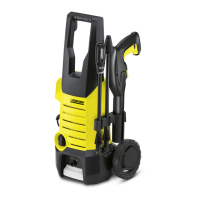
This document provides operating instructions for the Kärcher K 2.190 high-pressure cleaner, a device designed for domestic use to clean various items and surfaces with a high-pressure water jet, and optionally, detergents.
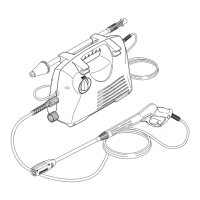
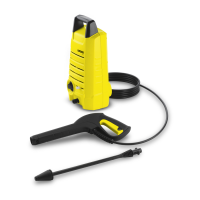
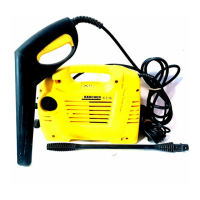
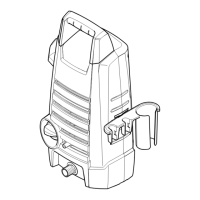
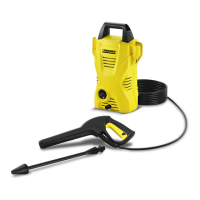
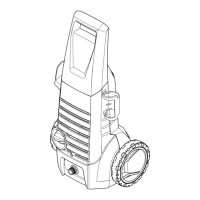
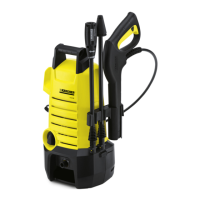
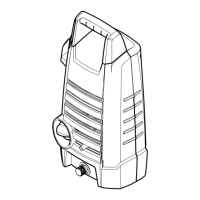
The Kärcher K 2.190 is a high-pressure cleaner that utilizes a powerful water jet to remove dirt and grime from machines, vehicles, buildings, tools, facades, terraces, and garden equipment. It can be used with or without detergents, provided they are approved by Kärcher. The unit features a high-pressure connection, an appliance switch for "0/OFF" and "I/ON" operation, and a water connection with an integrated sieve to prevent impurities from damaging the pump. A detergent suction hose with a sieve allows for the application of cleaning agents. The device is equipped with a trigger gun that includes a lock to prevent inadvertent operation, and an overflow valve with a pressure switch that turns off the pump when the trigger gun lever is released, stopping the high-pressure jet.
The K 2.190 is designed for ease of assembly and operation. Before first use, loose parts such as transport wheels and the transport handle need to be mounted. The high-pressure hose connects to the trigger gun with a clamp, ensuring a secure connection. For water supply, the appliance requires a fibre-reinforced water hose with a standard coupling, and it must never be used on a drinking water supply without a system separator. Kärcher recommends using a water filter to protect the high-pressure pump from impurities. The device can also draw water from a bucket using an optional suction hose accessory, which is useful in situations without direct mains water access.
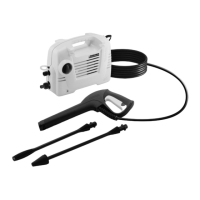
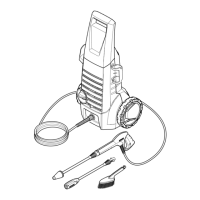
To start the appliance, the water tap must be fully open, and the mains plug inserted into a socket. The appliance is then turned on using the "I/ON" switch. The trigger gun's lever must be unlocked and pulled to activate the device. Releasing the lever switches the device off, but high pressure remains in the system. The K 2.190 comes with two types of spray lances: a high-pressure nozzle for normal cleaning tasks and a Dirtblaster for particularly dirty items or areas. Neither of these lances is suitable for use with detergents.
When working with detergents, the spray lance must be detached, and the detergent suction hose pulled out and suspended in a container filled with the cleaning agent. Kärcher emphasizes using only their approved detergents to ensure appliance safety and warranty validity. The recommended cleaning method involves sparingly spraying detergent on a dry surface, allowing it to react, and then spraying off the loosened dirt with the high-pressure jet. For interrupting operation, the trigger gun lever should be released and locked, and for longer breaks, the appliance should be turned off using the "0/OFF" switch.
After operation, especially when detergents have been used, the machine should be run for approximately one minute for a clear rinse. The tap is then turned off, the appliance detached from the water supply, and any remaining pressure in the system released by pressing the trigger gun lever. Finally, the trigger gun lever is locked, and the mains plug is pulled out.
The K 2.190 is largely maintenance-free, but certain care steps are recommended, especially before extended storage periods or during winter. Prior to any care or maintenance work, the appliance must be turned off, and the mains plug removed. For storage, the machine should be parked on an even surface, and all accessories, including the spray lance, trigger gun, mains cable, and high-pressure hose, should be stowed on the appliance.
To protect against frost, which can damage the appliance and its accessories if water residues remain, all water must be completely drained. This is achieved by switching the appliance on with the high-pressure hose and water supply detached for a maximum of one minute, until no more water exits the high-pressure connection, then turning it off. The appliance and all accessories should then be stored in a frost-free room.
Before longer storage periods, the filter from the detergent suction hose and the sieve in the water connection should be removed and cleaned under running water. The sieve in the water connection can be pulled out using flat-nose pliers. In case of minor faults, the user can refer to the troubleshooting guide provided in the manual. For instance, if the appliance is not running, checking the trigger gun lever, voltage, and mains connection cable is advised. If pressure does not build up, checking the spray lance setting, ventilating the appliance, checking the water supply, and cleaning the water connection sieve are recommended steps. Strong pressure fluctuations may indicate a need to clean the high-pressure nozzle. Slight leakage from the pump is considered normal, but increased leakage warrants contacting customer service. If no detergent is being fed, the spray lance should be detached, the detergent suction hose filter cleaned, and the hose checked for kinks. For any repairs or persistent issues, consulting an authorized customer service is recommended. Only original Kärcher spare parts should be used for replacements.
 General
| Max Pressure | 110 bar |
|---|---|
| Flow Rate | 360 L/h |
| Weight | 5.2 kg |
| Hose Length | 1.5 m |
| Power Cable Length | 5 m |
| Pressure | 110 bar |
| Power rating | 1.3 kW |
| Water Flow | 360 L/h |
| Power Source | Electric |
| Motor Power | 1.3 kW |

 To Next Page