Need help?
Do you have a question about the Keg King APOLLO SNUB NOSE and is the answer not in the manual?
Key usage guidelines and warnings for safe operation under pressure.
Lists warnings on temperature limits, pressure, chemical use, and material compatibility.
Lists the main attributes and benefits of the Apollo PET pressure fermenter.
Identifies the available connection ports on the Apollo fermenter lid for various functions.
Provides step-by-step instructions for attaching lid components like posts and valves.
Steps to perform a leak test on the fermenter and how to correct any identified leaks.
Guidelines for cleaning and sanitizing the fermenter effectively using recommended products.
Instructions on temperature control, pressure management, and sampling during fermentation.
Step-by-step guide for operating the Gen 3 Clean in Place cleaning system.
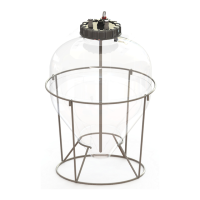
The Apollo Snub Nose is a series of P.E.T. pressure fermenters designed and engineered by Keg King, available in 30L and 60L capacities. These fermenters are part of Keg King's UniTank and closed-bottom Snub Nose varieties, offering a convenient solution for single-batch brewing. Made in Australia and individually pressure tested, the Apollo fermenters are crafted from BPA-free, bottle-grade PET plastic, ensuring safety and durability. They are pressure-rated at 5 bar, making them suitable for pressure fermentation, which offers several benefits such as low ester formation, reduced dependence on temperature control, oxygen-free transfer, and near-carbonated beer post-fermentation. This design allows for faster fermentation times, catering to both homebrewers and small batch brewers.
A key feature of the UniTank variety is its new centralized plunger valve, which facilitates more sanitary yeast harvesting and precise temperature control through a centralized thermowell. The plunger valve design is an improvement over traditional butterfly dump valves, being easier to disassemble and clean, thus promoting better sanitation—a crucial aspect of brewing quality beer. The plunger valve operates by being pushed in from the top to seal the bottom of the fermenter, creating an airtight seal. Pulling the valve up opens the bottom, allowing yeast slurry and other vegetal matter to fall through. It is recommended to begin fermentation with the valve open. The floating dip tube can be attached to the thermowell/plunger valve, enabling cleaner and clearer beer transfer from the center of the tank. The fermenters also boast a larger tank opening, which enhances ergonomic handling and simplifies cleaning.
The Apollo lid is versatile, featuring four ports for various uses: two for ball lock posts, one for the PRV/dry-hop port, and one for the thermowell/central plunger valve port. Assembly of the fermenter involves several steps to ensure proper sealing and functionality. First, the PRV Housing and its O-ring are seated into the PRV port, followed by the PRV itself. Next, the SS Short Dip Tubes with O-rings are placed through the ball lock post ports in the lid, and a Universal Poppet is inserted into each ball lock post. The liquid and gas posts are then tightened onto the threaded ball lock post ports, with the choice of side for liquid or gas not affecting performance. The silicone dip tube is slid onto the SS dip tube under the liquid ball lock post. Finally, the thermowell rod is screwed onto the bottom thread of the lid, and the neck ring is screwed on to firmly secure the lid assembly.
Before initial use, it is crucial to perform a leak test to ensure all parts are securely in place and that the vessel can operate safely under pressure. This involves pressurizing the tank to no more than 20 psi, disconnecting the gas line, and then checking for leaks around the seals and joins of the top and bottom assemblies using a spray bottle filled with foaming sanitizer or soapy water. Any detected leaks require depressurizing the tank before readjusting the fittings.
Maintenance of the Apollo fermenter focuses on proper cleaning and sanitation to ensure longevity and prevent contamination. For cleaning, non-caustic products such as sodium percarbonate or Keg King's Atomic 15 ABC (Alkaline Brewery Cleaner) are recommended. Caustic soda or strong acids should be avoided as they can deteriorate the plastic material. Similarly, steel-wool or abrasive scrubbers are not to be used; soft sponges are recommended for scrubbing protein residues. The tank should not be exposed to temperatures above 50°C (122°F) or below -2°C (28.5°F), as PET is a soft plastic that can deform at higher temperatures. For sanitizing, non-rinse phosphoric-acid type sanitizers like Atomic 15 Foaming Sanitiser are advised.
For enhanced cleaning, Keg King offers an optional Gen 3 CIP Cleaning Kit. This kit includes a 1½ BSP Female Hose Barb, a 1½ BSP Stainless Steel Spray-ball, 2 meters of Silicone Tube Hose, a 70W submersible pump, and a 15L bucket. To operate the cleaning kit, all fittings except the lid and neck ring are removed from the tank and placed in the 15L bucket. The pump, pre-packed with a black hose barb, is screwed onto the outlet of the submersible pump and placed in the middle of the bucket. The CIP Spray-ball is attached to the underside of the lid, and the ½ BSP female hose barb to the top side of the lid. Silicone tubing links the barbed pump outlet to the barb at the top of the fermenter lid. The tank is then filled with 5 liters of warm water (no higher than 50°C) and the recommended dosage of cleaner. The bucket is seated directly underneath the tank, and the pump is run to circulate the cleaning solution through the spray-ball until all fermentation residue is removed. Finally, the tank is rinsed with clean water.
During fermentation, wort should be chilled to below 30°C before transfer. After pitching the yeast, the tank is sealed, and fermentation proceeds under controlled temperature and pressure. Internal pressure can be managed by attaching a Keg King spunding valve to an MFL gas ball lock disconnect, which is then affixed to the gas ball lock post on the Apollo lid. Temperature monitoring is done via the thermowell, where a temperature control device probe (6mm or under) can be inserted to gauge liquid temperature readings. Hops can be added during or after fermentation by depressurizing the tank and using the dry-hop port for pellet hops. After adding hops, the tank can be purged and re-pressurized with a regulated CO2 source. Sampling is made easy with the liquid-to-liquid transfer line, connecting one end to the liquid post and moving liquid out by pushing down on the internal pin of the opposite disconnect, without needing additional CO2 as the fermenter is already pressurized.
Once fermentation is complete, the beverage temperature is lowered for cold crashing to clarify the beer. The spunding valve can be removed, and a gas line attached to maintain the desired carbonation pressure. If the internal gas pressure is insufficient for full carbonation after cold crashing, a regulated CO2 source can be attached to the gas post to achieve the desired carbonation level.
For those wishing to incorporate cooling, the Gen 3 Cooling Coil Kit is an optional addition. The ports for the cooling coil need to be manually drilled into the lid. Two 13mm diameter holes are drilled through the indentations marked on the lid. The Cooling Coil Posts are then protruded from the bottom of the Apollo lid, with male threads facing upward and O-rings on the underside. Each post is secured by screwing the Cooling Coil Nut onto the male thread. The Cooling Coil connects to the Gen 3 Lid by pushing its ends through the Cooling Coil Posts, and the seating level is adjusted.
After each fermentation, it is best practice to clean and sanitize the Apollo fermenter and store it dry. To keep the tank free from oxygen and bacteria for up to two weeks, it is recommended to pressurize it to 10 psi and store it in a cool room away from sunlight.
 General
| Material | Stainless Steel |
|---|---|
| Connection Type | Ball Lock |
| Pressure Adjustment | Manual |
| Pressure Gauge | Yes |
| Color | Silver |
| Primary Use | Homebrewing |

 To Next Page