Need help?
Do you have a question about the Kellogg-American V120103-452 and is the answer not in the manual?
Steps for reporting and handling damaged air compressor shipments, including documentation and communication.
Essential safety rules and precautions for operating the air compressor to prevent injury or damage.
Pre-installation check for transit damage and pulley movement before setup.
Guidance on selecting an appropriate, clean, dry, and well-ventilated installation site.
Table detailing oil viscosity and type based on ambient temperature for initial startup.
Steps to ensure the compressor is ready and safe before initial operation.
Routine checks for air leaks, rust, oil soiling, and fastener tightness.
Procedures for break-in lubrication, oil type, and oil change frequency.
Schedule for checking and replacing the air filter element based on hours or time.
Table outlining specific maintenance tasks and their recommended intervals.
This document is an instruction manual for an Industrial Series Piston Air Compressor manufactured by Kellogg American. The manual provides essential information for the safe operation, installation, and maintenance of the compressor.
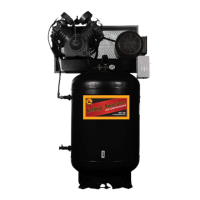
The Kellogg American Industrial Series Piston Air Compressor is designed to generate compressed air for various industrial applications. Piston compressors operate by using pistons driven by a crankshaft to compress air within cylinders. This compressed air is then stored in an air tank for later use. The compressor is powered by a 10 HP, 3-phase motor and features a K452 pump model. It includes a 120-gallon vertical air tank, which provides significant storage capacity for continuous or intermittent air demands in an industrial setting. The system is built for durability and reliable performance, typical of industrial-grade equipment.
The manual emphasizes several key aspects for proper usage to ensure longevity and safety. Before operation, users are instructed to thoroughly read and understand all instructions. The compressor should be installed in a clean, dry, and well-lit location. In colder climates, a heated building is recommended to prevent issues like condensate dripping and motor shorting. It is crucial to avoid installing the compressor in environments with corrosive or dust-laden air, such as boiler rooms, paint spray rooms, or sandblasting areas. If such conditions are unavoidable, the air intake should be piped to the outside and increased in pipe size for longer runs, with filters protected by a hood.
Upon receiving the compressor, a careful inspection for transit damage is required. Any damage must be documented with the trucking company and reported to the Kellogg Distributor. The unit should remain on its shipping skid until it reaches its final installation site, ensuring proper handling and securing during movement. A critical safety warning states that the pump or drive should never be used as a lift point.
Before starting the compressor, the crankcase must be filled with Kellogg-American oil to the high-level mark on the sight glass, adhering to specific viscosity and flash point specifications based on ambient temperature. The compressor should be manually turned over a few revolutions to ensure all parts are free. Belt tension needs to be checked, and all tools or loose objects must be removed from the vicinity. A strict safety rule is to never place hands or tools on the belts of idle units unless the main power is disconnected and locked. The direction of rotation, indicated by an arrow on the flywheel, must be counter-clockwise when facing the flywheel, ensuring air is drawn through the intercooler for maximum cooling.
The manual also highlights the importance of observing safety precautions to prevent injury, death, or property damage. This includes disengaging power before any maintenance, relieving all pressure from the tank and lines before attempting to remove pressurized systems, and never servicing the machine while in operation. The compressor should not be operated at pressures or speeds exceeding its nameplate ratings. Guards, shields, or screens must remain in place during operation and be replaced after maintenance. Daily checks of the delivery pressure gauge are necessary to confirm the automatic control system is functioning correctly. Periodic checks of all safety and relief devices are also mandated. Users are warned against playing with compressed air due to the risk of serious injury or death. Cleanliness during maintenance is stressed, with parts and exposed openings needing to be covered with a clean cloth. Pressure relief valves must be installed in any isolated piping in the plant system. Finally, the use of genuine Kellogg parts, operating oils, and materials is strongly recommended, and local effluent disposal laws for condensate must be strictly observed.
The maintenance section outlines a comprehensive preventative maintenance program crucial for reliable and satisfactory service. Users are advised to regularly check the compressor, the entire system for air leakage using soap and water solution, and remove rust and oil soiling. Fastener tightness should be checked using a torque wrench according to values in the full operations manual.
For compressor oil, the level must be checked weekly and topped off if necessary, ensuring the sight glass is ¾ full. A critical instruction is to always use the same brand of oil and never mix different types, weights, or brands. Compressors are initially filled with Kellogg break-in lubricant, an ISO non-detergent industrial lubricant with rust and oxidation inhibitors. The normal break-in period is 25 hours, after which the oil must be drained and replaced with Kellogg Synthetic Lubricant. After this initial change, the compressor should run for 200 hours, followed by another thorough drain and replacement with synthetic lubricant. For the first 500 hours of operation, a careful and regular check of the oil level is required, maintaining a full level at all times. After 500 hours, the compressor is ready for extended periods between lubricant changes, with oil changes recommended every 3000 operating hours. For constant run or extremely heavy-use applications, monthly oil changes are advised.
Air filter maintenance involves checking and cleaning the filter monthly to ensure it is free from debris and functioning properly. The filter element should be replaced every 1500 hours or annually, whichever comes first.
A maintenance intervals table provides a clear schedule for various tasks:
The manual strongly recommends downloading, reading, and reviewing the full Operations Manual available on the Kellogg-American website for complete information.
 General
| Model | V120103-452 |
|---|---|
| Horsepower | 10 HP |
| Maximum Pressure | 175 PSI |
| Tank Size | 120 Gallons |
| CFM @ 175 PSI | 34 CFM |
| Pump Type | Two-Stage |

 To Next Page