
 Need help?
Do you have a question about the Kenmore 580.75180 and is the answer not in the manual?
Sears will repair the air conditioner free of charge if defective in material or workmanship within one year.
Sears will repair the sealed refrigeration system free of charge if defective in material or workmanship within five years.
General safety instructions to avoid harm to yourself or damage to the air conditioner, including fire, shock, and injury risks.
Tips for efficient and satisfactory operation, including room capacity, shading, insulation, and appliance usage.
Details on power supply, grounding, and circuit breaker requirements, including use of a 3-prong plug.
Warning against using extension cords or adapter plugs to prevent electrical hazards.
Explanation of the power cord's interrupter device with test/reset buttons and its function.
Window size, clear opening, and clearance requirements for proper air conditioner installation.
Guidance on checking available electrical service and ensuring proper grounding for the unit.
List of parts and quantity required for installation, along with necessary tools.
Caution about the unit's weight, need for multiple people, and careful handling to avoid injury.
Step-by-step instructions for installing the air conditioner unit into the window.
Instructions for connecting a drain elbow and hose to the unit's drain pipe for water removal.
Steps for attaching the front grille, inlet grille, and securing the unit with screws.
Procedure for safely removing the air conditioner from the window, including unplugging and disassembly.
Guidance on installing a wood strip to overcome interference from storm window frames.
Explanation of how the unit cools, circulates air, lowers humidity, and filters impurities.
Description of expected sounds like pinging or hissing and their causes.
Factors affecting unit size selection and how load conditions influence running time.
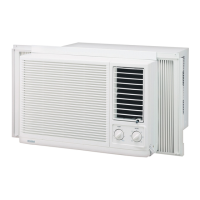
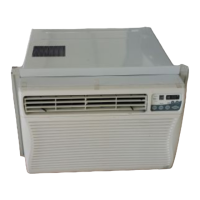
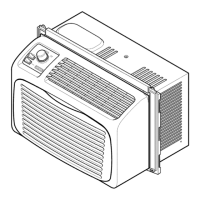
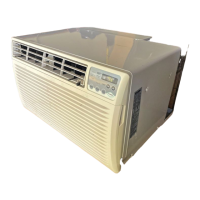
Identification of various parts of the air conditioner unit using a diagram.
Step-by-step guide to operating the air conditioner after installation, including initial settings.
Explanation of the vent control for recirculating or exhausting air and its effects on cooling.
Overview of the control panel display, remote signal receiver, and temperature setting functions.
Details on setting shut-off and start times for the air conditioner.
Explanation of how to shift between cooling and fan-only modes.
Instructions for using the remote control, including power, temperature, timer, and mode functions.
Step-by-step guide on how to open the remote and insert batteries correctly.
Instructions for cleaning the air filter to maintain airflow and cooling capacity.
Guidance on cleaning the front grille, inlet grille, cabinet, and condenser coils.
Step-by-step instructions for safely removing the front grille for cleaning or access.
Instructions for reattaching the front grille to the cabinet after cleaning or maintenance.
Common issues and solutions to avoid unnecessary service calls.
Troubleshooting steps for when the unit fails to turn on or function.
Steps to diagnose and fix issues where the unit is not cooling effectively.
Solutions for ice buildup, blocked airflow, settings, or open windows affecting room temperature.
Diagnosing and resolving issues of frequent cycling, unusual noises, and vibration.
Troubleshooting water leaks inside or outside the room, often related to installation or humidity.
Details on expert service, unlimited repairs, no-lemon guarantee, and annual maintenance checks.
Instructions on how to schedule service by phone or online after purchasing the agreement.
Information about Sears' extensive network of professional repair specialists and parts availability.
Phone numbers for purchasing agreements, additional information, and installation services.
 General
| Brand | Kenmore |
|---|---|
| Model Number | 580.75180 |
| Type | Window Air Conditioner |
| Room Size Coverage | Up to 350 sq. ft. |
| Fan Speeds | 3 |
| Compressor Type | Rotary |
| Remote Control | Yes |
| Power Supply | 115V / 60Hz |
| Included Accessories | Remote control, installation kit |
| Cooling Capacity | 8000 BTU |
| Noise Level | 52 dB |
| Operating Modes | Cool, Fan |


 To Next Page