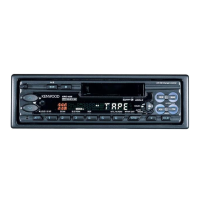
The Kenwood KRC-363D/L is a cassette receiver designed for in-car audio systems, offering a blend of radio and cassette playback functionalities. This service manual provides comprehensive details for repair, adjustment, and component identification, making it an essential resource for technicians.
Function Description:
The KRC-363D/L serves as a central audio unit for vehicles, integrating an FM/AM/LW tuner with a cassette deck. Its primary function is to provide audio entertainment through radio broadcasts and cassette tape playback. The unit features a microprocessor for system control, PLL (Phase-Locked Loop) for stable tuning, and an LED driver for the display.
The FM tuner section covers a frequency range of 87.5-108.0 MHz, with a usable sensitivity of 1.6 µV/75 ohms and a stereo sensitivity of 2.8 µV/75 ohms (S/N = 46 dB). It boasts a frequency response of 30-15,000 Hz (±4.5 dB), a signal-to-noise ratio of 68 dB (IEC-A), and a selectivity of 65 dB (DIN). Stereo separation at 1 kHz is 40 dB, with a 19 kHz carrier leakage of 50 dB.
The MW tuner section operates from 531-1,611 kHz with a usable sensitivity of 30 µV. For the KRC-363L model, an LW tuner section is included, covering 153-281 kHz with a usable sensitivity of 60 µV.
The cassette deck features a tape speed of 4.76 cm/s. Its wow and flutter are rated at 0.12% WRMS (0.2% W-PEAK). Fast winding time for a C-60 cassette is approximately 110 seconds. The frequency response for 120 µs tapes is 40 Hz-14 kHz (+4 dB, -6 dB), and for 70 µs tapes, it's 40 Hz-16 kHz (+4 dB, -6 dB). Stereo separation at 1 kHz is 37 dB, and the signal-to-noise ratio (IEC-A) is 52 dB.
The audio section delivers a maximum output power of 8 W x 2 or 6.5 W x 4 (1 kHz, 4 ohms). The rated output power is 6 W x 2 (10% THD, 1 kHz, 4 ohms) or 5 W x 2 (1% THD, 1 kHz, 4 ohms).
General specifications include an operating voltage of 14.4 V (11-16 V) and a current consumption of 2.7 A at rated power. The dimensions (W x H x D) are 188 x 58 x 153 mm, with a body size of 180 x 50 x 135 mm. The unit weighs 1.5 kg.
Usage Features:
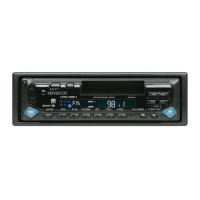
The front panel of the KRC-363D/L is intuitively designed with various knobs and buttons for easy operation.
- Knobs: Separate knobs are provided for BASS, TREBLE, EJECT, REW (rewind), FF (fast forward), FADER, VOLUME, LOUD, AME (AM/FM), and FM/AM tuning. These allow for precise control over audio output and radio/cassette functions.
- Display: An LCD display shows information such as FM1/FM2, MW, LW, AUTO, MTL (metal tape), T.ADV (tape advance), LOUD, and DK (Dolby noise reduction).
- Controls: Dedicated buttons for UP/DOWN tuning, TUNE CONTROL, and various preset stations (S1-S16) simplify radio navigation.
- Cassette Mechanism: The cassette mechanism supports loading, playback (FWD/RVS), fast forward, rewind, program play, and eject functions. The mechanism operation description details the intricate movements of levers, gears, and springs during these actions, including the engagement and disengagement of pinch rollers and reel bases. Auto-reverse functionality ensures continuous playback.
- Safety Features: The unit incorporates fuses for ACC (5A) and BACK UP (3A) to protect against electrical overloads.
Maintenance Features:
The service manual outlines detailed procedures for disassembly, reassembly, and adjustment, crucial for troubleshooting and repair.
- Disassembly: The manual provides step-by-step instructions for removing the top cover, bottom cover, main volume control knob, panel escutcheon, front panel, cassette mechanism assembly, and sub-panel. Further detailed instructions are given for disassembling and reassembling the holder (action plate), which involves removing screws, springs, and carefully aligning projections and holes.
- Circuit Description: A block level diagram and a detailed circuit description identify key components such as the audio power amplifier (TA7280P), radio/tape/AF select IC (M51551P), CMOS logic ICs (BU4081BP, BU4069), and the microprocessor (µPD1719-538). Transistors (e.g., 2SC2021, 2SD1225M, 2SA874) are described with their specific switching functions for power supply, mute, loudness, and filter operations.
- Adjustment: Comprehensive adjustment procedures are provided for both FM, MW, LW, and cassette deck sections.
- FM Section: Adjustments include discriminator (IFT301), soft mute ratio (VR302), auto stop level (VR304), separation (VR152, VR303), and ANRC.
- SDK Section: DK level (L901, VR901) and SDK volume level (VR951) adjustments are specified.
- MW/LW Section: Band edge (L8, L9), IF (IFT1, IFT2), RF alignment (L4, L5, L6, L7, TC3), and auto stop level (VR251) adjustments are covered.
- Cassette Deck Section: Demagnetization and cleaning of the recording head, capstan, and pinch roller are recommended. Azimuth adjustment (using a screw) is detailed to ensure maximum output.
- Parts List: An extensive parts list categorizes components by reference number, address, and part number, along with a description and destination remarks (e.g., Japan made, France made). This includes ICs, transistors, diodes, capacitors, resistors, switches, knobs, and mechanical parts. Safety-critical components are specifically indicated.
- Exploded Views: Exploded diagrams of the mechanism and unit provide visual guidance for component placement and assembly, aiding in identification and reassembly.
The KRC-363D/L is a robust and feature-rich cassette receiver, designed for reliable performance in a vehicle environment, with a comprehensive service manual to support its maintenance and repair throughout its lifespan.

 Need help?
 General

 To Next Page