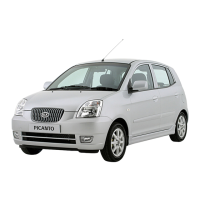
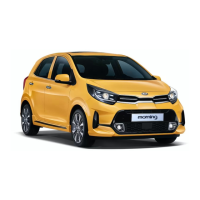
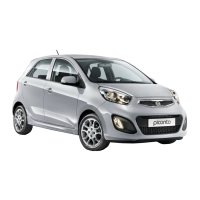
This document is an Owner's Manual and Quick Reference Guide for a Kia Picanto, providing an overview of its interior, instrument panel, engine compartment, and various operational and maintenance features.
Interior Overview
The interior overview details several key controls and components:
- Door lock/unlock button [4]: Controls the central locking system.
- Central door lock switch [4]*: An optional switch for central door locking.
- Power window switches [4]*: Controls the operation of the power windows.
- Power window lock button [4]*: An optional button to lock the power windows, preventing their operation by passengers.
- Outside rearview mirror control switch [4]*: An optional switch to adjust the position of the outside rearview mirrors.
- Outside rearview mirror folding switch [4]*: An optional switch to fold the outside rearview mirrors, useful in tight spaces.
- Bonnet release lever [4]: Releases the bonnet (hood) for access to the engine compartment.
- Fuel filler lid release lever [4]: Releases the fuel filler lid.
- Steering wheel [4]: The primary control for steering the vehicle.
- Steering wheel tilt control [4]*: An optional feature to adjust the steering wheel's angle for driver comfort.
- Headlight leveling device [4]*: An optional device to adjust the angle of the headlights.
- Idle Stop and Go system OFF button [5]*: An optional button to disable the Idle Stop and Go (ISG) system, which automatically stops and restarts the engine to save fuel.
- ESP OFF button [5]*: An optional button to disable the Electronic Stability Program (ESP).
- Heated steering wheel switch [4]*: An optional switch to activate the heated steering wheel.
- Fuse box [7]: Contains the vehicle's fuses.
- Brake pedal [5]: Engages the vehicle's braking system.
- Accelerator pedal: Controls the vehicle's speed.
Instrument Panel Overview / Engine Compartment
The instrument panel and engine compartment are detailed as follows:
Instrument Panel:
- Instrument cluster [4]: Displays vital vehicle information such as speed, RPM, fuel level, and warning lights.
- Horn [4]: Activates the vehicle's horn.
- Driver's front air bag [3]*: An optional safety feature for the driver.
- Light control/Turn signals [4]: Controls the vehicle's lights and turn signals.
- Wiper and washer control lever [4]: Controls the front and rear wipers and washers.
- Ignition switch or ENGINE START/STOP button [5]**: Starts and stops the engine.
- Hazard warning light [6]: Activates all turn signals simultaneously to warn other drivers of a hazard.
- Audio [4]*: The vehicle's audio system.
- Climate control system [4]*: Controls the vehicle's heating, ventilation, and air conditioning.
- Shift lever [5]*: Used to select gears in automatic or manual transaxle vehicles.
- Steering wheel audio control [4]*: Optional controls on the steering wheel for the audio system.
- Passenger's front air bag [3]*: An optional safety feature for the front passenger.
- Glove box [4]: Storage compartment in the dashboard.
- Parking brake lever [5]: Engages the parking brake.
- Power outlet [4]*: An optional 12V power socket.
- Cigarette lighter [4]*: An optional cigarette lighter, often also used as a power outlet.
- Seat warmer [3]*: An optional feature to heat the seats.
- Driver's knee air bag [3]*: An optional safety feature for the driver's knees.
Engine Compartment:
- Engine coolant reservoir [7]: Holds the engine coolant.
- Radiator cap [7]: Seals the radiator and allows for coolant refilling.
- Brake fluid reservoir [7]: Holds the brake fluid.
- Air cleaner [7]: Filters air entering the engine.
- Engine oil dipstick [7]: Used to check the engine oil level.
- Engine oil filler cap [7]: Where engine oil is added.
- Windscreen washer fluid reservoir [7]: Holds fluid for the windscreen washers.
- Fuse box [7]: Contains fuses for various engine compartment electrical components.
- Positive battery terminal [7]: The positive connection point of the battery.
- Negative battery terminal [7]: The negative connection point of the battery.
- Automatic transaxle fluid dipstick [7]*: An optional dipstick to check the automatic transaxle fluid level.
Door Locks / Tailgate / Bonnet / Fuel Filler Lid
This section covers the operation of various access points:
- Operating door locks manually [4]: Instructions for locking/unlocking doors from the inside using the door lock knob and the central door lock switch (if equipped).
- Child-protector rear door lock [4]: Explains how to engage the child safety locks on the rear doors.
- Opening the tailgate [4]: Shows two types (Type A and Type B) of tailgate opening mechanisms.
- Closing the tailgate [4]: Demonstrates how to securely close the tailgate.
- Opening the bonnet [4]: Involves pulling the release lever inside the cabin, then pushing a secondary latch under the bonnet, and finally using a support rod to keep it open.
- Closing the fuel filler [4]: Instructions for securing the fuel filler cap (clockwise until it clicks) and closing the lid.
- Opening the fuel filler [4]: Involves pulling up the fuel filler lid release lever and turning the cap counterclockwise.
Windows / Wipers and Washers
This section describes the operation of windows and wiper systems:
- Windows [4]:
- Driver's door power window switch: Controls the driver's window.
- Front passenger's door power window switch: Controls the front passenger's window.
- Rear door (right) power window switch*: Optional control for the right rear window.
- Rear door (left) power window switch*: Optional control for the left rear window.
- Window opening and closing: General operation of power windows.
- Automatic power window up/down**: Optional one-touch up/down function for power windows.
- Power window lock switch*: Optional switch to disable passenger window controls.
- NOTICE: Warns that power windows may not work in freezing conditions.
- Front [4]:
- Wiper speed control: Settings for high, low, intermittent, and off.
- Intermittent wipe time adjustment: Adjusts the delay for intermittent wiping.
- Wash with brief wipes (front): Activates the front washers and wipers.
- Rear [4]*:
- Rear wiper/washer control: Settings for continuous, intermittent, and off.
Seat / Air Bag / Child Restraint System
This section covers seating adjustments, airbag systems, and child restraint installation:
- Seats [3]:
- Forward and rearward: Adjusts seat position.
- Seatback angle: Adjusts the recline of the seatback.
- Seat cushion height*: Optional adjustment for seat height.
- Seat warmer*: Optional seat heating function.
- Headrest: Adjusts headrest height.
- Walk-in seat (for 3 door vehicle only): Specific feature for 3-door models to allow rear access.
- Seatback folding*: Optional feature to fold down seatbacks.
- Passenger's front air bag ON/OFF switch [3]*: An optional switch to enable or disable the front passenger airbag.
- Installing a child restraint system by lap/shoulder belt [3]: Instructions for securing child seats using the vehicle's seat belts.
- Securing with “Tether Anchor” system [3]*: Instructions for using the top tether anchors for child restraints.
- Securing with “ISOFIX” system and "Tether Anchorage" system [3]*: Instructions for using the ISOFIX lower anchors and top tether anchors.
- ISOFIX Anchor Position Indicator/ ISOFIX Anchor: Explains the location of ISOFIX anchors in the rear seats.
Climate Control System
This section details the manual and automatic climate control systems:
- Manual climate control system [4]*:
- Temperature control: Adjusts the cabin temperature.
- Air intake control: Selects between fresh air and recirculation.
- Fan speed control: Adjusts the fan intensity.
- Mode selection: Directs airflow to different vents (e.g., face, feet, defrost).
- Rear window defroster: Activates the rear window defroster.
- Air conditioning*: Activates the air conditioning system.
- Automatic climate control system [4]*:
- Temperature control: Sets the desired temperature.
- AUTO (automatic control): Automatically manages fan speed, mode, and air intake to maintain the set temperature.
- OFF: Turns off the climate control system.
- Climate control display: Shows current settings.
- Fan speed control: Manual adjustment of fan speed.
- Air conditioning*: Activates the air conditioning system.
- Air intake control: Selects between fresh air and recirculation.
- Mode selection: Manually directs airflow.
- Rear window defroster: Activates the rear window defroster.
- Front windscreen defroster: Activates the front windscreen defroster.
Instrument Cluster / Lighting Control / Steering Wheel
This section describes the instrument cluster, lighting controls, and steering wheel adjustments:
- Instrument Cluster [4]:
- Tachometer: Displays engine RPM.
- Turn signal indicators: Shows when turn signals are active.
- Speedometer: Displays vehicle speed.
- Fuel gauge: Shows the fuel level.
- Warning and indicator lights: Various lights indicating vehicle status or warnings.
- Odometer/Trip computer*: Displays total mileage and trip mileage.
- Lighting control [4]:
- OFF: All lights off.
- Parking light: Activates parking lights.
- Headlight: Activates headlights.
- Auto light*: Optional automatic headlight activation based on ambient light.
- Tilt steering [4]*:
- Steering wheel angle adjustment: Allows the driver to adjust the steering wheel's angle for comfort by pulling down a lock release lever, adjusting, and then pulling the lever up to lock.
- Heated steering [4]*:
- Function: When the ignition is ON, pressing the button warms the steering wheel. An indicator light on the button illuminates when active. Pressing again turns it off.
Towing / Tyre Mobility Kit
This section provides information on towing and using the Tyre Mobility Kit:
- Towing [6]:
- Emergency towing: Instructions for towing the vehicle in an emergency without wheel dollies, including setting the ignition to ACC, placing the transaxle in N (Neutral), and releasing the parking brake. Recommends professional towing by an authorised Kia dealer or commercial tow truck service.
- Removable towing hook: Instructions for installing and removing the towing hook, which is stored in the luggage box cover under the tailgate.
- Jack and tools [6]*:
- Location: The jack, jack handle, and wheel lug nut wrench are stored in the luggage compartment, accessible by pulling up the luggage box cover.
- Tyre Mobility Kit [6]*:
- Components: Includes a compressor and a sealant bottle.
- Usage: Designed to temporarily seal a punctured tyre, allowing the driver to cautiously drive (up to max. 200km (120 miles) at a max. speed of 80km/h (50mph)) to the nearest service point for repair or replacement. Users are advised to read the instructions before use.
This section covers fluid checks and additional vehicle features:
- Checking the engine oil level [7]:
- Procedure: On level ground, pull out the dipstick, wipe it clean, re-insert it fully, then pull it out again to check the level. The oil level should be between the 'F' (Full) and 'L' (Low) marks.
- Refilling engine oil [7]:
- Procedure: Use only the specified engine oil [8] and a funnel to avoid spillage on engine components.
- Checking the washer fluid level [7]:
- Procedure: Check the fluid level and add fluid as necessary.
- Additional Information*:
- Idle Stop & Go (ISG):
- Function: Automatically stops and restarts the engine to reduce fuel consumption and emissions.
- Conditions: May not work if battery charge is low, ambient temperature is too low, engine temperature is too low, or if certain climate control settings are active.
- Hill-Start Assist Control (HAC):
- Function: Prevents the car from rolling backward on hills by maintaining braking pressure for 2 seconds when driving off.
- Parking brake (Handbrake):
- Procedure: Apply the footbrake first, then pull up the parking brake lever as far as possible.
- Recommendation: Leave the car in first or reverse gear (manual) or 'P' (Park) (automatic) when parked.
- Bluetooth®:
- Function: Enables wireless connectivity for mobile phones for convenience.
- Compatibility: Check www.kia.co.uk for compatibility information.
- The Kia Service App:
- Availability: Free on iPhone/iPad and Android.
- Features: Locates Kia dealers in Europe, displays them on a map, and allows users to call a dealer, visit their website, or get directions. Available in selected markets only.
- Kia 7 year warranty:
- Details: 7-year/100,000 miles new car warranty, valid in EU member states (plus Norway, Switzerland, Iceland, and Gibraltar), subject to local terms and conditions.
This manual provides a comprehensive guide to the Kia Picanto's features, operations, and basic maintenance, with references to specific chapters for more detailed information.

 Need help?
 General

 To Next Page