Need help?
Do you have a question about the KID Trax Rideamals Snack Time Blue and is the answer not in the manual?
Guidelines for adult supervision, safe riding practices, and child-specific safety rules.
Critical warnings for handling, charging, and potential hazards associated with the battery.
Information on product chemical exposure risks and safety precautions during adult assembly.
Specific guidance on battery recharge intervals, time limits, and potential damage.
A mandatory checklist for adults to perform before each ride to ensure the toy is safe.
List of all included parts and required tools for assembly and maintenance.
Detailed instructions and recommendations for charging the ride-on toy's battery.
Explanation of how to operate the ride-on toy, including acceleration and toy food storage.
Guidance on checking parts, cleaning the toy, and proper storage to protect from weather.
Instructions for replacing the battery and responsible disposal methods for lead-acid batteries.
Information on obtaining service, FCC compliance statement, and contact for replacement parts.
Overview of the 90-day limited warranty, including coverage, claim procedures, and proof of purchase.
Explanation of warranty limitations, excluded damages, legal terms, and consumer rights.
This document is an owner's manual for the Kid Trax Rideamals "Snack Time Blue" ride-on toy, model KT1612WM. It provides essential information for assembly, safe operation, maintenance, and warranty.
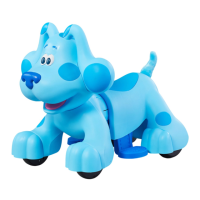
The "Snack Time Blue" is a battery-powered ride-on toy designed for young children, specifically aged 18-30 months, with a maximum weight limit of 44 lbs (20 kg). Its primary function is to provide a fun, low-speed riding experience for toddlers, moving at a maximum speed of 1.5 mph. The toy features a playful blue dog design, complete with a seat that lifts to store "toy food" accessories like a cookie, carrot, and strawberry.
The core function of the "Snack Time Blue" ride-on toy is to offer a motorized, interactive play experience for toddlers. It is powered by a 6V rechargeable battery, allowing the child to accelerate by pressing a button. The toy is designed for single riders and is intended for use in safe, supervised environments. The inclusion of "toy food" items suggests an interactive element, encouraging imaginative play where children can "feed" their ride-on companion. The toy's design emphasizes a friendly, approachable aesthetic, making it appealing to its target age group.
The manual outlines several key usage features and safety guidelines to ensure a secure and enjoyable experience. Before each ride, a supervising adult must perform a pre-ride safety checklist, ensuring the steering wheel/handlebars are tight and properly aligned, and that the wheels are securely attached and in good condition. The drive wheel must be fastened to the gearbox, and all electrical components, including the battery, must be fully charged and properly connected without any exposed or damaged wiring. All electrical buttons, including the power and accelerator buttons, must be in proper working order. The ride-on toy should be clean, dry, and free of any cracks or structural problems. All safety labels must be in place and readable.
The toy is operated by pressing a button to accelerate, reaching a maximum speed of 1.5 mph. The seat cover can be lifted to reveal a storage compartment for the included toy food accessories (toy cookie, toy carrot, toy strawberry). This encourages interactive play, allowing children to engage with the toy beyond just riding. The manual explicitly states that the toy will not turn on while plugged into the charger, requiring it to be disconnected before use.
Safe riding practices are heavily emphasized. The toy should only be used on flat, hard surfaces, away from streets, roads, sidewalks, or any other areas with moving vehicles. Continuous adult supervision is mandatory. Adults are responsible for setting up barriers if necessary to ensure a safe riding environment. The toy lacks braking capabilities, so it should not be used in areas where braking is required. Children must be instructed not to allow other children to use the toy and to keep hands, legs, hair, and clothing away from moving parts. Wearing shoes is required during use. Unsafe behaviors such as traveling at unsafe speeds, not riding in a seated position, riding at night or in low visibility, riding in wet conditions (rain, snow, ice), performing stunts (jumps, ramps, stairs, hills, sloped surfaces), off-road riding (rough terrain, dirt, mud, gravel), riding near pools or open bodies of water, pushing/pulling the driver, or using the toy without safety covers are strictly prohibited. The "play food" accessories are for play only and not for consumption.
Maintenance instructions are provided to prolong the life and ensure the safe operation of the ride-on toy. The battery is a sealed lead-acid, non-spillable type, and its replacement and disposal require specific attention. The battery is expected to last one to three years, depending on usage and conditions. When the battery needs to be replaced, it must be recycled responsibly, as it contains lead acid and cannot be incinerated or disposed of in landfills in most areas. It should be taken to a federal or state-approved lead-acid battery recycler, authorized service center, or local automotive battery retailer.
Before each use, the ride-on toy should be checked for damage, missing, or badly worn parts. This includes checking the tightness of fasteners and wheels, ensuring the battery is securely in place, and verifying that all electrical components are in good condition.
For storage, the ride-on toy should be kept indoors or covered with a tarp to protect it from wet weather and heat sources like stoves and heaters. Prolonged exposure to sun can cause fading, so storing it in the shade or covering it with a tarp is recommended.
Cleaning the toy involves using a soft, dry cloth. For plastic parts, a non-wax furniture polish can be used to restore shine. Car wax, abrasive cleaners, soap, and water should not be used for cleaning, as water can damage the motor, electrical system, and battery. The manual also advises against washing the unicorn with a hose.
The charging process is a critical maintenance aspect. The average charging time is 10 hours, with a maximum of 24 hours. Overcharging can permanently damage the battery and void the warranty. The battery should never be allowed to drain completely and should always be kept charged. Only the supplied rechargeable battery and charger should be used, and charging should not occur near heat or flammable materials. An adult who understands the safety warnings must handle, charge, and recharge the battery. The charger should be plugged directly into a wall outlet, not an extension cord. Regular checks of the charger, supply cord, and connector for wear and damage (frayed wires, exposed inner wires, missing insulation) are essential, and a damaged charger should not be used.
 General
| Product Type | Ride-On Toy |
|---|---|
| Batteries Required | Yes |
| Manufacturer | KID Trax |
| Character | Blue |
| Battery Requirements | 6V battery and charger included |
| Features | Lights and sounds |
| Maximum Weight Capacity | 60 lbs |
| Ride-On Type | Electric |

 To Next Page