11
7. Recommended Locations For Smoke And Carbon Monoxide Alarms
• Locate smoke alarms in all sleeping areas. Try to monitor the exit path as the bedrooms are usually
farthest from the exit. If more than one sleeping area exists, locate additional alarms in each
sleeping area.
• Locate additional alarms in stairways, because stairways act like chimneys for smoke and heat.
• Locate at least one alarm on every floor level.
• Locate an alarm in every bedroom.
• Locate an alarm in every room where electrical appliances are operated (i.e. portable heaters or
humidifiers).
• Locate an alarm in every room where someone sleeps with the door closed. The closed door may
prevent an alarm not located in that room from waking the sleeper.
• Smoke, heat, and combustion products rise to the ceiling and spread horizontally. Mounting the
smoke alarm on the ceiling in the center of the room places it closest to all points in the room.
Ceiling mounting is preferred in ordinary residential construction.
• For all alarm locations, be sure to choose a flat, solid surface for mounting, with no holes or gaps
under the mounting bracket.
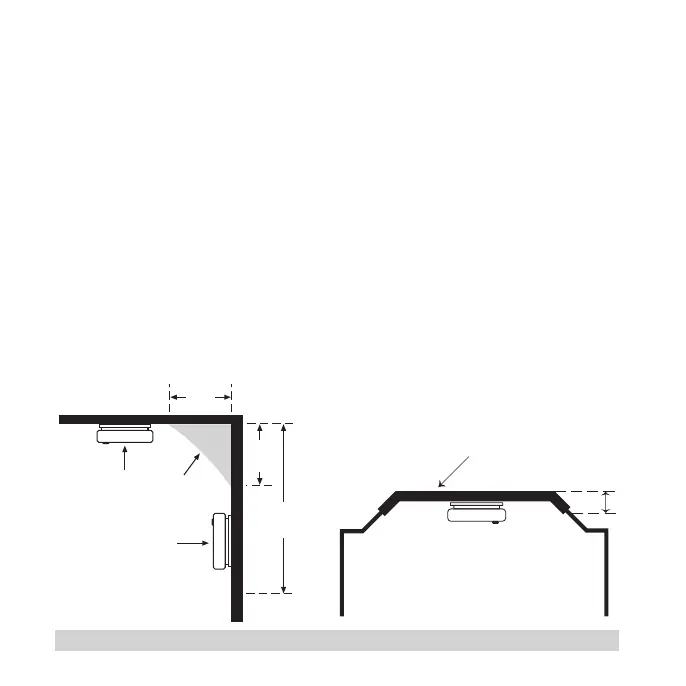
Figure 7-A
(12in )
MAXIMUM
30.5cm
(12in )
MAXIMUM
10 cm
(4in)
MINIMUM
10 cm
(4in)
MINIMUM
BEST
HERE
NEVER
HERE
ACCEPTABLE
HERE
CEILING
SIDE
DEAD AIR
SPACE
ACCEPTABLE
TOP OF ALARM
ACCEPTABLE HERE
Note: measurements shown
are to the closest edge
of the alarm.
Note: measurements shown
are to the closest edge
of the alarm.
NOT IN
THIS AREA
ANYWHERE IN
THIS AREA
0.9 m (3ft) 0.9 m (3ft)
HORIZONTAL DISTANCE
FROM PEAK
ANYWHERE IN
THIS AREA
30 cm
(12in)
NOT IN
THIS AREA
ANYWHERE IN
THIS AREA
0.9 m (3ft)
20 cm (7.8in)
ACCEPTABLE
PLACEMENT
MAXIMUM
MAXIMUM
20 cm (7.8in)
30.5cm
(12in )
MAXIMUM
10 cm
(4in)
MINIMUM
10 cm
(4in)
MINIMUM
BEST
HERE
NEVER
HERE
SIDE
WALL
ACCEPTABLE
HERE
CEILING
DEAD AIR
SPACE



 To Next Page