32
Introduction
Daily use
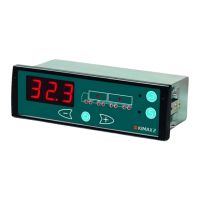
KIMAX2
Menu
Configuration
Calibration
Protecting
calibration
Electrical
installation
Sensor
installation
Additional
information
Sensor installation
Air sensor installation
Connection of compressed air.
Before you carry out any installation work related to the air suspension, make sure that the
suspension has been brought to the lowest possible position and all compressed air are
released.
It is important to install the hoses in such a way that they are not affected by other
components. The hoses must be fixed at suitable intervals.
Route the hoses in such a way that they are not exposed to exhaust heat and other heating
sources that may lead to the permissible temperature being exceeded.
Avoid damages from gravel, friction and contact with sharp edges.
Avoid excessive tension of the hoses.
Make sure that the smallest bending radius is not exceeded.
Make sure there is no leakage at the fittings; it will affect the accuracy of the measurement.
Basic installation:
First of all, you have to identify the supply hoses for the bellows.
Depending on the layout of your vehicle you can have one or two bellows each side on each
axle.
Your air suspension system can be deviated in a left-hand side and a right-hand side with
individual air circuits and individual level controlling valves due to minimizing rolling.
In all cases, you will get the best accuracy and the fasted response, when you use Kimax 2
Instruments with double air-inlet for each axle.
In cases of steering axles or rear axles with common air circuit you can use a single input
Kimax 2 instrument in order to save cost in installation and investment.
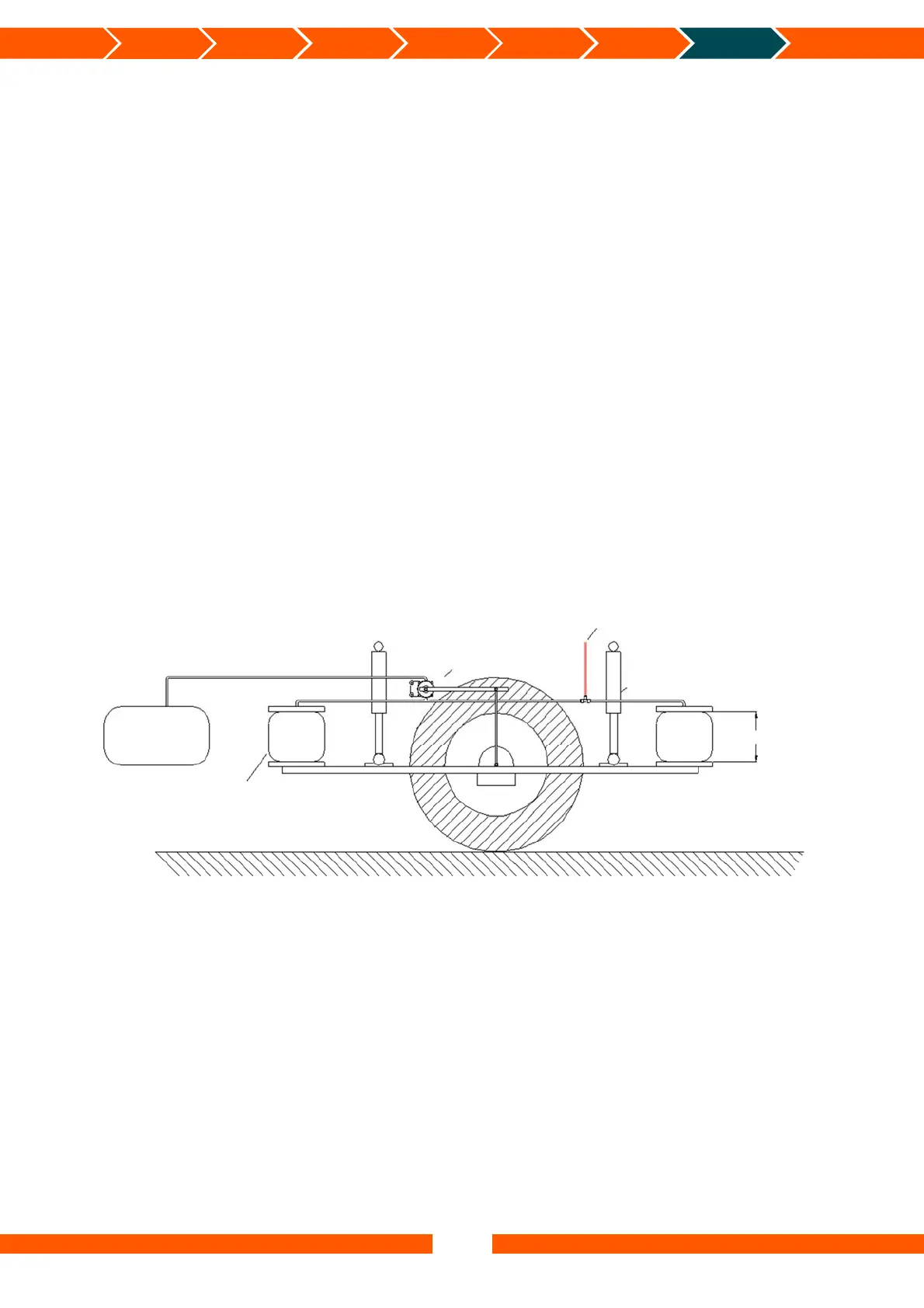
Storage tank
Bellow
Level valve
Air-pressure for Kimax
Shock absorber
Maintain
level


 To Next Page
 Loading...