Need help?
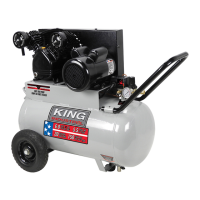
Do you have a question about the King Industrial KC-2051H2 and is the answer not in the manual?
Keep dated proof of purchase for warranty and servicing purposes.
Refer to King Canada website for updated parts diagram and lists.
Parts available at authorized service centers using 10-digit part numbers.
Details 1-year warranty against defects in materials and workmanship.
Manual is a guide; specifications subject to change without notice.
Covers sparking contacts, flammable vapors, and ventilation restrictions causing fire or overheating.
Explains tank rust, modifications, unauthorized changes, and excessive vibration leading to rupture.
Warns about touching hot compressor parts immediately after operation.
Covers oil leaks during transport, potential damage to vehicles and surfaces.
Covers reading manual, electrical codes, oil-free air, safety glasses, damaged parts, belt guard, safety valve, tank modifications, and draining.
Details model, voltage, horsepower, amperage, RPM, phase, hertz, operating pressure, CFM, and tank size.
Emphasizes qualified electrician for connections and safety during adjustments/repairs.
Ensures proper grounding to reduce electric shock risk and avoid altering the grounding prong.
Covers factory 120V setting, 240V conversion, and proper outlet requirements.
Provides guidelines for using extension cords, recommending air hoses instead.
Instructions for assembling wheels, foot, and handle; choosing a dry, clean, cool, ventilated area.
Critical steps for initial operation to prevent serious damage, including oil level and drain valve usage.
Discusses the use of air pressure regulators and air transformers for controlled air supply.
Explains the function of check valve, tank pressure gauge, ON/AUTO-OFF switch, and pressure switch.
Details the safety valve's role in preventing over-pressurization and maintenance for proper function.
Describes the outlet gauge and how to adjust the regulator for desired air pressure.
Explains the drain valve for condensation and the motor reset for overload protection.
Addresses moisture buildup in the tank and its impact on spraying or sandblasting.
Safety steps before maintenance: power off, drain pressure, unplug cord.
Steps to follow after each use: turn off switch, release pressure, drain tank.
Checks for oil level, condensation, noise, vibration, and tightness of nuts/bolts.
Inspect air system for leaks using soapy water and tightening joints.
Details the first oil change at 100 hours and subsequent changes every 300 hours or 3 months.
Instructions for draining oil, refilling crankcase with SAE 30 non-detergent oil.
Advice on blowing out air passages and cleaning parts with a damp cloth.
Guidance on adjusting drive belt tension and replacing the belt.
Identifies causes like blown fuse, loose connections, or overheating; suggests checks and resets.
Troubleshoots air leaks, open drain cock, restricted filter, or defective check valve.
Addresses issues with defective pressure switch or improper adjustment causing the safety valve to release.
Covers causes like improper oil viscosity, overfilling, overheating, or restricted filter.
Diagnoses problems related to restricted filters, leaks, slipping belts, open drain valves, or defective gauges.
Lists causes such as incorrectly installed valves, tight belts, defective switches, or motor failure.
Troubleshoots loose components, unlevel compressor, tight bolts, wrong oil, or worn valves.
Identifies causes like restricted air filter, wrong oil, high oil level, or worn piston rings.
 General
| Power | 2 HP |
|---|---|
| Voltage | 120V |
| Tank Size | 20 Gallons |
| Pump Type | Oil-Free |
| CFM @ 90 PSI | 4.5 CFM |

 To Next Page