Need help?
Do you have a question about the King Long XMQ6130C Series and is the answer not in the manual?
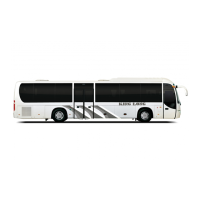
This document outlines the operation and maintenance of the King-Long XMQ6130C series tourist bus, manufactured by Xiamen King Long United Automotive Industry Co., Ltd. The manual, updated in July 2015, emphasizes the vehicle's superior economy, security, and comfort, featuring luxury interior trimming, high speed, strong power, and stable driveability suitable for inter-city transportation, touring, and business.
The XMQ6130C series tourist bus has an overall length of 12950 mm, a width of 2550 mm, and a height of 3300 mm (with air spring). Its wheelbase is 6800 mm, with front and rear wheel tracks of 1860 mm. The minimum lift-off clearance is 180 mm. The vehicle has an approach angle of 8.5° and a departure angle of 7°. It is designed to carry 73 passengers plus a driver. The kerb weight is 13800 kg, and the maximum gross mass is 19500 kg. The maximum speed is 130 km/h, and it boasts a maximum gradeability of ≥20%. The minimum turning diameter is ≤24 m. The parking slope is 20% for 5 minutes.
The bus is equipped with an ISL8.9E5380 in-line six-cylinder water-cooling direct-injection diesel engine. It has a cylinder diameter of 114x144.5 mm and a displacement of 8900 ml, with a compression ratio of 16.6:1. The rated capacity is 279 kW at 2100 rpm, and the maximum torque is 1700 N·m at 1300-1400 rpm. The fuel tank capacity is 300 L. Fuel recommendations include diesel oil (cetane value ≥45, sulfur content ≤0.2%) suitable for various temperature zones (-10°C to 4°C). Natural gas with a methane value of low to 65 is recommended for Natural Gas Vehicles.
The engine oil capacity is 27.6 L, transmission lubricant is 23 L, main retarder lubricant is 16 L, and power steering hydraulic oil is 8 L. Clutch lubricant is 0 L. Recommended engine oil quality is API CF-4 or CH-4. Gear oil should be ATF220, SAE90 API GL-5 grade, with viscosity adjusted for ambient temperature. Chassis grease should be 2# lithium base lubricant for temperatures between -30°C and +120°C, or 0# for centralized lubrication. Long-life anti-freezing and antirust fluid should be used in the water tank, with a freezing point 5°C lower than the lowest environment temperature. Coolant replacement is recommended every 2 years.
The bus features a semi-integral body structure with closed girder construction, offering strong structural stiffness, torsion resistance, and bending resistance. Skeleton components undergo anticorrosion treatment. The interior has a flexible design with a steel plate/wood block composite floor covered with anti-slip and antifriction leather for sound insulation. Windows include hyperboloid triplex front windshield, hardened rear windshields, and hardened glass side windows. The driver’s window is a sliding type. The baggage compartment uses a transverse run-through design made of aluminum.
The driver's seat is a Q15-2 type, adjustable with a high backrest and three-point seat belts. Passenger seats are HX type, 3+2 layout, high back, adjustable style, with three-point seat belts. Interior accessories include an electronic clock, sunshade, safety hammer, emergency escaping window, curtain, luxury bilateral luggage rack F-1, safe door, guiding seat, reversal monitor, vehicle traveling data recorder, reading lamp, toilet, drinking trough, color TV, DVD system, LCD, and guide mike.
The cooling system is a KING LONG top-mounted dependent air-conditioning system. Defrosting is handled by a NANFENG cooling/heating defrosting device. The heating system uses a WEBASTO heater and NANFENG radiator system. The air conditioner control panel (SK-17-1 KL-30YA) allows selection of air speed (low, midterm, high), cooling, setting temperature (15.0°C to 40.0°C), and fresh air. It also displays room and outer temperatures, and evaporator/fan speeds. The system can automatically select flow rate based on air return temperature. Strong cooling function is available for maintenance.
The bus is equipped with full aluminum remote-control out-swing pneumatic doors, designed for placid, agile, and safe motion with anti-clamp function. Doors can be controlled by two electrical switches (interior trigger touch-tone on the dashboard, exterior remote control switch). An emergency switch is available for opening the door in emergencies. The door remote control operates only when the parking brake is engaged.
The driver zone includes a seat belt inserting socket, horn, rocker switches, light operation handle, reversal monitor, combination instrument, steering wheel, electric mirrors pushbutton, engine cabin fire extinguisher pushbutton, wiper control handle, power charging socket, parking brake handle, gearbox operation handle, WEBASTO A/C and heating operation panel, and NANFENG radiator operation panel.
The instrument panel provides various indicators and displays:
The steering wheel play should be 20-30 degrees. The ABS (WABCO) system works in emergency situations to prevent wheel lock-up, maintaining vehicle stability and steerability. Drivers should rapidly depress the brake pedal to its limit. ECAS (Electronically Controlled Air Suspension) system provides automatic level control, kneeling function, and lift function.
The manual outlines daily, weekly, and mileage-based maintenance operations (5000km, 10000km, 20000km, 40000km, 80000km, and beyond).
The manual includes sections for common troubles and their elimination methods for the diesel engine (cannot start, power deficient, abnormal noise, exhaust issues, oil pressure/temperature problems), chassis (propeller shaft, transmission, rear axle, front axle, steering system, braking system), electrical equipment (generator, battery, starter), and air conditioner system (abnormal pressure, insufficient cooling, fan not working).


 To Next Page
 General