The Kistler Sensor Tester Type 5495C is a versatile handheld device designed for testing and analyzing various types of sensors, primarily focusing on cavity pressure sensors, temperature sensors, and charge amplifiers. Its primary function is to measure, analyze, and evaluate sensor performance, ensuring their proper operation and reliability.
Function Description:
The Sensor Tester 5495C performs several key functions:
- Cavity Pressure Sensor Analysis: It can measure and evaluate the sensitivity of cavity pressure sensors, both directly and indirectly. This includes determining the quality of insulation and analyzing the sensor's response to pressure. The device can detect if a sensor is "good," "fair," or "bad" based on its sensitivity and error percentage.
- Temperature Sensor Analysis: The tester supports direct connection of temperature sensors (thermocouples) and indirect connection via external temperature amplifiers. It can display temperature readings, identify maximum and minimum temperature differences, and allow for the selection of different thermocouple types and measuring ranges.
- Amplifier Analysis (Charge Output): It can check charge amplifiers in the measuring chain against a defined charge output. This involves removing the antenna, connecting the charge output cable, and connecting the external charge amplifier to the BNC socket. The device displays the charge output and allows for numeric input of desired charge values.
- Insulation Measurement (Isolation Test): The device performs an isolation test to check the insulation of all components in the connected measuring chain. It displays the insulation resistance in TΩ and evaluates it as "good," "fair," or "bad" based on predefined ranges.
- Sensor Creation/Deletion/Change: Users can create, delete, or change customer-specific sensor definitions, allowing for customization and adaptation to various sensor types and applications.
Important Technical Specifications:
While specific numerical values for all technical specifications are not explicitly detailed in the provided document, the manual highlights several key aspects:
- Display: Features a 3.5" touch screen display for intuitive operation and data visualization.
- Connectivity: Includes a 15-pin D-Sub socket for external temperature amplifiers, a power supply socket, and a USB port with an SD slot for data transfer and storage. It also has a socket for BLT antenna and charge generation, a Series 102 Fischer connector for thermocouple types J, K, N, and a BNC socket for measuring charge sensitivity.
- Power: Operates on a rechargeable battery or with a DC supply. It includes power management features such as power on/off and sleep mode to optimize battery life.
- Data Storage: Supports data storage via an SD card (Kistler USB Memory Stick 8GB is mentioned as an accessory).
- Software: The device's functionality is driven by embedded software, which can be updated.
- Accessories: A range of accessories are available, including a case with sheath, pressure test pin, Bluetooth antennas, power supply, various adapters (for 1 mm sensors, diaphragm sensors), connecting cables for 4-channel and 8-channel connectors, extension cables, and a Kistler USB Memory Stick.
Usage Features:
The Sensor Tester 5495C is designed for user-friendly operation with several key features:
- Touch Screen Interface: The 3.5" touch screen allows for easy navigation through menus and input of values.
- Intuitive Buttons and Symbols: The device utilizes clear buttons and symbols for various functions, including "Back," "Settings," "Password entry," "Table navigation," "Start/cancel measuring," and power on/off.
- Color-Coded Feedback: The display uses colors to provide clear feedback on sensor status and measurement results (e.g., green for good, yellow for fair/adequate, red for bad/poor). Cyan flashing indicates a button to be pressed, while static green or flashing red radio symbols indicate communication status with the test pin.
- Numeric and Alphanumeric Input: The device provides on-screen keypads for entering numeric and alphanumeric values, including options for negative signs, decimal points, and saving/returning.
- Selection from Lists: Users can select values from predefined lists, such as sensor types or languages, simplifying configuration.
- Rechargeable Battery Status Display: A clear battery symbol and charging bar indicate the current charging status and residual charge, with color-coded warnings for low battery levels.
- Multilingual Support: The device supports multiple languages, including German, English, and French, enhancing usability for a global audience.
- Measurement Process Guidance: The manual provides step-by-step instructions for performing various measurements, including connecting sensors, initiating tests, and interpreting results.
- Error Handling and Notifications: The device provides warnings and notifications for noncompliance, mechanical damage, and signal quality issues, ensuring safe and accurate operation.
- Customizable Sensor Definitions: The ability to create and modify sensor definitions allows users to tailor the device to specific sensor types and applications.
Maintenance Features:
Maintenance aspects of the Sensor Tester 5495C are primarily focused on ensuring its longevity and accurate operation:
- Software Updates: Kistler provides software upgrades and updates for embedded software, ensuring the device remains current with the latest functionalities and improvements.
- Disposal Instructions: Clear guidelines are provided for the disposal of old electronic instruments in municipal trash, emphasizing the importance of returning the product to an authorized local electronic waste disposal service or Kistler Instrument sales office for proper recycling.
- Battery Management: The device is designed to be charged using the provided charging device. Warnings are issued if the device is shut down improperly, which could lead to data loss.
- Care and Handling: The manual emphasizes the importance of protecting the device from transport damage, impurities, and excessive mechanical strain (shock, vibration). It advises attaching covers to connections and plugs when not in use.
- Customer Service: Users are encouraged to contact Kistler Customer Service for any questions, modifications, or changes to the instruction manual, or in cases of technical progress or advanced notification. Kistler also offers extensive support organization for further assistance.
- Product Documentation: Kistler provides product and application brochures with an overview of their product range, and detailed data sheets are available for almost all products, aiding in understanding and maintaining the device.

 Need help?
 General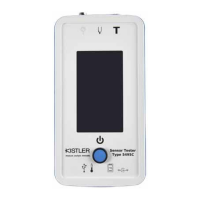

 To Next Page