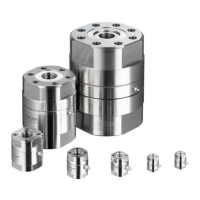
This document describes uncooled piezoelectric pressure sensors, specifically types 6052, 6054, 6056, 6058, 6124, 6125, 6044, and 6045, manufactured by Kistler. These sensors are designed for highly efficient design and analysis of combustion chambers, providing high-precision measurements of engine operation mode and boundary conditions.
Function Description
The core principle of these sensors relies on the piezoelectric effect. A sensor membrane converts the measured pressure into a force, which is applied to a piezoelectric measuring element. This element, typically a piezoelectric crystal, generates an electrostatic charge proportional to the applied force. An electrode collects this charge and supplies it to a sensor connector. Via a piezoelectric cable, the charge amplifier converts this charge into an electric voltage for measurement and processing. This principle allows for fast, dynamic, and quasi-static pressure changes to be measured, making them suitable for engine pressure measurements.
Kistler offers a wide range of products for use in measuring technology, including piezoelectric sensors for measuring force, torque, strain, pressure, acceleration, shock, vibration, and acoustic-emission. They also provide strain gage sensor systems for measuring force and moment, piezoresistive pressure sensors and transmitters, signal conditioners, indicators and calibrators, electronic control and monitoring systems, and data transmission modules (telemetry). Kistler develops and produces measuring solutions for various applications in engines, vehicles, manufacturing, plastics, and biomechanics sectors.
Important Technical Specifications
The sensors are designed for uncooled operation. The document highlights the importance of precise installation for optimal performance.
- Sensor Bore Machining: The sensor bore must be machined to specified tolerances. The specified tightening torque of the piezoelectric sensor must be observed.
- Installation with Sleeve: For installations where the cylinder head cannot be accessed via an oil or cooling water gallery, a mounting sleeve is necessary. The sleeve is screwed and sealed with a sealing ring at the front. Loctite 648 or similar compounds are recommended for shaft-hub connections.
- Benefits of using a mounting sleeve: Precise sensor bore inside the sleeve, machining of the bore for the mounting sleeve is simplified, and the mounting sleeve has the required strength to ensure the sealing part can resist wear.
- Disadvantages: Can influence the cylinder head cooling performance depending on the size and position of the sleeve with respect to the water cooling channels.
- Plug-in Sensors (Type 6124/6125) and 8 mm Threaded Sensors (Type 6044/6045): These sensors are particularly sensitive to machining bore tolerances. The smooth, larger bore is used to correctly position the sensor concentrically before the clamping device is applied. Any mis-alignment can create potential or incorrect sealing, leading to localized heat build-up and premature failure of the sensor itself.
- Front Sealed Sensors: These sensors require structural material at the front of the sensor to provide and support the sealing surface itself. The front seal cannot be mounted flush with the cylinder head surface. The size of this volume depends on the material surrounding the sensor installation. A higher strength material can provide the required support with less material and thus a smaller volume in front of the membrane.
- Aluminum Cylinder Heads: For aluminum, up to 4 mm of material is required to support the sealing face, whereas steel or cast iron needs approximately 2.5 mm. The effect of this volume needs to be considered and understood well. A 3 mm thick stainless steel or Inconel "wear-tape" of 8 mm diameter and length is created in front of the membrane. Typically, this dimension gives a resonant frequency of approximately 30 kHz.
- Piezoelectric Cable: The cable must be routed to avoid high-frequency or power cables, as well as other ignition or fuel injection system cabling, dynamometer or motor power cables. It should be kept perpendicular to high-frequency signal lines to reduce signal interference.
- Charge Amplifier Connection: The piezoelectric sensor cable and an extension cable should be connected before connecting the extension cable to the input socket of the charge amplifier. Ensure the piezoelectric sensor cable is not in tension when connecting to the charge amplifier input to avoid potential damage.
- Cable Length: The length of piezoelectric cables between sensor and charge amplifier should not exceed 10m. Interference from extraneous voltages and ground loop issues at the test cell can be avoided or reduced by using a short piezoelectric cable and positioning the charge amplifier close to the piezoelectric sensor.
- Sensor Sensitivity: The sensor is calibrated from production in several pressure and temperature ranges. The user should select an optimum sensitivity according to the expected temperature range of their measurements. For uncooled sensors of 8 mm and plug-in types, 250 °C is recommended. For M5 type sensors, 200 °C is recommended.
Usage Features
- Installation:
- Direct Installation: Requires the least installation space. It is only possible if it is not necessary to cross any water or oil galleries in the cylinder head casting.
- Machining the Mounting Bore: Ensure the thread is concentric in relation to its individual steps. The sealing part must be completely flat. Refer to specifications and tolerances on the datasheet. All machining steps with the drill, milling cutter, reamer, and screw tap must be performed with the work held securely in the same position.
- Sealing Surface: The sealing surface has two functions: in addition to the pressure seal, this surface provides a heat transfer path for the sensor itself. For front sealed sensors, this is particularly critical as the seal is in front of the measuring element, and thus directs heat away from the measuring element itself. This is part of the sensor temperature management strategy.
- Mounting Nipple (Type 6124/6125): Mounting bore specification for mounting nipple.
- M10x1 Mounting Nipple: Step drill Type 1337A and screw tap Type 1353 are used for mounting.
- Check Points Before Installation:
- Piezoelectric Cable: Check if the cable connected to the sensor is loose. It must be retightened and made secure.
- Cable Damage: Carefully check the piezoelectric cable for damage over its full length. If necessary, replace it completely. Insulation resistance of sensor and piezoelectric cable should be checked by connecting the insulation tester at the end of the piezoelectric cable. The minimum requirement at room temperature is 10E13 Ω.
- Sensor Seal Ring: The sensor seal ring must always be applied to the shoulder sealing sensor. If the sealing ring is damaged, it should be replaced. Front sealing sensors are mounted without any sealing ring, hence the surface finish requirements are critical.
- Mounting Bore: Check the condition of the mounting bore and sealing face. It must be machined to the specified dimensions and tolerances as described in the datasheet, and also clean and dry prior to installation.
- Flameguard for M5 Sensors:
- Installation: Place the flameguard on a plane surface, then press the sensor on the flameguard. Work with both parts aligned in the same axis, otherwise the flameguard clips may get damaged.
- Removal: The flameguard can be removed with the finger and pressed in between the gap of diaphragm and flameguard. Possible to use the use of a tap wrench to hold and pull the flameguard.
- Caution: Do not use any hard tool to separate both parts, otherwise the sensor diaphragm can be damaged.
- Assembly: Feed the piezoelectric cable through the mounting wrench, and then fit the mounting wrench on the hex of the sensor. Before installing the sensor in the bore, the thread and sealing part should be lubricated with high-temperature resistant grease (e.g., MOLYKOTE HSC-plus or Metaflux 70-81). This will facilitate dismounting the sensor from the bore post-testing. During use, pay attention to protecting the sensor's piezoelectric cable. Do not squash, twist or pull the piezoelectric cable. Screw the sensor hand-tight and then use the torque wrench for tightening to the required value as specified in the datasheet of the sensor.
Maintenance Features
- Dismounting:
- Allow the cylinder head to cool down before removing the sensor from the mounting bore.
- Dismount in reverse order than installation.
- Disconnect the piezoelectric sensor cable from the charge amplifier/from the extension cable.
- Feed the piezoelectric sensor cable through the mounting wrench, carefully slide it to the sensor, and then fit the mounting wrench on the hex of the sensor.
- Unscrew the sensor from the bore.
- General Maintenance:
- Piezoelectric pressure sensors are precision instruments; they will deliver measurements in the specified accuracy range only if they are handled with care. Special attention is required for the front part of the sensor – the diaphragm and sealing area must always be protected against mechanical damage.
- Caution: Do not tap impact or shock the front surface of the sensor with metal or any other objects – this will help to avoid damage to the membrane.
- Visual Inspection: Sensor and piezoelectric cable should be carefully inspected for anomalies (damage, soot deposits, overheating due to combustion gas leakage).
- Cleaning: After the sensor is disassembled from the engine, combustion deposits must be cleaned with a soft brush and isopropyl alcohol (CAS Number 67-63-0). The front part of the sensor (membrane) cannot be cleaned using mechanical means such as brushing, sand blasting, grinding, etc. as this will irreparably damage the diaphragm and therefore the sensor. Visual inspection after cleaning, see above.
- Insulation Check: The insulation resistance of the sensor with piezoelectric cable should be checked by connecting the insulation tester Type 5493 at the end of the piezoelectric cable. The requirement at room temperature is 10E13 Ω. If the value is too low, all piezoelectric connectors should be disconnected and the insulators cleaned with electronic cleaning spray Kistler Type 1003 or a similar product. Do not touch the connector insulator with bare fingers and do not blow it out with shop compressed air.
- Pressure Calibration: Recalibration is recommended every 200 hours of operation or after each disassembly of the sensor from the cylinder head.
- Exchange of Components: It is possible to replace the piezoelectric cable, the sealing ring (shoulder sealing sensors), and the flameguard (M5 front sealing sensors), if not welded. Material numbers are listed in the datasheet of the sensor. The replacement of the sealing ring should be done by Kistler.
- Removing a Defective Piezoelectric Cable: Unscrew the piezoelectric cable connector by using an open ended wrench.
- Installing a New Piezoelectric Cable: Necessary material: spare piezoelectric cable, open ended wrench, insulation tester Kistler Type 5493, cleaning spray Kistler Type 1003 or similar product.
- Procedure: Clean the piezoelectric sensor connector on the sensor using cleaning spray Kistler Type 1003. Ensure that the respective O-ring is mounted on the piezoelectric sensor connector. Screw the piezoelectric cable on the piezoelectric sensor connector. Check the insulation of the assembly piezoelectric sensor and piezoelectric cable again. It must reach 10E13 Ω.
- Inspecting M5 Bores: Necessary material: borescope, cleaning spray Kistler Type 1003 or similar product, dusting spray.
- Procedure: Remove the sensor from the installation bore and clean the bore thoroughly with cleaning spray. Dry the area with dusting spray ready for inspection. Using the borescope with integrated illumination, look down into the measurement bore paying particular attention to the front sealing face. There must be no visible surface roughness or chatter marks. The sealing surface must have a generally even appearance. Examine with borescope from different angles in order to fully visualize all aspects of the bore.
- Quality Check of Sealing Surface: The document provides a visual guide (Fig. 16) for areas of focus for front sealing sensor installation quality topics, including distance between sealing surface and thread, specified bore and surface finish, thread and sealing surface concentricity, edge of sealing surface, and position of 3 mm bore.
- Ream M5 Bores with Reamer: If the sealing face is found to be sub-optimal, it is possible to recondition the sealing surface with the appropriate tools and knowledge.
- Necessary material: Finishing tool Type 1300A79 for standard M5x0.5 bore, borescope, grease (Type 1063), cleaning spray Kistler type 1003 or similar product, dust spray.
- Procedure: Clean and dry the sensor bore, fill the flutes of the cutter with grease (this collects any swarf building up and reduces the risk that the cutter sticks). Adjust the preloading force of the finishing tool with the barrel or chuck (using the M5 thread) so that the friction force is small when the cutting head is turned. The finishing operation must feel as if it is removing metal evenly and easily. After turning 3 to 5 times, remove and clean the finishing tool. After removing the tool, clean and dry the bore again, ensuring the removal of any swarf or contaminants.
- Cleaning the Milling Surface: (Fig. 20) shows cleaning the milling surface of the tool - removing swarf build-up.
- Re-inspect the measurement bore: Monitor the improvement or otherwise to the sealing face. This should be considered an iterative process – a number of attempts should be made to improve the sealing face step-by-step. If this method is not followed and too much material is removed from the sealing face in one attempt, it is often the case that the sealing surface can be permanently damaged with chatter marks created by excessive material removal.
- Reconditioning Process: (Fig. 21) illustrates the reconditioning process gradually bringing the sealing face back to useable condition. The pictures above show a typical sealing face as it is re-conditioned – the iterative process of gently removing material allows the sealing face to gradually be brought back to serviceable condition – but ensuring enough material remains to support the sensor installation and sealing performance. Once the sealing face is fully re-worked (minimum 3 attempts) the bore can finally be cleaned, inspected and is ready for use. The sensor can now be installed as per the guideline in this document. It is recommended to inspect the sealing face every time the sensor is removed or re-installed in service.
Kistler Technical Center services are available to ensure measurement data within the specified accuracy, the measuring equipment used for combustion development, performance tests, durability tests or engine calibration requires precise examination at regular intervals during its lifetime. Kistler Technical Centers located in Europe, Asia, and America offer benefits such as reliable operation of the measuring equipment, reduced response time, and professional technicians.

 Need help?
 General

 To Next Page