
 Need help?
Do you have a question about the KitchenAid KCMC1575 and is the answer not in the manual?
Essential safety precautions for operating the microwave oven, covering hazards and protective measures.
Specific guidelines to prevent harmful exposure to microwave energy, focusing on door integrity and oven condition.
Techniques for covering, stirring, arranging, piercing, shielding food, and standing time for optimal cooking.
Explanation of different power levels and their corresponding uses for various foods.
Instructions for manually setting cooking time and power level for custom cooking cycles.
Explanation of sensor cooking technology that automatically adjusts time based on food humidity.
Instructions for using pre-programmed menu items for quick cooking and reheating.
Comprehensive cleaning instructions for all parts of the microwave oven, including stainless steel surfaces.
Solutions for common operational problems, such as no power, display errors, noise, and interference.
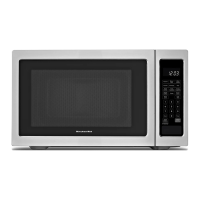
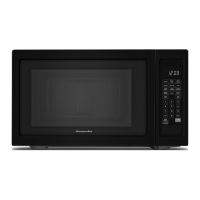
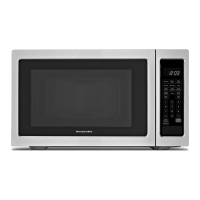
This document describes the KitchenAid Microwave Oven with Convection, a versatile appliance designed for various cooking needs. It combines microwave, grill, and convection cooking technologies to offer a wide range of functions, from quick heating to baking and roasting.
The microwave oven utilizes a magnetron to produce microwaves that reflect off the metal interior, passing through the turntable and cookware to heat food. Microwaves are absorbed by fat, sugar, and water molecules, causing them to move, producing friction and heat for cooking.
Microwave Cooking: This is the primary function for rapid heating and cooking. The oven offers various power levels (from 10% Low to 100% High) to suit different food types, such as soups, beverages, vegetables, meats, and casseroles. It supports manual cooking where users can set specific cook times and power levels. For convenience, preprogrammed menu items like Popcorn, Pizza Reheat, Beverage, Soup, and Potato are available, some with sensor cooking capabilities.
Sensor Cooking: A sensor detects humidity released from food as it heats, automatically adjusting cook time. This feature is ideal for items like Dinner Plates, Fresh Vegetables, and Frozen Vegetables, ensuring optimal results without manual time setting. Foods should be covered with loose-fitting lids or plastic wrap with a large vent to allow steam detection.
Grill Function: The grill uses a calrod thermal element to quickly heat and grill foods. It's recommended for items like toast and steaks. The tall grill rack is provided to position food closer to the element, and an ovenproof pan should be used to catch drippings. The oven cavity and door become very hot during grilling, so oven mitts are advised.
Convection System: This system circulates hot air with a fan throughout the oven cavity, quickly heating the outer portion of food. It offers two main modes:
Cooking in Stages: The microwave oven can be programmed to cook at different power levels for various lengths of time, up to two stages, which can include a defrosting stage. This allows for complex recipes that require different cooking methods or intensities.
Defrost Function: This feature has preset times and cook powers for defrosting meat, poultry, and fish by weight. It should not be used for foods left outside the freezer for more than 20 minutes or for frozen ready-made meals. Foods should be unwrapped, and shallow packages defrost more quickly. Small pieces of aluminum foil can be used to shield thin or bony parts of food.
Control Panel: The appliance features a user-friendly control panel with dedicated buttons for various functions like Popcorn, Dinner Plate, Pizza Reheat, Beverage, Soup, Potato, Fresh/Frozen Vegetable, Defrost, Convection Bake, Grill, Convection Roast, Cook Time, and Power Level. A digital display shows cook time, time of day, or timer countdown.
Start/Stop Cancel: The START control initiates any function and resumes interrupted cycles. The ADD 30 SEC control quickly starts the oven at 100% power for 30 seconds and adds 30-second increments during cooking. The STOP CANCEL control clears incorrect commands, cancels programs, and is also used to activate/deactivate the Control Lock.
Clock and Timer: A standard 12-hour clock can be set, and a separate timer can be used for up to 99 minutes and 99 seconds, operating independently of cooking functions.
Language and Weight Entry Mode: The display language can be set to English or French. The weight entry mode for Defrost can be switched between imperial (pounds) and metric (grams).
Control Lock: This feature disables the control panel to prevent unintended use, especially by children. It is activated and deactivated by holding the STOP CANCEL button.
Turntable: A removable glass turntable rotates in either direction to ensure even cooking. It must be in place for proper operation.
Racks: The appliance comes with a tall grill rack for grilling and a short convection rack for convection cooking. These racks are designed for specific functions and should be used with appropriate ovenproof pans.
Tones: Audible signals indicate valid entries, control lock status, end of stages, preheat completion, timer countdown, and end of cooking cycles. These tones can be turned off or on.
General Cleaning: Before cleaning, ensure all controls are off and the oven is cool. Soap, water, and a soft cloth or sponge are generally recommended.
Microwave Oven Cavity: To avoid damage, abrasive cleaners, steel-wool pads, or gritty washcloths should not be used. For average soil, mild soaps and detergents are sufficient. For heavy soil, heating a cup of water for 2-5 minutes can create steam to soften the residue. Odors can be removed by heating a cup of water with lemon juice or vinegar. The microwave inlet cover should be kept clean with a wet cloth.
Microwave Oven Door and Exterior: The door and frame areas should be cleaned with mild, nonabrasive soaps and detergents, followed by rinsing and drying with a soft, lint-free cloth. Glass cleaner applied to a towel (not directly to the surface) can be used for the glass. For stainless steel models, a stainless steel cleaner should be used, rubbing in the direction of the grain. Vinegar can help with hard water spots.
Control Panel: A damp sponge or soft cloth with water is recommended for cleaning the control panel. Chemical or abrasive cleansers should be avoided to prevent damage.
Turntable: The turntable can be cleaned with a mild cleanser and scouring pad or placed in a dishwasher. It must be replaced correctly after cleaning.
Convection and Grill Racks: These racks are not recommended for dishwasher cleaning. Abrasive cleansers or scrubbers should not be used. Mild soap, water, and a washcloth are suitable for cleaning.
 General
| Type | Countertop |
|---|---|
| Capacity | 1.5 cu. ft. |
| Power | 900 Watts |
| Control Type | Electronic |
| Turntable | Yes |
| Color | Stainless Steel |
| Sensor Cooking | Yes |
| Child Lock | Yes |
| Warranty | 1 Year Limited |
| Cooking Modes | Popcorn, Reheat, Defrost |


 To Next Page