KITCHENAID
Stand Mixer Service Manual LIT4177310-C 2005 KitchenAid
When both contacts are closed, the triac is full
on; consequently, full power is applied to the
motor. In this way, the speed is controlled.
If the mixer motor begins to run too fast for a
particular speed setting, one or both contacts
open, which cuts back on the voltage the motor
sees, thus slowing it up.
If the motor operation becomes too slow, one or
both contacts will close, applying the needed
voltage to the motor to sufficiently increase
motor speed.
This is always accomplished through the triac.
The control plate contacts control the triac, and
in turn, controls the amount of power supplied to
the motor.
BEATER
The beater should fit freely on the beater shaft
located in the planetary.
Power is transmitted from the motor to the
center-bevel gear assembly by means of the
worm gear.
The center-bevel gear assembly engages the
beater pinion, located in the planetary, to turn the
beater shaft.
The attachment hub bevel gear also meshes with
the center-bevel gear assembly to transmit power
when various attachments are being used.
LUBRICATION
Under normal service conditions, the mixer will
not require lubrication for many years.
The gear case is lubricated with an ample supply
of Benalene 930-2 grease (6 fluid ounces), which
lubricates all the gears and shafts.
GEARCASE LUBRICATION
All KitchenAid Stand Mixer Gearcases are
lubricated with 6 Fluid Ounces of:
BENALENE 930-2 GREASE
(OR EQUIVALENT)
NOTE: Gearcases lubricated with this grease
will not require lubrication for years.
The motor bearing and the beater shaft bearing
are oil impregnated.
The rear motor bearing has a felt washer which
has been presoaked in oil.
The front motor bearing in the mixer housing is
a ball bearing.
SECTION 1
DISASSEMBLY OF THE GEARCASE AND
PLANETARY
A. All solid state KitchenAid mixers have the
same motor and control parts and the gears in the
gearcase are alike, with one exception: “K45SS
units built prior to May 6th, 2002.”
Planetary parts are all the same, except that some
early production K5SS had a lead weight.
Gearing and motor instructions are for both tilt
head and bowl lift machines and any differences
will be pointed out.
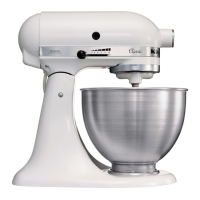
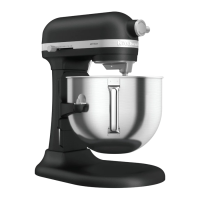
BOWL LIFT
- Models K5SS,KSM5,KSM50,
KSMC50,KPM5, KPM50, KP50. The bowl is
raised and lowered into position.
TILT HEAD
- Models K45SS, KSM45, KSM75,
KSM90, KSM103, KSM110, KSM150, KSM151,
KSM152. The mixer head is tilted up and down
into position.
Bowl, column, base and bowl lift details are
covered separately in section 7.
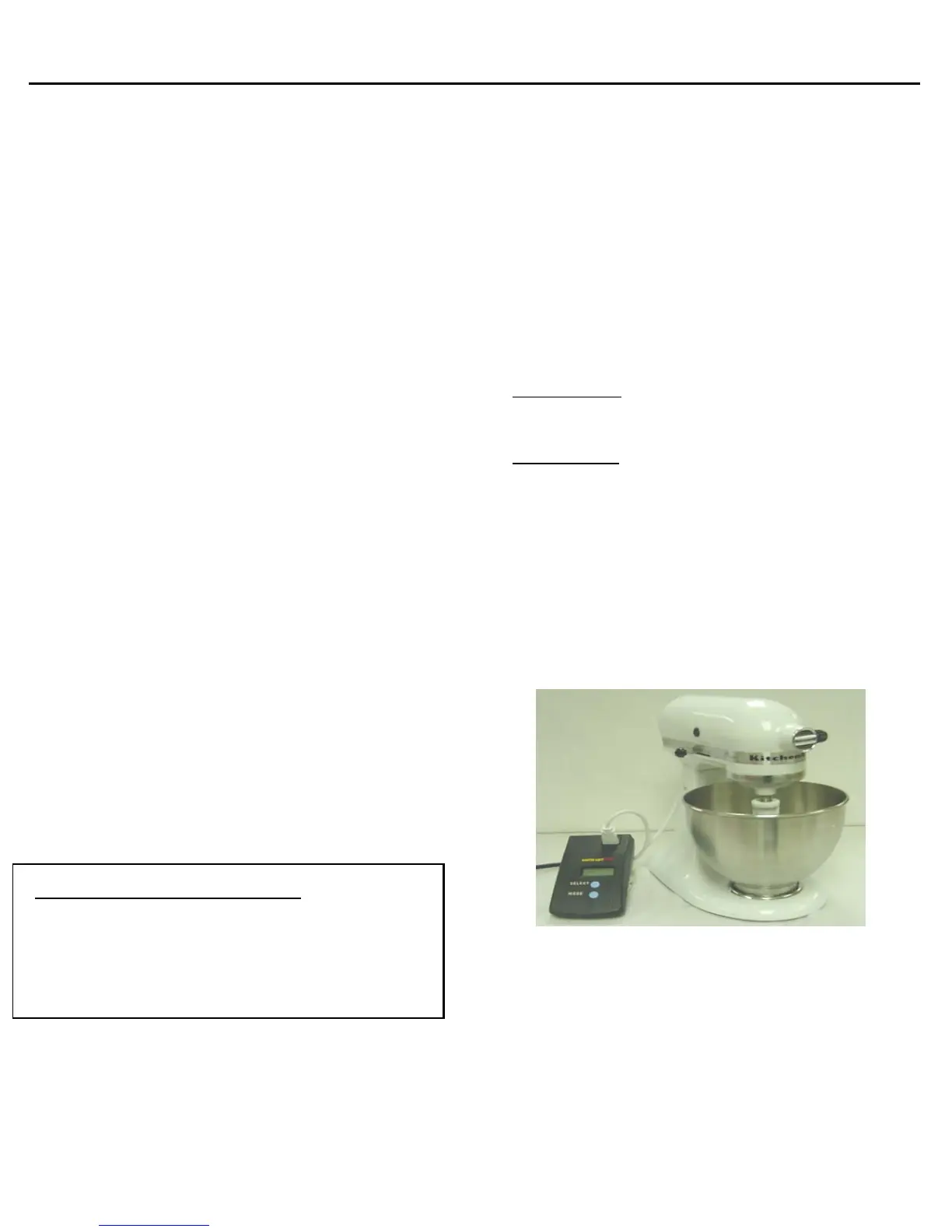
B. Before repairs are attempted on any KitchenAid
mixer, a wattmeter test should be made. To make
the test, set the wattmeter to the proper voltage.
Next, plug the cord from the mixer into the
wattmeter. Turn on the current and run the mixer.
If the wattmeter shows up to 135 watts, going from
stir to #10 speed, the mixer is in good condition.
If the wattmeter reading is 175 to 400 watts, there
is a problem.
High wattage mixer readings indicate either
electrical or mechanical problems.
Check first for bearing/gear drag, then for
motor/brush problems.
CAUTION: Always remove power cord from
electrical outlet before servicing any part of the
mixer.
PAGE 2
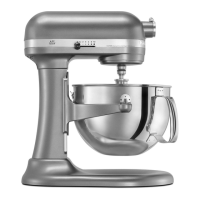
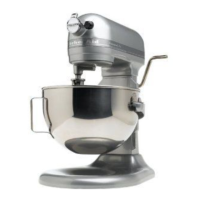
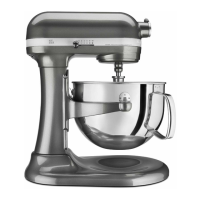
KitchenAid stand mixer shown with a digital wattmeter




 To Next Page