3524 690 32 Rev. A KohlerEngines.com
Propane EFI System
Injector problems due to dirt or clogging are generally
unlikely due to design of injectors and high fuel pressure.
Symptoms that could be caused by dirty/clogged
injectors include rough idle, hesitation/stumbling during
acceleration, or triggering of fault codes related to fuel
delivery. Injector clogging is usually caused by a buildup
of deposits inside injector or on inlet fi lter, restricting
fl ow of fuel, resulting in low fl ow. Some contributing
factors to injector clogging include higher than normal
operating temperatures, short operating intervals, and
dirty, incorrect, or poor quality fuel. Cleaning of clogged
injectors is not recommended; they should be replaced.
Ignition Coil
If a coil is determined to be faulty, replacement is
necessary. An ohmmeter may be used to test wiring and
coil windings.
NOTE: Do not ground primary coil with ignition ON as
they may overheat or spark.
NOTE: Always disconnect spark plug lead from spark
plug before performing following tests.
NOTE: If ignition coil(s) are disabled and an ignition
fault is registered, system will automatically
disable corresponding fuel injector drive
signal. Fault must be corrected to ignition coil
and ECU power (switch) must be turned OFF for
10 seconds for injector signal to return. This is a
safety measure to prevent bore washing and oil
dilution.
Testing
Using an ohmmeter set on Rx1 scale, check resistance
in circuits as follows:
1. To check cylinder coil 1 (starter side), disconnect
Black connector from ECU and test between Black
pins 1 and 15. To check cylinder coil 2 (oil fi lter side),
disconnect Grey connector from ECU and test
between Grey pins 10 and 17. Wiring and coil
primary circuits are OK if readings are 0.5-0.8
2. If reading(s) are not within specifi ed range, check
and clean connections and retest.
3. If reading(s) are still not within specifi ed range, test
coils separately from main harness as follows:
a. Remove screw retaining coil to housing and
disconnect primary leads connector.
b. Connect an ohmmeter set on Rx1 scale to
primary terminals of coil. Primary resistance
should be 0.5-0.8 Ω.
c. Connect an ohmmeter set on Rx10K scale
between spark plug boot terminal and B+ primary
terminal. Secondary resistance should be 6400-
7800 Ω.
d. If secondary resistance is not within specifi ed
range, coil is faulty and needs to be replaced.
FUEL COMPONENTS
WARNING
High Pressure Fluids can puncture skin and
cause severe injury or death.
Do not work on fuel system without proper
training or safety equipment.
Fluid puncture injuries are highly toxic and hazardous.
If an injury occurs, seek immediate medical attention.
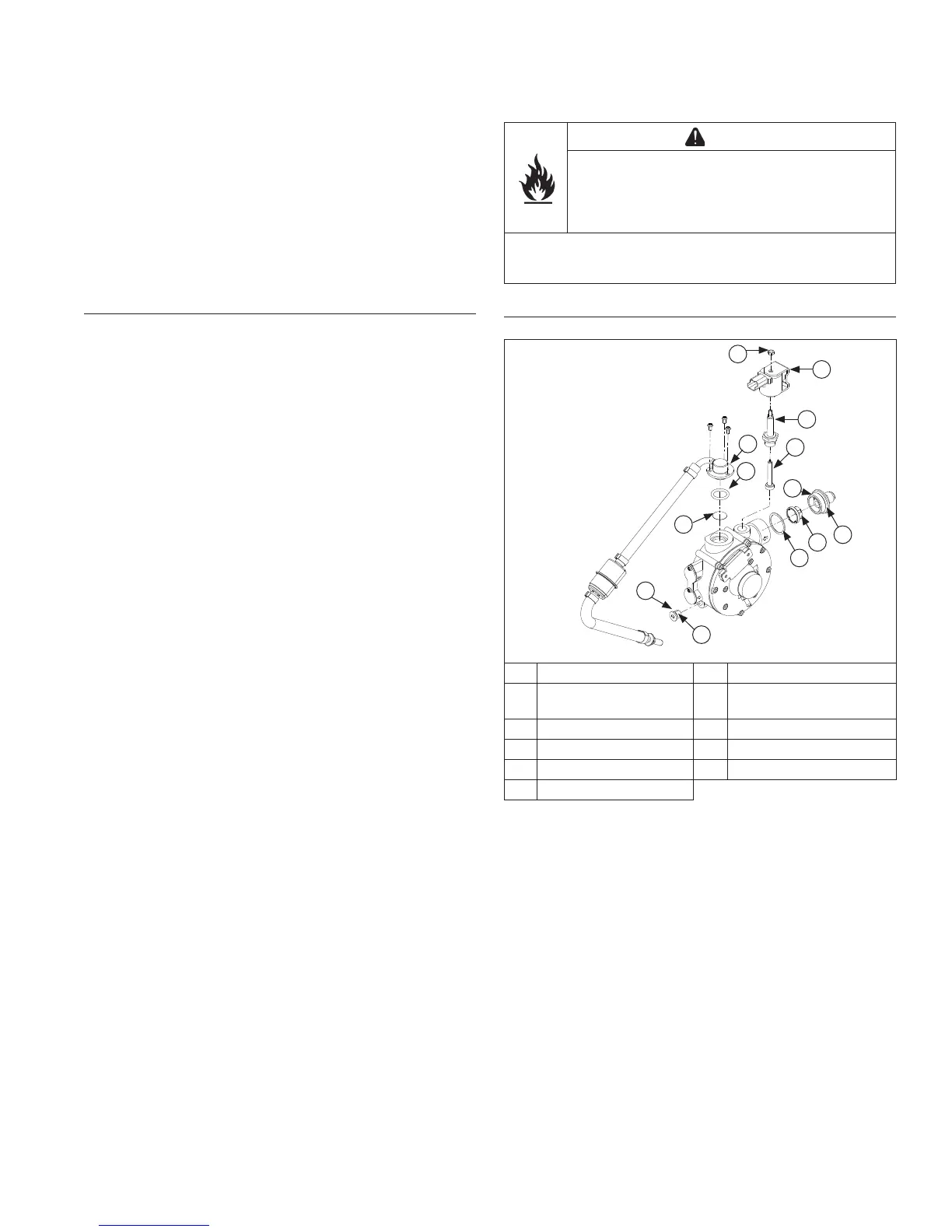
Vaporizer/Regulator/Lock-Off
Details
A
A Brass Plug B Inlet Fitting
C
30-Micron Button
Filter
D Button Filter Gasket
E O-Ring F Nut
G Lock-Off H Lock-Off Valve Body
I Plunger J Screen
K Outlet Fitting
Ensure there is an adequate supply of fuel in tank
and that fuel valve is turned ON. Vaporizer/Regulator
is preset at factory, is not serviceable, and must be
replaced if determined to be faulty. If a regulator problem
is suspected, make certain lock-off is being activated,
all electrical connections are properly secured, fuses
are good, and a minimum of 7.0 volts is being supplied.
If required, testing of regulator and lock-off may be
conducted.
1. Relieve fuel pressure at lock-off. Shut off tank valve.
If possible, run engine in a well-ventilated area until
fuel system is empty and engine stops. If unable to
run engine, work in a well-ventilated area and
carefully loosen inlet fuel fi tting on vaporizer/
regulator, slowly venting off fuel from line. When fuel
is dispensed, retighten fi tting and remove quick
connect fi tting to allow fuel to escape from line.
Insert pressure test jumper (from Kohler EFI Service
Kit) between high pressure fuel line and fuel lock-off.
D
J
E
K
I
H
F
G
E
C
E
B


 To Next Page
 Loading...